Follow Us:
Follow Us:


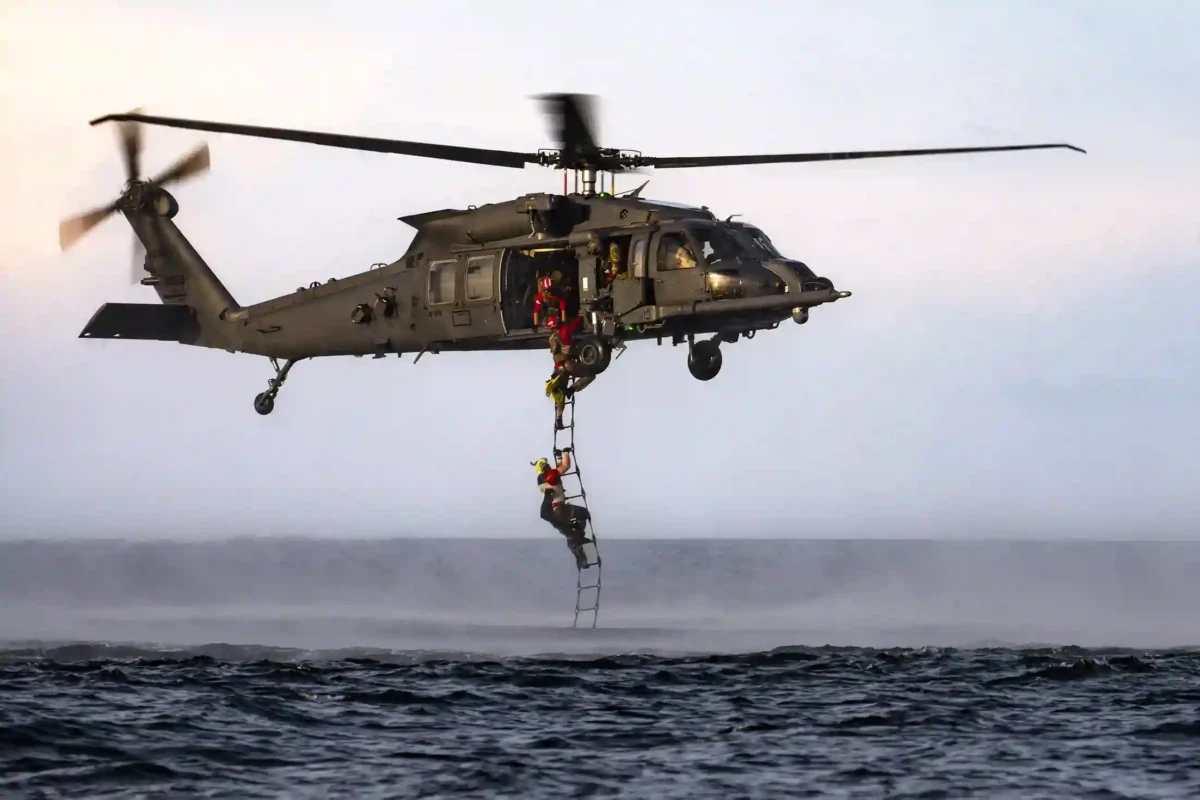
Defense Feeds – The US Air Force Trials HH-60 Helicopters as part of a major effort to prepare its combat rescue fleet for modern conflict scenarios by conducting specialized maritime exercises.
Held off the coast of California in late August, these trials focused on testing how the HH-60G Pave Hawk and its successor, the HH-60W Jolly Green II, withstand aerial threats in high-intensity maritime environments.
The evaluation, led by the 129th Rescue Wing of the California Air National Guard, included participation from the 144th Fighter Wing and the Air Force Reserve Command Test Center (AATC).
Technical support came from the Naval Air Warfare Center at Point Mugu, emphasizing the importance of interservice collaboration in advancing next-generation combat rescue operations.
The heart of the trials revolved around the challenge of realistic aerial combat scenarios at sea.
Two helicopters, an HH-60G Pave Hawk of the 129th Rescue Wing and an HH-60W Jolly Green II from the 305th Rescue Squadron, faced simulated fighter engagements from an F-15D Eagle operated by the 144th Fighter Wing.
These scenarios recreated the harsh dynamics of naval combat environments, bridging the gap between theory and real-world operational conditions.
According to Air Force officials, the mission was not just about survivability but about measuring how well the helicopters’ defensive systems operate when confronted with modern radar tracking and missile threats.
Humidity, salt air, and unstable sea winds all pose significant complications to onboard sensors and countermeasures, making such maritime testing vital.
According to Lieutenant Colonel Don Smith, deputy director of the AATC HH-60 Division, this marked the first time the HH-60W underwent such an evaluation.
The data collected will guide upgrades, training modules, and tactics aimed at ensuring rescue crews can enter hostile areas and safely extract downed pilots or personnel under fire.
The Modern Technology Solutions Inc. (MTSI), a defense contractor with expertise in electronic warfare, played a central role in planning and performance analysis.
This involvement points to the Air Force’s strategy of leveraging industry expertise to strengthen defensive systems for aircraft operating in contested zones.
The operational backdrop of these tests mirrors a significant shift in the Air Force’s personnel recovery aviation fleet.
The HH-60G Pave Hawk, first fielded in the 1980s, is slowly being phased out after decades of service in conflicts ranging from Iraq and Kosovo to humanitarian missions in Japan, Afghanistan, and the US homeland during natural disasters like Hurricane Katrina.
Built on the Black Hawk platform, the Pave Hawk has long featured adaptable mission equipment such as in-flight refueling probes, 600-pound hoists, flare and chaff dispensers, and defensive radar and infrared jammers.
However, with growing threats from advanced radar-guided missiles and increasingly networked adversaries, the helicopter’s older avionics are reaching their limits.
The HH-60W Jolly Green II, which follows the HH-60G, brings a significant advancement designed to meet the demands of today’s high-threat combat environments.
Based on the UH-60M variant, the new helicopter carries cutting-edge avionics with digital multifunction displays, secure Link 16 and SADL tactical data links, and robust defensive sensors capable of tracking radar signals, missile launches, and even hostile gunfire.
Protection has been significantly tightened with armor plating in the cockpit and crew compartments, redesigned engine exhausts to reduce infrared signature, and optimized rotor blades for performance in contested zones.
Its extended operational range—nearly 600 nautical miles—and altitude capability up to 20,000 feet make the Jolly Green II a decisive step forward.
Since becoming operational in 2022, the HH-60W has been steadily entering service across the Air Force, but exercises such as this maritime test help crews learn how to leverage its technology while adapting tactics that fit joint force operations.
Strengthening Joint Force Readiness
The August exercise was more than just a technical trial—it was a demonstration of how the Air Force integrates its Active-Duty units, Air National Guard squadrons, and Reserve forces to operate seamlessly in complex scenarios.
Photos released by the Air Force showed the helicopters deploying flares and chaff as the F-15D executed simulated missile engagements, testing responsiveness and survivability under pressure.
The focus was on the use of vital defensive systems like the AN/APR-52 radar warning receiver, the AN/AAR-57 Common Missile Warning System, and the AN/ALE-47 countermeasure dispensers, which provide the helicopters’ first line of defense during dangerous recovery missions.
Lieutenant Colonel Terry Parham, director of the AATC HH-60 Division, emphasized the significance for the Air National Guard, which typically sees limited high-end training opportunities despite carrying an operational burden equal to active-duty forces.
Exercises like this help maintain tactical proficiency across all Air Force components, ensuring every rescue squadron can respond at the same standard in future conflicts.
For the Air Force, upgrading and validating countermeasure tactics for maritime and coastal scenarios is not just about helicopters—it’s about sustaining access to contested environments.
If future conflicts emerge in the Indo-Pacific or similar regions where adversary missile systems dominate the seas, the ability of HH-60 crews to penetrate these air defense belts will directly impact whether downed airmen can be rescued.