Follow Us:
Follow Us:

When it comes to modern air combat, few debates ignite as much curiosity and speculation as the showdown between Russia’s Su‑57 and America’s F‑35.
Picture this: two fifth-generation fighters, born from entirely different design philosophies, locked in a technological arms race that spans continents, doctrines, and decades of aerospace evolution.
The Su‑57 is Russia’s answer to stealth, super-maneuverability, and raw firepower. The F‑35, on the other hand, is America’s emblem of networked warfare, stealth mastery, and precision engagement.
On paper, both are marvels of engineering, but what really happens when you start stacking them side by side?
This isn’t just a numbers game, either. Every jet has a story, a strategic purpose, and a set of compromises hidden beneath the polished metal skin.
The Su‑57, for example, flaunts agility and a punchy payload but is still ramping up production and operational experience.
Meanwhile, the F‑35 has become the backbone of multiple allied air forces worldwide, yet its top speed and dogfight capabilities spark endless debates among pilots and analysts alike.
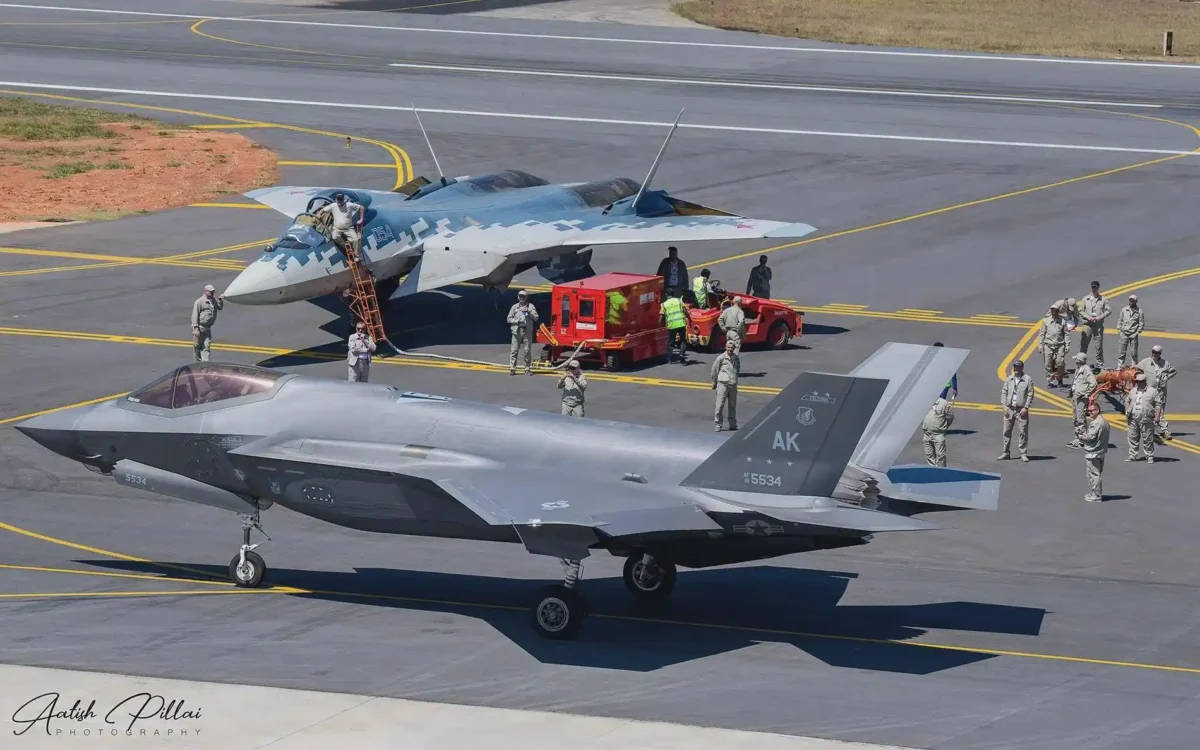
In this post, we’re going to go beyond the headlines and superficial specs. You’ll get ten revealing facts about these two airframes, from stealth and speed to sensors, combat readiness, and global deployment.
By the end, you’ll see that comparing the Su-57 vs F-35 isn’t just about checking boxes on a spec sheet; it’s about understanding the philosophies that shape modern aerial warfare.
Every fighter jet tells a story, and the Su‑57 and F‑35 have very different narratives.
The Su‑57 felon, also known as the T-50 during its development, is Russia’s leap into fifth-generation air combat. Designed by Sukhoi, it’s intended to assert air superiority and give Russia a multirole edge.
The philosophy here leans toward raw power: speed, maneuverability, and heavy payload capacity. In essence, the Su‑57 is like a heavyweight chess player, aggressive, daring, and built to dominate one-on-one confrontations.
Contrast that with the F‑35 Lightning II, Lockheed Martin’s brainchild and the United States’ poster child for networked, multirole warfare.
Unlike the Su‑57, which prioritizes maneuverability, the F‑35 is a stealth-optimized, sensor-laden, digitally integrated platform designed for modern warfare’s complex web. It’s less about raw dogfighting and more about “see first, shoot first, and vanish.” Its three variants—F‑35A (conventional), F‑35B (short takeoff/vertical landing), and F‑35C (carrier-based)—allow for unprecedented operational flexibility across allied air forces.
In practical terms, the Su‑57 is ideal for air dominance missions and high-speed interception, while the F‑35 excels in precision strikes, intelligence sharing, and electronic warfare.
Operational philosophies diverge sharply: Russia leans on agility and firepower to overwhelm, whereas the U.S. emphasizes stealth, integration, and long-range situational awareness.
If fighter jets were athletes, the Su‑57 would be a sprinter with raw explosive power, while the F‑35 would be a tactical marathoner, built for endurance, strategy, and precision.
Let’s talk numbers first: the Su‑57 can reportedly reach speeds exceeding Mach 2.0, or over 2,100 km/h at high altitude.
That’s blistering for a fifth-generation fighter and gives it a remarkable edge in intercept missions or hit-and-run strikes. Its twin-engine design, combined with 3D thrust-vectoring nozzles, allows for rapid acceleration and extreme agility, especially in close-range dogfights.
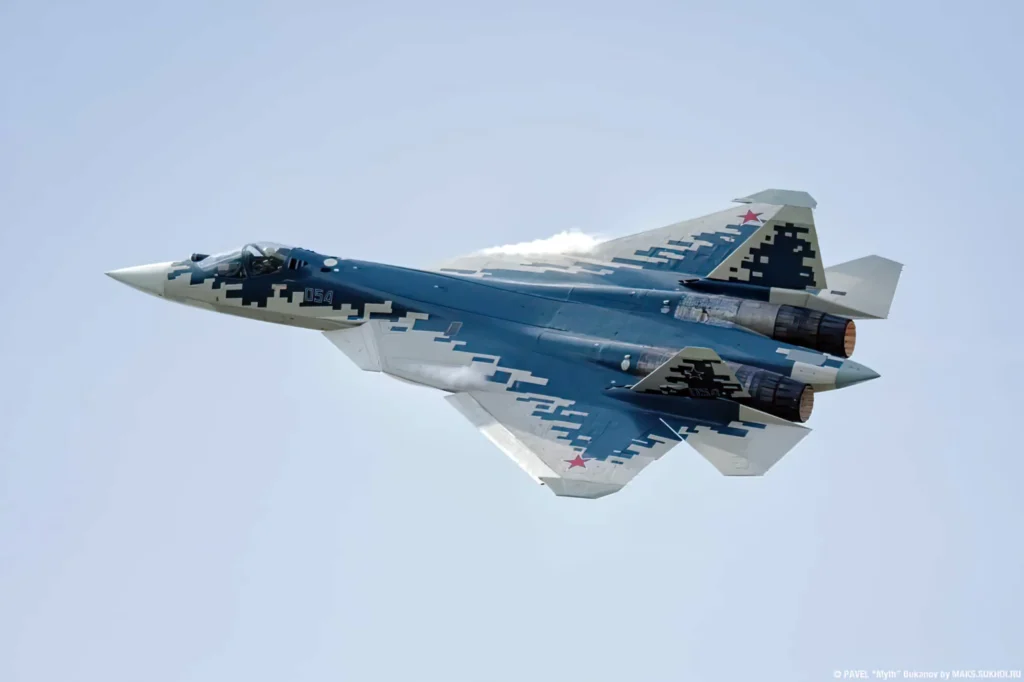
The F‑35, meanwhile, maxes out around Mach 1.6, roughly 1,930 km/h. While that’s slower on paper, the F‑35’s design focuses on energy efficiency, stealth, and sensor operations rather than outright speed. Its single-engine layout reduces weight and maintenance complexity, and its aerodynamics are optimized for multi-role missions, including long-range strike and carrier operations.
Pilots report that the F‑35 excels in high-angle-of-attack maneuvers when combined with its advanced flight control system, but it cannot match the Su‑57’s raw thrust in a vertical climb or sustained high-speed dogfight.
But here’s the kicker: speed isn’t everything. In modern air combat, situational awareness, radar evasion, and integrated weapons systems often outweigh pure Mach numbers.
That said, the Su‑57’s ability to zip past an adversary at Mach 2+ gives it a tactical advantage in certain scenarios, especially against slower, less maneuverable aircraft.
So when comparing Su‑57 vs F‑35, speed and performance illustrate the fundamental contrast in design philosophy: raw power versus networked, strategic finesse.
Stealth is often the headline in any Su‑57 vs F‑35 comparison, but it’s more nuanced than just “who’s invisible to radar?”
Read also: How Do Stealth Aircraft Work? Stealth Tech Breakdown
The F‑35 is widely recognized as one of the stealthiest fighters in the world. Its radar cross-section (RCS) is estimated at less than 0.005 m², which is remarkably low—essentially, a blip the size of a small bird on advanced radar systems.
This stealth isn’t just about shape; it’s a combination of radar-absorbing materials, internal weapons bays, and careful attention to edges and angles. What this means in practice is that the F‑35 can approach enemy defenses with a lower probability of detection, gather intelligence, and strike before opponents even know it’s there.

The Su‑57, on the other hand, adopts a different stealth philosophy. While it features radar-absorbing coatings and a design that reduces frontal RCS, it’s generally considered less stealthy than the F‑35.
Some estimates suggest an RCS between 0.1–1 m² depending on configuration, meaning it’s more detectable, particularly from certain angles.
However, Russia compensates with super-maneuverability, speed, and electronic countermeasures, allowing the Su‑57 to survive encounters even when detected.
Stealth isn’t just technical, it’s tactical. The F‑35 thrives in a networked, coalition-based battlefield where it can exploit early detection and shared intelligence.
The Su‑57 prefers the cat-and-mouse game: striking hard and fast, then leveraging agility to evade retaliation.
In short, comparing Su‑57 vs F‑35 in stealth isn’t just about who disappears better—it’s about the entire combat philosophy each jet embodies.
In modern aerial warfare, knowing what’s around you can be far more lethal than raw speed or maneuverability.
This is where avionics and sensor fusion define the difference between the Su‑57 and F‑35. Think of it like giving each pilot a superhuman set of eyes and ears—instantaneous awareness of every threat, target, and ally in the sky.
The F‑35 excels in this area. Its AN/APG-81 AESA radar provides long-range target tracking and high-resolution mapping, while systems like the Distributed Aperture System (DAS) and Electro-Optical Targeting System (EOTS) feed the pilot a 360-degree, real-time battlefield picture.
All these inputs are fused into a single, intuitive interface, allowing the pilot to react faster than any human could alone. Essentially, it’s like having an invisible co-pilot constantly warning you of incoming threats and guiding every move.
The Su‑57 also boasts impressive avionics, including the N036 Byelka AESA radar and Infrared Search and Track (IRST) systems, which give it solid situational awareness, especially in beyond-visual-range engagements.
However, analysts argue that the Su‑57’s sensor fusion isn’t as seamless as the F‑35’s. Data integration and automatic threat prioritization remain less advanced, requiring more manual input from the pilot under high-pressure conditions.
In the Su‑57 vs F‑35 matchup, avionics aren’t just numbers—they’re philosophy incarnate. The F‑35 is about networked awareness and preemptive action, while the Su‑57 emphasizes raw data, pilot skill, and adaptability.
In many scenarios, the ability to “see first and act first” gives the F‑35 a distinct advantage, even against a faster or more agile aircraft.
When it comes to packing a punch, the Su‑57 and F‑35 approach the battlefield differently—almost like comparing a heavy artillery truck to a precision-guided drone.
The F‑35 prioritizes stealth-friendly, internal weapon storage. Its internal bays can carry air-to-air missiles like the AIM-120 AMRAAM, precision-guided bombs such as JDAMs, and even laser-guided munitions.
External hardpoints allow for heavier ordnance but at the cost of radar visibility. This design reflects the F‑35’s philosophy: strike from stealth, hit hard, and stay hidden.
The Su‑57, by contrast, has a more aggressive payload philosophy. Its internal bays accommodate medium-range missiles, while external hardpoints allow it to carry long-range air-to-air missiles, air-to-surface missiles, and even hypersonic weapons in the future.
Russian engineers have designed the jet to combine high maneuverability with heavy firepower, making it formidable in dogfights and beyond-visual-range engagements.
For example, its ability to carry the K-77M medium-range missile provides significant reach in air dominance missions.
Here’s a quick comparison table:
| Feature | Su‑57 | F‑35 |
| Internal Weapons | Medium-range missiles, bombs | AIM-120, JDAM, laser-guided bombs |
| External Weapons | Long-range missiles, hypersonics | Optional external pylons |
| Combat Philosophy | Aggressive firepower | Stealth-first precision |
Ultimately, weapons aren’t just about quantity, they reflect doctrine.
The Su‑57 favors a “hit hard, move fast” style, while the F‑35 embodies surgical strikes with digital precision. In a head-to-head engagement, each jet’s arsenal shines under conditions tailored to its strengths.
If aerial combat were a dance, the Su‑57 would be the acrobat, flipping and twisting with daring precision, while the F‑35 would be the strategist, moving deliberately and efficiently to outsmart its opponent.
Maneuverability is where the Su‑57 truly shines.
Thanks to 3D thrust-vectoring nozzles and a lightweight, aerodynamically advanced airframe, it can perform extreme high-angle-of-attack maneuvers, tight turns, and even post-stall maneuvers that most fighters would struggle to survive. This makes it particularly deadly in dogfights where raw agility counts.
The F‑35, in contrast, emphasizes energy management and stability over raw acrobatics. Its fly-by-wire system and aerodynamically optimized design allow it to execute precise maneuvers while maintaining stealth and sensor functionality.
While it cannot match the Su‑57 in terms of tight, high-G turns, the F‑35 compensates with situational awareness, data-driven threat responses, and missile engagement from beyond visual range.
Essentially, it trades some aerobatic freedom for survivability and tactical advantage in networked warfare.
Consider this analogy: the Su‑57 is a fighter jet gymnast—capable of stunning, agile feats—but it relies heavily on pilot skill to maximize its potential.
The F‑35 is more like a chess grandmaster in the sky—strategically moving pieces with foresight, integrating real-time data from allied forces, and striking with precision from a distance.
So, when comparing Su‑57 vs F‑35, agility alone doesn’t tell the full story.
The Su‑57 dominates in raw dogfight scenarios, but the F‑35 uses its integrated systems and precision tactics to offset physical limitations, highlighting the contrast in Russian vs U.S. aerial combat philosophy.
Numbers and specs are one thing, but real-world combat experience often separates theory from reality.
When comparing Su‑57 vs F‑35, deployment history provides valuable context about how these aircraft perform under pressure.
The F‑35 has a significant operational footprint. Introduced in 2015, it has been adopted by over a dozen countries and accumulated thousands of flight hours in training, exercises, and operational missions.
Pilots report that its networked systems, stealth features, and sensor fusion allow the F‑35 to operate in heavily defended airspaces where older jets would struggle.
For instance, during joint exercises with NATO forces, F‑35s have successfully demonstrated suppression of enemy air defenses (SEAD) and precision strikes without detection, showcasing the platform’s strategic versatility.
The Su‑57, by contrast, remains in limited deployment. Only a handful of units are active in the Russian Aerospace Forces, primarily for evaluation and pilot training. While the jet has participated in select air exercises and patrol missions, it hasn’t yet faced combat against technologically comparable adversaries.
This limited exposure means its capabilities, especially in long-term operational scenarios, are largely theoretical. Analysts note that while its maneuverability and speed are impressive, the jet’s true performance under sustained combat conditions is still untested.
This contrast highlights a key point: the F‑35 isn’t just a technological marvel—it’s a battle-proven system, integrated into real-world operations across multiple theaters.
The Su‑57, meanwhile, represents a potential untapped platform with a formidable design but limited evidence in active combat.
When weighing Su‑57 vs F‑35, operational experience becomes a critical differentiator, influencing both strategic planning and pilot confidence.
A fighter jet’s presence on the world stage isn’t just about its specs—it’s also about how many are built and who gets them.
In the Su‑57 vs F‑35 debate, production scale and export potential reveal a lot about global influence and operational readiness.
The F‑35 dominates on this front. Since its first flight in 2006 and entry into service in 2015, over 1,500 units have been delivered to the U.S. Air Force, Navy, Marine Corps, and international partners, including the UK, Israel, Japan, and Australia.
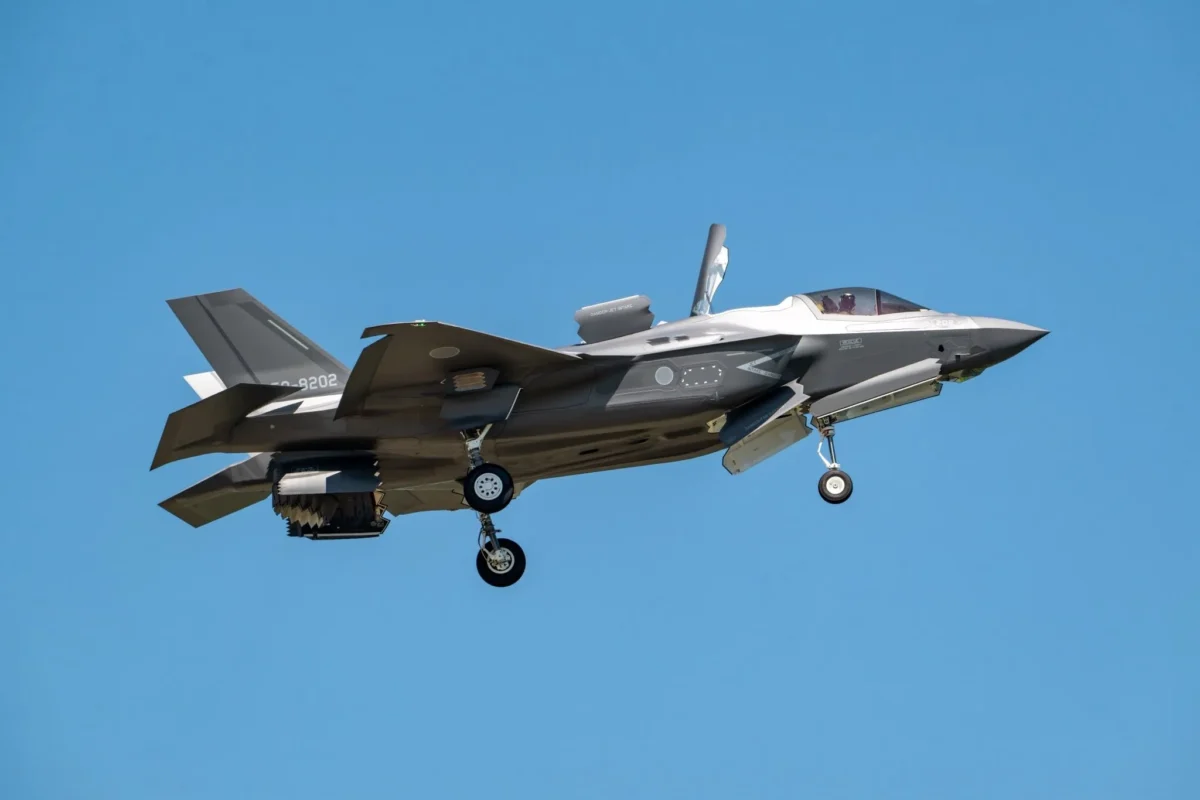
Its large-scale production has created a robust logistics network, with spare parts, maintenance protocols, and pilot training programs standardized across multiple continents.
This widespread adoption ensures interoperability among allied forces, making the F‑35 not just a fighter jet but a cornerstone of modern coalition air strategy.
The Su‑57, by comparison, remains rare. Production has been slow, with fewer than 30 units reportedly delivered to date.
Manufacturing hurdles, technological challenges, and limited budget allocations have constrained Russia’s ability to mass-produce the aircraft.
Exports are in early stages, with countries like India initially showing interest but encountering delays and program uncertainties.
Consequently, the Su‑57’s global footprint is minimal, limiting its strategic leverage and pilot experience opportunities compared to the F‑35.
This disparity in production and export highlights a subtle but critical advantage: availability equals influence.
The F‑35’s presence in multiple air forces creates a web of strategic and tactical superiority that extends beyond individual performance.
The Su‑57, while technologically impressive, remains largely a symbol of potential rather than widespread operational power.
Owning a fighter jet is one thing; keeping it mission-ready is another entirely.
In the Su‑57 vs F‑35 discussion, cost and logistics play a decisive role in long-term operational effectiveness.
The F‑35 is famously expensive.
Each unit costs roughly $80–100 million, depending on the variant, with lifetime operating costs estimated at $1.5 trillion for the fleet over 50 years.
These high expenses stem from advanced stealth materials, cutting-edge avionics, and a global support infrastructure that ensures consistent maintenance and rapid part replacement.
However, this investment comes with predictability: standardized training, global logistics hubs, and an extensive network of simulators and spare parts make sustaining the fleet manageable—if costly. In short, you pay a premium for reliability and performance consistency.
The Su‑57, while cheaper per unit, estimated at around $40–50 million, is less predictable.
Limited production, fewer support facilities, and ongoing development of key systems mean maintenance can be sporadic and resource-intensive.
Spare parts may be scarce, and logistics chains are less robust compared to the international F‑35 network. Pilots and ground crews may face longer downtimes, which affects operational readiness.
That said, the Su‑57’s simpler avionics and fewer network dependencies could make field repairs faster in isolated scenarios, giving it a certain tactical flexibility that the F‑35’s complex systems sometimes lack.
Essentially, cost and logistics are about trade-offs.
The F‑35 represents high-cost, high-reliability networked power, while the Su‑57 is lower-cost, potentially more adaptable, but less battle-tested and supported.
In a sustained campaign, these factors could matter as much—if not more—than raw speed or stealth.
When comparing the Su‑57 vs F‑35, the most revealing differences often come from how each aircraft is intended to be used. The jets aren’t just machines—they are embodiments of military doctrine and strategic philosophy.
The F‑35 is designed for networked, coalition-based warfare. Its stealth, advanced sensors, and communication systems allow it to operate seamlessly alongside allied forces, sharing data in real-time and coordinating strikes with precision.
The jet fits into the U.S. concept of “see first, strike first, and stay unseen,” excelling at intelligence gathering, suppression of enemy air defenses, and long-range precision strikes.
Think of it as a digital-era scout and sniper rolled into one—a force multiplier that leverages information dominance as much as firepower.
The Su‑57 reflects Russia’s focus on raw agility and independent operations. Its doctrine prioritizes air dominance, rapid interception, and flexible engagement strategies.
Maneuverability, speed, and powerful armament allow it to thrive in one-on-one combat scenarios or contested airspace where stealth alone may not suffice.
Russia’s approach emphasizes pilot skill and tactical improvisation, contrasting with the F‑35’s reliance on integrated systems and coalition coordination.
In essence, these jets are mirrors of their nations’ military philosophies. The F‑35 is about precision, integration, and global reach, while the Su‑57 is about raw performance, adaptability, and tactical audacity.
Understanding these roles is crucial for anyone comparing the two: it’s not just which jet is “better,” but which is better suited for specific strategic objectives.
Sometimes a picture, or in this case, a table, is worth a thousand words.
Here’s a detailed breakdown of how the Su‑57 and F‑35 stack up across critical categories:
| Feature | Su‑57 | F‑35 |
| Origin & Role | Russian multirole air superiority fighter | U.S. multirole stealth fighter, networked warfare |
| Top Speed | ~Mach 2.0+ | ~Mach 1.6 |
| Engines | Twin AL-41F1 engines with thrust vectoring | Single Pratt & Whitney F135 |
| Stealth | Partial, frontal RCS reduction | Advanced, very low RCS (<0.005 m²) |
| Avionics & Sensors | N036 AESA radar, IRST, moderate fusion | AN/APG-81 AESA radar, DAS, EOTS, superior fusion |
| Weapons & Payload | Internal + external hardpoints, potential hypersonics | Internal bays for missiles/bombs, external options reduce stealth |
| Maneuverability | Super-maneuverable with 3D thrust vectoring | Moderate agility, optimized for energy management |
| Combat Experience | Limited deployment, mostly training | Widely deployed globally, battle-tested |
| Production & Export | <30 units delivered, limited export | >1,500 units delivered, adopted by 15+ countries |
| Cost & Logistics | ~$40–50 million/unit, limited support network | ~$80–100 million/unit, extensive global support |
| Strategic Doctrine | Aggressive, independent, dogfight-focused | Precision, stealth, network-centric, coalition-friendly |
This table highlights the core contrasts: the Su‑57 excels in agility, speed, and firepower, while the F‑35 dominates in stealth, avionics, and operational integration. It’s not just about specs; it’s about how each aircraft is meant to fight and the philosophy behind its design.
Comparing the Su‑57 vs F‑35 isn’t just a numbers game; it’s a study in philosophy, strategy, and technological culture.
On one side, the Su‑57 dazzles with raw speed, super-maneuverability, and a heavy-hitting arsenal—a jet built for daring pilots and high-intensity dogfights
On the other side, the F‑35 represents precision, stealth, and integrated networked warfare, thriving in coordinated missions where situational awareness and data dominance are king.
Each fighter has its strengths and compromises.
The Su‑57’s agility and potential payloads make it a formidable force in contested skies, but its limited production, logistics, and operational experience temper its battlefield influence.
The F‑35, while slower and less acrobatic, benefits from a proven global track record, advanced avionics, and stealth capabilities that allow it to operate effectively even in heavily defended airspace.
Ultimately, the “winner” depends on context. In a one-on-one dogfight at close range, the Su‑57 may hold an advantage.
In a modern, multi-theater, networked engagement, the F‑35’s integrated systems and global support network tip the scales.
The comparison also underscores a deeper lesson: fighter jets are as much about the doctrine, strategy, and human ingenuity behind them as they are about engines and radar cross-sections.
For enthusiasts, analysts, or policymakers, understanding these nuances goes beyond curiosity—it’s about appreciating how technology, design philosophy, and strategy converge in the sky.
Whether you’re team Su‑57 or team F‑35, one thing is clear: the future of air combat is as fascinating as it is complex, and these two jets are at the forefront of that evolution.