Follow Us:
Follow Us:

If you’ve ever heard people mention the E-4B Doomsday Plane, it probably sounds like something straight out of a disaster movie. And honestly, that nickname isn’t completely off-base.
The E-4B, sometimes called E-4B Nightwatch, is the aircraft the U.S. might rely on during the absolute worst-case scenario. It’s basically a flying command center designed to keep national leadership connected and in control even if things on the ground go sideways in a big way.
Not every detail is public, and some of its capabilities are intentionally vague. But the general idea is pretty clear, this is an airborne HQ built to stay resilient during crises, including the kind you hope never actually happens.
People often ask, “What is the Doomsday plane?” or “Why do they call it that?”, and the answers are surprisingly practical once you dig in.
At its core, the E-4B Doomsday Plane is the U.S. military’s airborne command post, basically a flying crisis bunker. It’s built on a modified Boeing 747 frame, but the inside is packed with hardened communications gear, workspaces, briefing rooms, and systems meant to keep national leadership connected even if the world is having its worst day.

Not every detail is publicly available, of course, but the general picture is that it gives the government a secure, mobile “backup headquarters” when fixed locations might be at risk.
Day to day, the aircraft is tied to the E-4B Nightwatch mission, which keeps one of these planes on standby at nearly all times.
The whole purpose is continuity: making sure critical decisions can still be made, coordinated, and transmitted no matter what kind of disruption is unfolding.
The nickname “Doomsday Plane” comes from the kind of scenarios it’s designed for.
We’re talking about events that could disrupt communications on a massive scale, potentially even nuclear-level crises. The aircraft is supposed to stay airborne, stay connected, and stay survivable when almost everything else might be compromised.
People call it the “Doomsday Plane” not because it guarantees some kind of sci-fi immunity, but because it’s meant to function during the kinds of crises everyone hopes remain purely hypothetical. Its existence is basically a safety net for the highest level of government, meant to be there if the unthinkable ever starts becoming real.
Now, I’d be cautious about assuming it’s invincible.
The term “Doomsday” is more of a shorthand for its mission rather than a literal promise that it can handle anything. Still, the fact that such a plane exists and stays ready, says a lot about how seriously the U.S. treats worst-case planning.
The E-4B doomsday plane grew out of Cold War anxieties, back when the U.S. was constantly thinking about how to keep the government running if the worst ever happened. There was this real fear that a nuclear strike could knock out command centers on the ground, and relying on bunkers alone felt a little too risky.
So the thinking shifted: why not put the command center in the air, where it’s harder to hit and easier to keep connected? That mindset eventually shaped what became the E-4 program.
Using the Boeing 747 as the starting point made a lot of sense. It had the space, the range, and the reliability the Air Force needed for something this important. But once the military started converting it, the 747 basically stopped being anything like a passenger jet.

The whole interior got rebuilt with secure comms gear, planning rooms, staff areas, and protective systems designed to shrug off things like electromagnetic pulses. It’s still a 747 on the outside, but inside, it’s closer to a hardened office building that just happens to fly.
As the years rolled on, the E-4 picked up upgrades whenever tech moved forward.
Early versions were pretty analog by today’s standards, but later ones added more advanced radios, tougher wiring, better data links, and systems meant to keep everything running smoothly even if conditions get messy.
A lot of the exact details don’t get spelled out publicly, but the general trend is clear enough to keep the plane useful, keep it resilient, and keep it ready for situations nobody really wants to imagine.
A big part of what sets the E-4B Doomsday Plane apart is its communication backbone. It’s built to stay connected almost no matter what’s happening on the ground, using layers of radios, satellite links, and low-frequency systems that can reach forces around the world.
It also carries a mix of defensive systems meant to give it a fighting chance if things ever get dangerous. These can include countermeasures like flares, electronic protections, and shielding designed to help the aircraft keep flying and keep working even in messy environments. Nothing makes it invulnerable, but it’s definitely tougher than any everyday jet.
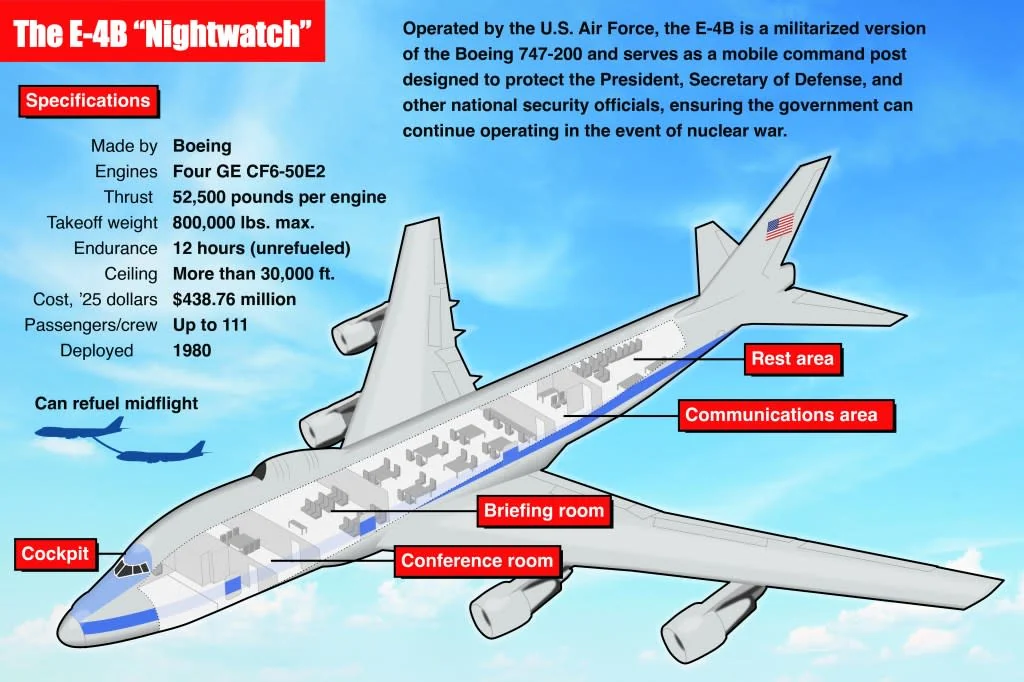
In terms of range and endurance, the E-4B can stay in the air for long stretches, especially when supported by aerial refueling. It’s not a fast mover compared to fighters, but it cruises steadily and can remain operational for many hours at a time, which is really what matters for a flying command post.
The crew setup is another thing that makes the plane stand out. Instead of just pilots and a few flight attendants, you get a whole mix of specialists: communications teams, planners, technical staff, operations leaders, and support personnel.
The E-4B can carry roughly 60–100 people, depending on the mission, and everyone on board has a role in keeping the airborne command center running smoothly.
When things take a serious turn, whether it’s a nuclear scare or a major national emergency, the E-4B steps in as a kind of airborne safety net. It’s designed to launch quickly, often within minutes, and head to a safe altitude where it can run its operations without being tied to any vulnerable ground facility.
In those moments, the plane becomes a moving command hub, giving national leadership a stable place to coordinate decisions.
A lot of the aircraft’s value comes from its command and control role. It can connect with military forces around the world, relay orders, gather situational updates, and keep information flowing when normal channels might be overloaded or disrupted.
And because it’s constantly in motion, it’s much harder to target, which adds another layer of resilience. The goal isn’t to fight battles from the sky, it’s to make sure the people who make the big calls can still communicate clearly enough to steer the response.
The E-4B also plays a huge part in the continuity of government operations. If something ever threatens the ability of key leaders to operate from fixed command centers, the aircraft becomes a backup workspace where they can keep functioning. This includes everything from coordinating emergency plans to staying in touch with other government branches and allied forces.
The E-4B’s crew is a surprisingly diverse group, and the aircraft operates more like a flying operations center than a typical jet.
Up front are the pilots and flight engineers handling the actual flying, but the real activity unfolds throughout the rest of the cabin. There are communication specialists who manage all the radio, satellite, and data links, basically the folks making sure the plane can talk to anyone it needs to, even if traditional networks are having a bad day.
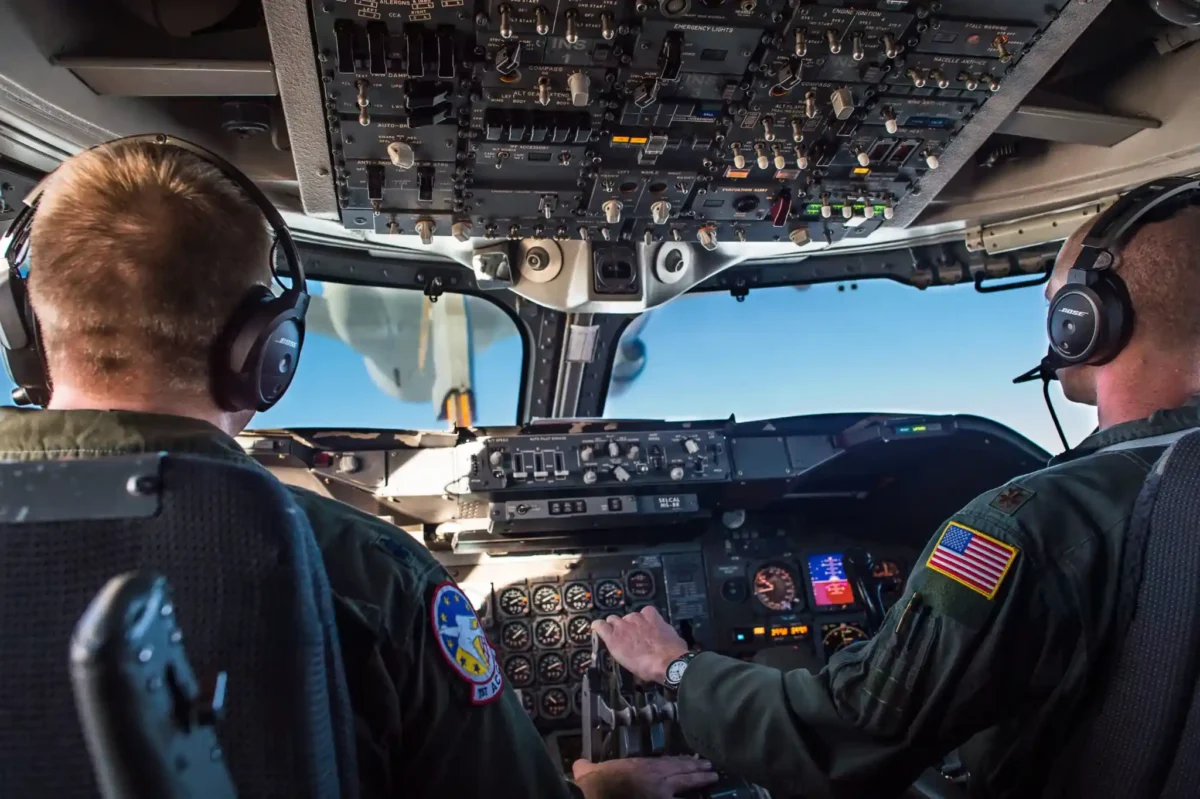
Alongside them are planners, technical teams, and command staff who help run the airborne headquarters and keep everything functioning smoothly during high-stress moments.
Coordination with the president and senior military leadership is a central part of the mission. The onboard team acts as a link between decision-makers and the forces they oversee, relaying orders, gathering situational updates, and maintaining a steady flow of information.
In some scenarios, national leaders may even use the E-4B as a temporary command space, allowing critical decisions to continue unaffected by disruptions on the ground.
The exact details of how those interactions play out aren’t always spelled out publicly, but the general idea is pretty clear: the E-4B crew keeps communication lines open and trusted, so leadership can stay focused on responding to whatever crisis is unfolding.
The E-4B Doomsday Plane has picked up all kinds of dramatic attention over the years, especially in movies and online speculation. It’s easy to see why; an aircraft built for worst-case scenarios almost invites a bit of mystery.
Still, a lot of the hype tends to drift pretty far from how the plane actually works. Some assumptions come from outdated info, and some come from pure Hollywood imagination, so separating the flashy myths from the grounded reality can be helpful.

In reality, the E-4B is important, but it isn’t some magical, all-powerful aircraft. It doesn’t operate with unlimited endurance or superhero-level technology, and it’s not meant to ride out the literal end of the world.
Its purpose is more practical: to provide a reliable airborne headquarters when things on the ground start getting unpredictable. Even though a few details stay classified for understandable reasons, the bigger picture is much more grounded than the fiction suggests.
Even with newer technology and evolving threats, the E-4B doomsday plane still plays a surprisingly relevant role in modern planning.
The world hasn’t exactly gotten calmer, and the need for a resilient way to keep national leadership connected hasn’t gone away. If anything, the mix of cyber risks, communication vulnerabilities, and unpredictable global tensions makes a dependable airborne command center feel even more useful.
The E-4B might not be flashy, but its reliability and proven design give it a kind of steady confidence that newer systems sometimes take years to earn.
There’s also something to be said for the way the aircraft fits into broader government strategy. It’s part of a layered approach to continuity, one that assumes not everything will go right in a crisis.
Having a flying headquarters that can operate independently adds a lot of flexibility, especially when ground-based systems might be strained or temporarily unavailable. Even if some of its capabilities stay behind the scenes, the idea it represents is pretty straightforward: make sure leadership can keep functioning, no matter what.
In the big picture, that makes the E-4B’s strategic importance hard to overlook. It’s not just a Cold War relic hanging on out of habit. It’s a tool built for moments when stability is fragile, and decisions matter most. And as long as those kinds of moments remain possible, the Doomsday Plane is likely to stay part of the conversation.
There aren’t many E-4B Doomsday Planes out there, in fact, the fleet is pretty small.
The Air Force operates four of them, and that number has stayed fairly steady for years. Keeping a tiny fleet might seem odd at first, but each aircraft is expensive, specialized, and constantly maintained, so at least one can be ready to launch on short notice. With a mission this specific, a handful of aircraft ends up being enough, even if the work behind the scenes is a lot more involved than most people realize.

The endurance question gets a little more flexible because it depends on conditions, crew limits, and how intensively the systems are being used. With tanker support, the aircraft can stay airborne for a very long stretch. Documented missions have pushed past 30 hours, and under the right circumstances, it can go well beyond that.
There’s also a popular claim floating around that the E-4B can remain in the air for up to seven days straight. In theory, with enough refueling support and careful crew rotations, the plane could stay airborne for an extremely long duration.
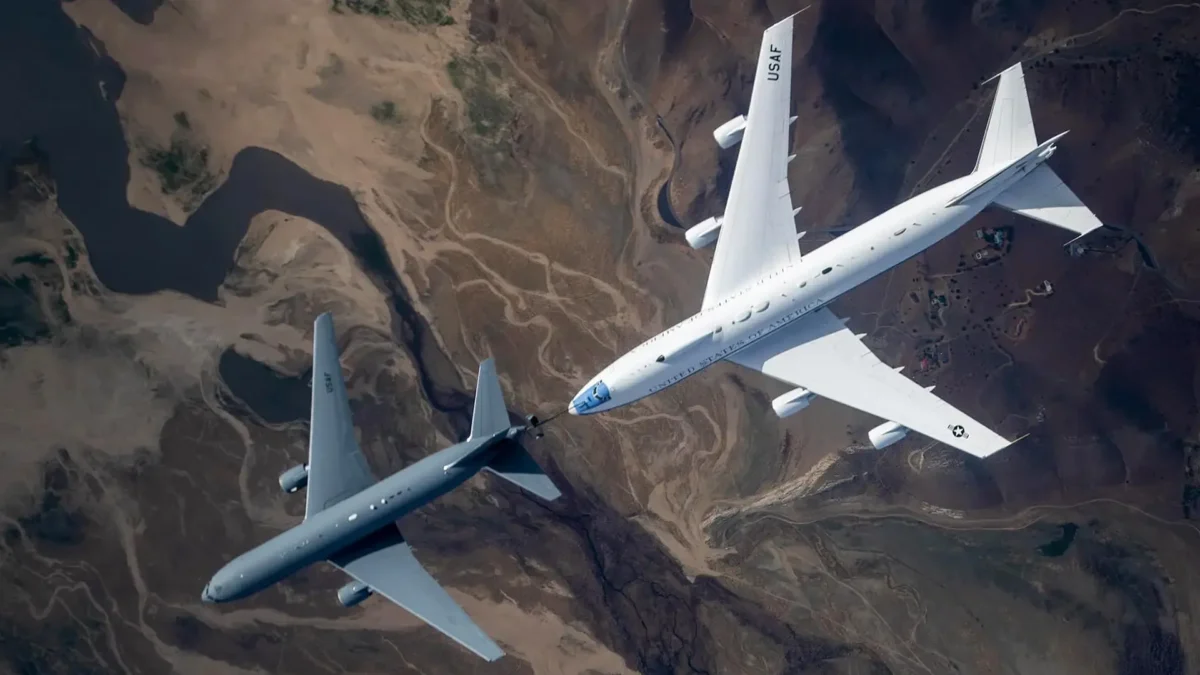
But in reality, things like maintenance needs, crew fatigue, and system limits make a full week more of a theoretical upper bound than something the aircraft is routinely expected to do.
So the simplest way to put it is this: the Doomsday Plane can stay airborne a very long time, especially with refueling, but “seven days nonstop” is more of a best-case scenario than a regular operational standard.
The design leans more toward “endurance when it counts” rather than “indefinite flight,” which fits the role it’s meant to play.