Follow Us:
Follow Us:

Picture this for a moment. It’s the middle of the night, somewhere hundreds of kilometers behind the front line. Suddenly a faint buzzing sound grows louder, almost like a lawn mower in the distance. Radar operators see a tiny dot creeping across the screen. It isn’t a fighter jet. It isn’t a missile either.
It’s a kamikaze drone.
Over the past few years, these small, relatively cheap flying weapons, technically called loitering munitions, have quietly changed the economics of warfare. Instead of launching million-dollar cruise missiles, militaries can send swarms of expendable drones that hunt targets and explode on impact.
And that brings us to the increasingly searched comparison: LUCAS drone vs Shahed-136.
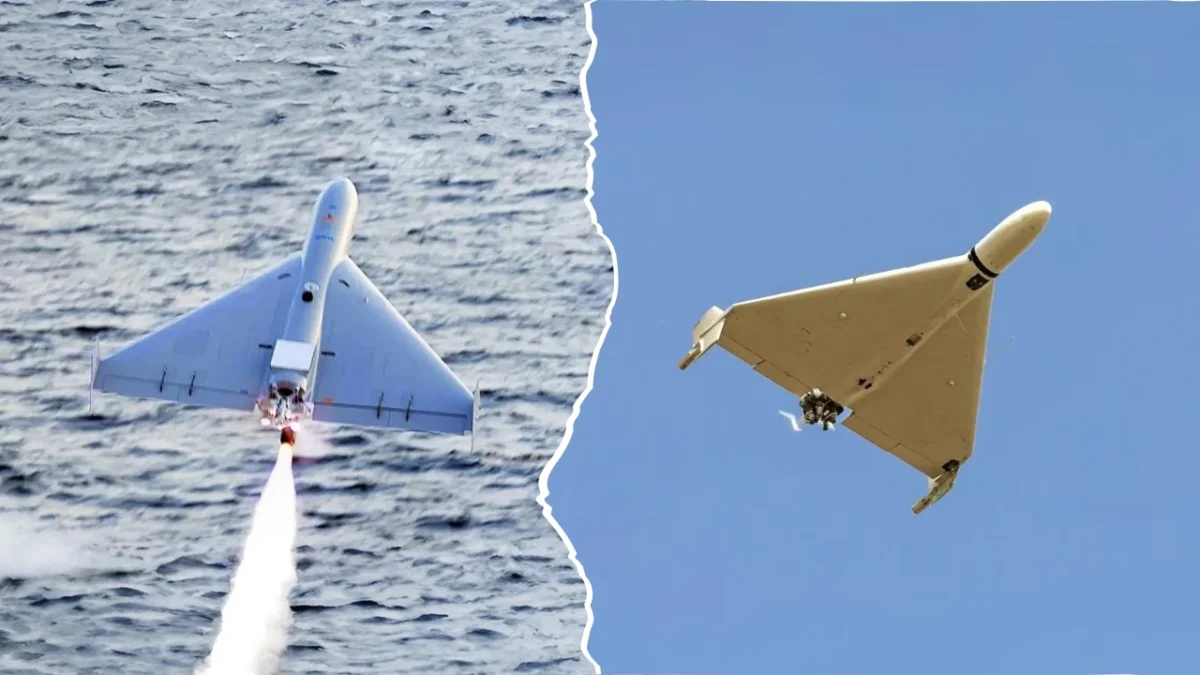
At first glance, the two drones even look similar. Same delta-wing layout. Same pusher propeller. Same one-way mission.
But appearances can be misleading.
When you start comparing range, guidance systems, payload capacity, and battlefield roles, the story gets a lot more interesting. One drone prioritizes simplicity and mass production. The other leans heavily into connectivity and modular warfare.
In this post, we’ll break down the LUCAS drone vs Shahed-136 comparison piece by piece, examining their specifications, strengths, weaknesses, and the strategic thinking behind each design.
The LUCAS drone, short for Low-Cost Uncrewed Combat Attack System, is part of a new generation of American loitering munitions designed around a simple but powerful idea: warfare at scale.
Instead of relying solely on expensive precision missiles or advanced aircraft, the concept behind LUCAS is to deploy large numbers of relatively affordable drones that can scout, loiter, and strike targets when the moment is right.
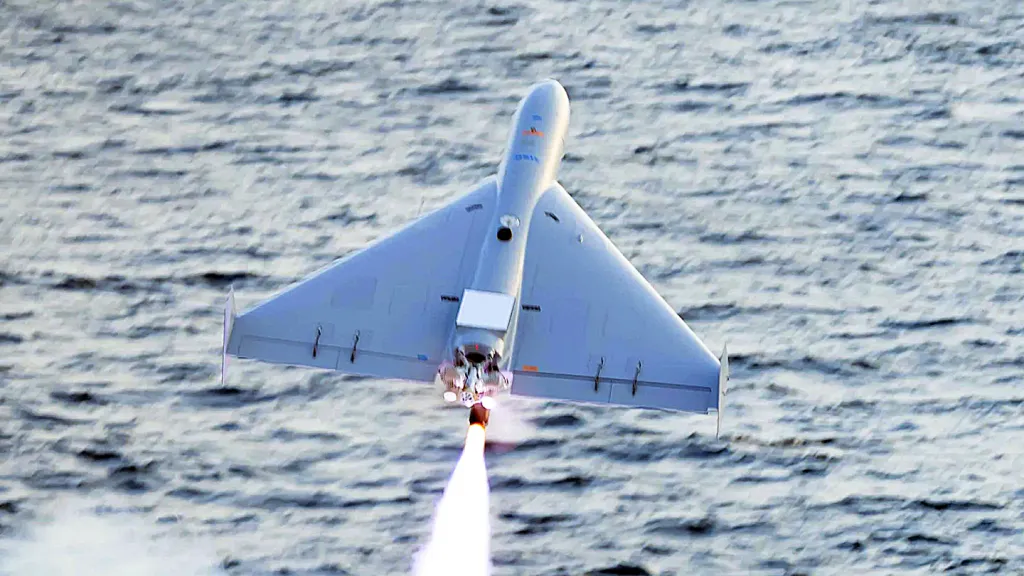
In other words, it’s a weapon built for the age of drone swarms.
The program was introduced publicly in the mid-2020s by the U.S. defense tech firm SpektreWorks, which developed the platform under rapid procurement initiatives within the U.S. Department of Defense. These programs, often described as “affordable mass” strategies, aim to give the military thousands of expendable systems rather than a handful of extremely costly ones.
And yes, many observers immediately noticed something familiar.
Read also: Switchblade 600 Drone – Specs, Range, Cost & How It Works
Technically speaking, LUCAS is closer to a networked combat node than a simple kamikaze drone. It’s designed to operate within a broader digital ecosystem,
The drone can carry different payload modules, explosive warheads, surveillance sensors, or communication relay equipment. That flexibility means the same platform could support reconnaissance missions one day and perform precision strikes the next.
In short, the LUCAS drone isn’t just trying to copy existing kamikaze drones. It’s trying to turn them into a networked battlefield system.
Long before the LUCAS drone vs Shahed-136 debate began circulating in defense circles, the Shahed-136 had already made a name for itself, loudly, quite literally.
If you’ve followed footage from the war in Ukraine, you’ve probably heard that distinctive sound: a buzzing, chainsaw-like engine droning through the night. Soldiers nicknamed it the “moped drone.” Not exactly flattering, but memorable. And for a weapon designed to be cheap and disposable, memorable can be enough.
The Shahed-136 is an Iranian-made loitering munition developed by Iran’s aerospace industry and first revealed publicly around 2020. Its purpose is straightforward: fly long distances, locate or approach a target, and detonate on impact. No return trip. One mission only.
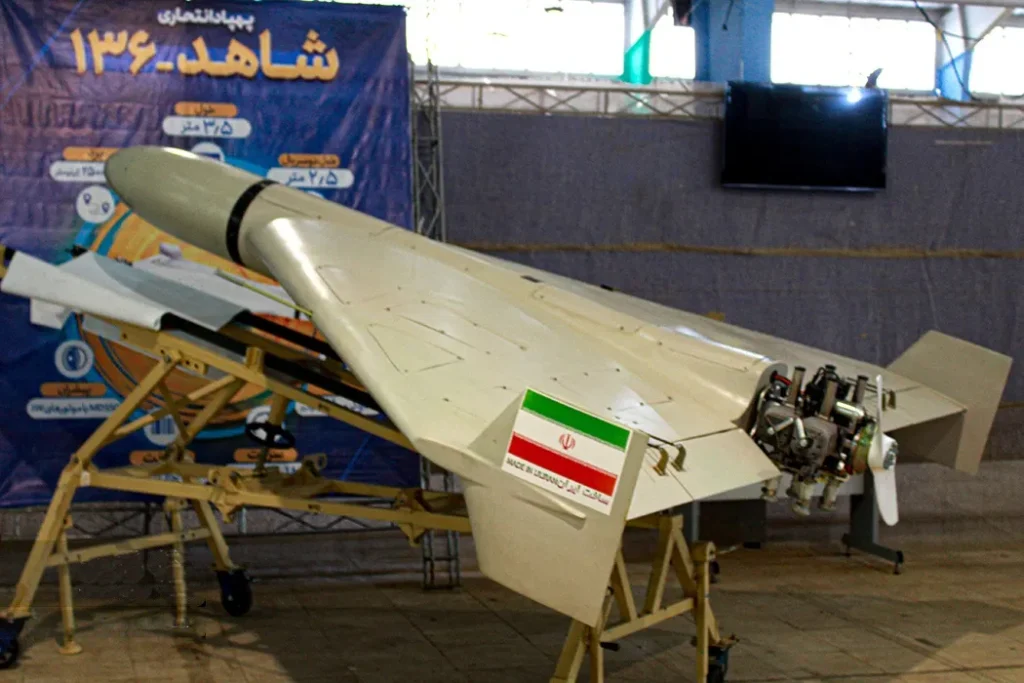
Yet what makes the Shahed-136 interesting isn’t technical sophistication, it’s economics.
Compared with traditional precision weapons, the drone is remarkably inexpensive. Estimates vary widely, but many analysts place the cost somewhere between $20,000 and $80,000 per unit, depending on manufacturing scale and electronics packages. For context, a modern cruise missile can cost $1–2 million.
That price gap changes battlefield math.
Instead of firing a handful of expensive weapons, operators can launch dozens of Shahed drones simultaneously, overwhelming air defenses that must respond with far more expensive interceptor missiles.
At first glance, comparing the LUCAS drone vs Shahed-136 feels a bit like comparing two cars built on the same chassis but tuned for very different drivers. They share a silhouette, triangular wings, rear propeller, compact fuselage, but their design philosophy diverges once you start looking under the hood.
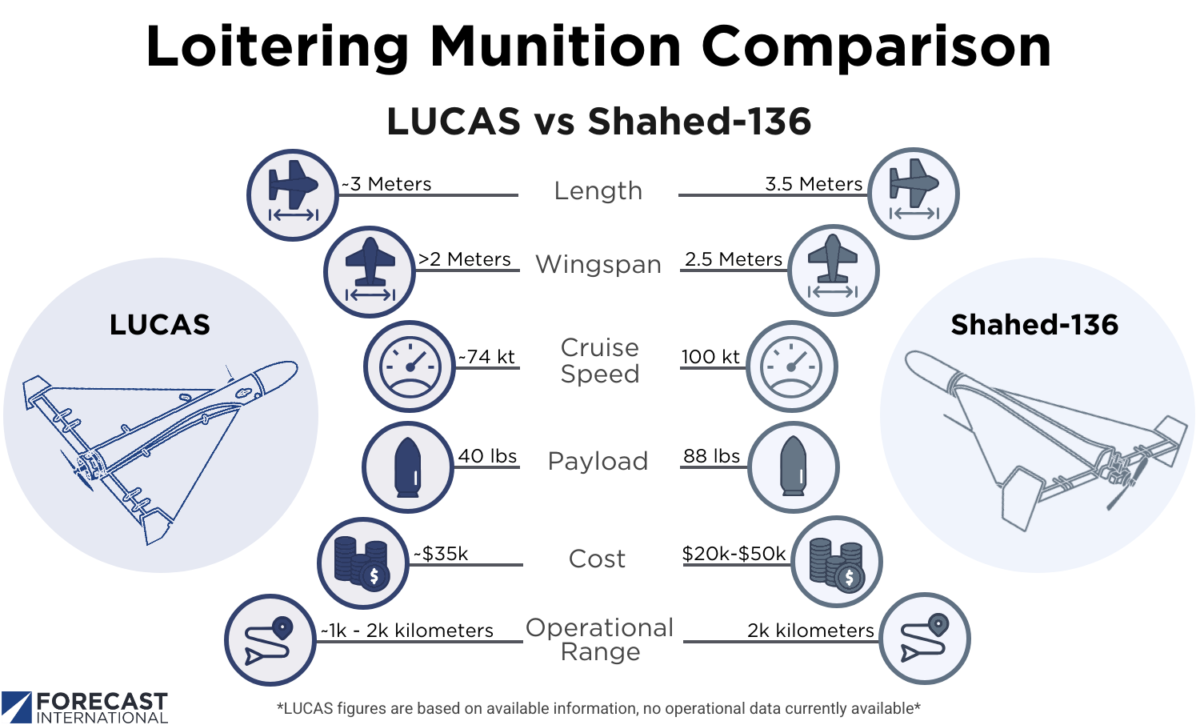
Think of the Shahed-136 as a blunt instrument: simple, long-range, and built to be produced in large numbers. The LUCAS drone, by contrast, is designed more like a connected device, part weapon, part sensor node in a larger battlefield network.
Both drones belong to the category known as loitering munitions, which means they can fly toward an area, search or wait for a target, and then crash into it with an explosive payload. But the way they accomplish that mission differs.
Let’s break down the most discussed specs in the LUCAS vs Shahed-136 comparison.
| Feature | LUCAS Drone | Shahed-136 |
| Type | Networked loitering munition | Loitering munition |
| Length | ~3 m | ~3.5 m |
| Wingspan | ~2.4 m | ~2.5 m |
| Speed | 150–185 km/h | ~180–185 km/h |
| Range | ~500–2,000 km (estimated) | Up to ~2,500 km |
| Warhead/Payload | 18–50 kg | 30–50 kg |
| Estimated Cost | ~$35,000 | $20k–$80k |
| Guidance | Satellite + GPS/INS | GPS waypoint navigation |
| Swarm Capability | Designed for coordinated swarms | Limited |
A couple of patterns jump out immediately.
First, range. The Shahed-136 still appears to have the edge in long-distance strikes, capable of traveling across entire regions. That’s one reason it has been used to hit infrastructure hundreds of kilometers from the launch site.
Second, connectivity. The LUCAS drone is reportedly designed with satellite communications and real-time data links, allowing operators to update targets mid-flight.
And that difference, connectivity versus simplicity, sits right at the heart of the LUCAS drone vs Shahed-136 debate.
Once you move past the similar triangular shape, the LUCAS drone vs Shahed-136 comparison starts revealing two very different design philosophies. One drone prioritizes simplicity and reach. The other leans into connectivity, adaptability, and battlefield networking.
Let’s unpack the biggest differences that defense analysts keep pointing out.
The LUCAS drone is designed to operate as part of a larger digital ecosystem. That means it can communicate with satellites, command centers, and potentially other drones in flight. If a target moves, or a better target appears, operators could theoretically update the mission mid-flight.
That’s a major shift.
The Shahed-136, by contrast, usually follows a pre-programmed route. Once it launches, it flies toward the coordinates entered before takeoff. Simple. Cheap. But not very flexible.
Navigation is another major difference in the LUCAS vs Shahed-136 comparison.
| Guidance Feature | LUCAS Drone | Shahed-136 |
| GPS Navigation | Yes | Yes |
| Inertial Navigation | Yes | Yes |
| Satellite Data Link | Yes (reported) | No |
| Mid-flight Retargeting | Possible | Limited |
| Autonomous Swarm Coordination | Designed for it | Not typical |
In practical terms, this means LUCAS can behave more like a connected battlefield sensor, not just a one-way weapon.
The Shahed-136 is essentially a dedicated strike drone. It launches, travels to the target area, and detonates.
The LUCAS drone, however, is built with a modular payload concept. Depending on the mission, it could carry:
That flexibility might sound like a minor technical tweak, but it changes how commanders can use the drone. Instead of a single-purpose weapon, LUCAS becomes a multi-role battlefield tool.
In short, when discussing the LUCAS drone vs Shahed-136, the real difference isn’t just hardware.
It’s how each drone fits into modern military strategy.
With all the talk about advanced networking and swarm coordination, it’s easy to assume the LUCAS drone vs Shahed-136 comparison automatically favors the newer American system. But that would be a mistake.
In several key areas, the Shahed-136 still holds some surprisingly strong advantages.
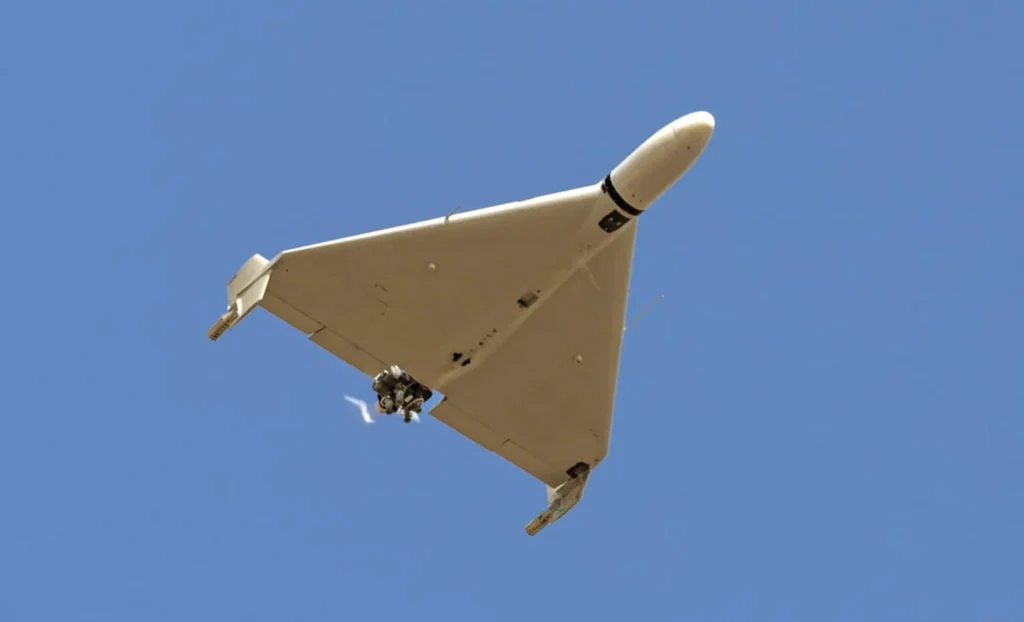
And those advantages explain why it has become one of the most widely discussed loitering munitions in recent conflicts.
The first, and arguably biggest, advantage is range.
The Shahed-136 is believed to reach distances of up to 2,500 kilometers under certain conditions. That kind of reach turns it into more than a tactical battlefield weapon; it becomes a strategic strike platform capable of hitting infrastructure deep inside enemy territory.
For comparison, the estimated operational range of the LUCAS drone is often discussed in the 500–2,000 km range depending on payload and mission profile.
| Capability | LUCAS Drone | Shahed-136 |
| Maximum Range | ~500–2,000 km (est.) | Up to ~2,500 km |
| Primary Role | Networked strike / ISR | Long-range strike |
| Operational Depth | Tactical to regional | Regional to strategic |
That extra reach can be decisive when targeting power plants, logistics hubs, or air bases far from the front line.
Another edge in the LUCAS vs Shahed-136 comparison is payload mass. The Shahed drone typically carries a 30–50 kg explosive warhead, large enough to seriously damage infrastructure or armored vehicles.
While the LUCAS drone can carry a similar payload range, its modular design sometimes trades explosive weight for sensors or communications equipment.
Perhaps the most underrated advantage: combat experience.
The Shahed-136 has been used extensively in real conflicts, particularly in Ukraine. Thousands of launches have provided valuable data on effectiveness, survivability, and tactics.
Read also: Russian Shahed-136 Drones Escalate Use of Anti-Tank Mines
LUCAS, by contrast, is still relatively new.
And in warfare, a weapon that has already proven it works under pressure carries a certain credibility that no specification sheet can replicate.
If the Shahed-136 represents the power of simplicity, the LUCAS drone represents something else entirely: the idea that even low-cost weapons can be part of a connected, intelligent battlefield network.
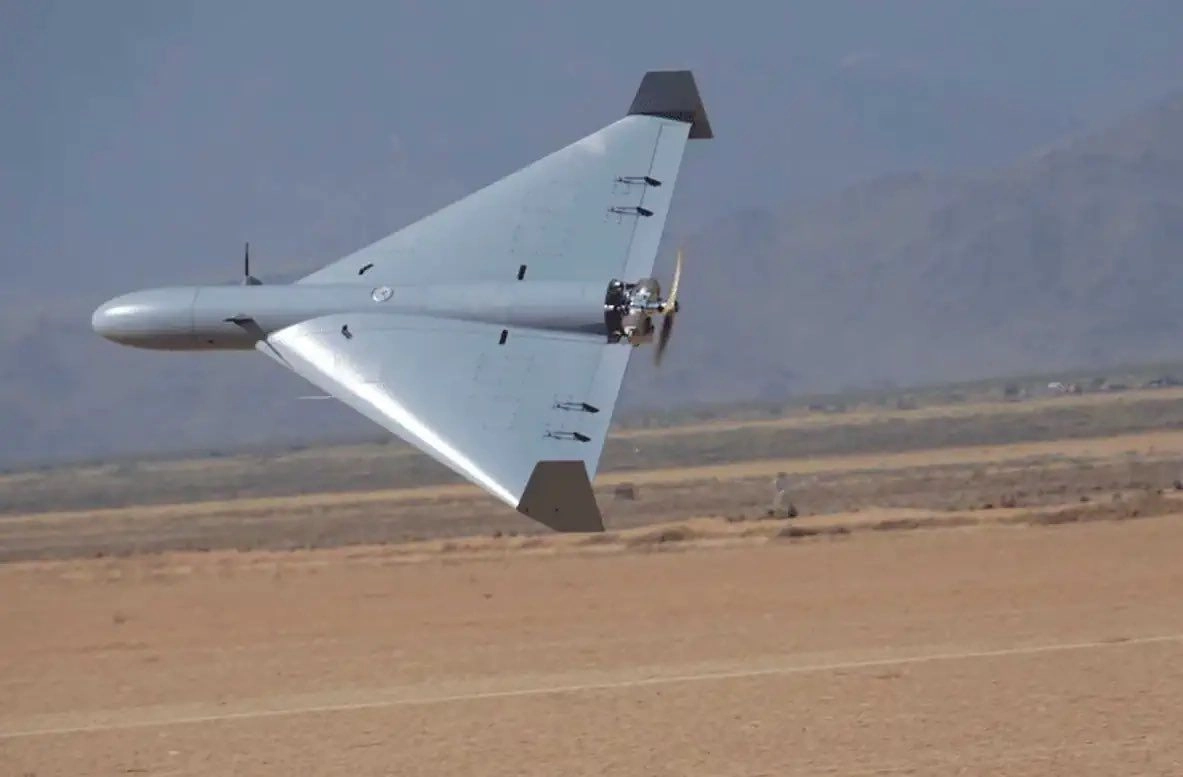
This is where the LUCAS drone vs Shahed-136 comparison starts to tilt in the other direction. Because while the Shahed excels at being cheap and long-range, LUCAS was built with the assumption that future wars will be fought not just with drones, but with entire drone ecosystems.
One of the most talked-about features of the LUCAS drone is its potential for coordinated swarm operations.
Instead of launching a group of drones that all fly blindly to pre-set coordinates, LUCAS units can theoretically share data with each other. One drone might detect a radar signal, another could relay the information, and a third might adjust its flight path to strike the target.
In practical terms, that means a swarm can behave like a single coordinated system, not just a cluster of flying bombs.
Military planners love that idea.
Another major upgrade in the LUCAS vs Shahed-136 comparison is connectivity.
The Shahed-136 generally follows a programmed GPS route. Once it launches, the mission is largely locked in.
The LUCAS drone, however, is designed with beyond-line-of-sight communication, often discussed alongside satellite links such as secure military constellations.
This opens the door to several capabilities:
Suddenly the drone isn’t just a weapon, it becomes part scout, part messenger, part strike platform.
Then there’s the modular architecture.
Instead of being limited to a single explosive role, LUCAS can potentially carry different payload packages depending on the mission:
| Payload Type | Possible Mission |
| Explosive warhead | Precision strike |
| ISR sensors | Surveillance and reconnaissance |
| Communications relay | Battlefield networking |
That flexibility gives the LUCAS drone something the Shahed lacks: adaptability.
And in modern warfare, adaptability can matter just as much as firepower.
By this point in the LUCAS drone vs Shahed-136 comparison, one thing should be clear: asking “Which drone is better?” isn’t quite the right question.
A more accurate question might be: better for what mission?
Both drones were built with different strategic priorities in mind. One focuses on long-range strike capability with minimal complexity. The other is designed to plug into a networked battlefield where drones communicate, coordinate, and adapt mid-mission.
So instead of crowning a simple winner, it’s more useful to compare where each drone shines.
If the goal is to hit targets hundreds or even thousands of kilometers away, power plants, logistics hubs, or military bases, the Shahed-136 still holds the edge.
Its long range and relatively large warhead make it well suited for deep infrastructure attacks.
| Mission Type | Better Option |
| Long-distance infrastructure strikes | Shahed-136 |
| High-volume saturation attacks | Shahed-136 |
And because the drone is designed with simplicity in mind, it’s relatively easy to produce and launch in large numbers.
The LUCAS drone, on the other hand, is built for a more digitally connected style of warfare.
Its ability to potentially receive mid-flight updates, relay data, and coordinate with other drones gives it an advantage in dynamic battlefield environments where targets move or intelligence changes quickly.
| Mission Type | Better Option |
| Coordinated drone swarms | LUCAS |
| ISR + strike hybrid missions | LUCAS |
| Network-centric operations | LUCAS |