Follow Us:
Follow Us:

It’s wild to think that, in 2026, Greenland, the massive, icy island most of us only learned about in school geography, is suddenly a headline-grabbing geopolitical flashpoint.
But here we are, President Trump has once again thrust the world’s largest island into the spotlight with bold claims that the United States “needs” Greenland for national security and might secure it “one way or the other,” even as allies push back hard.
And honestly, the more it comes up, the harder it is not to feel a little skeptical. Why this place? Why now?
On the surface, the official explanations seem neat enough: Arctic security, growing competition with China and Russia, and America’s long-standing military presence on the island. Fair points, at least on paper.
But critics and analysts alike have started wondering whether there’s more going on beneath the ice, especially as global demand for rare earth minerals explodes and melting Arctic routes quietly reshape world trade. That timing alone feels… convenient.
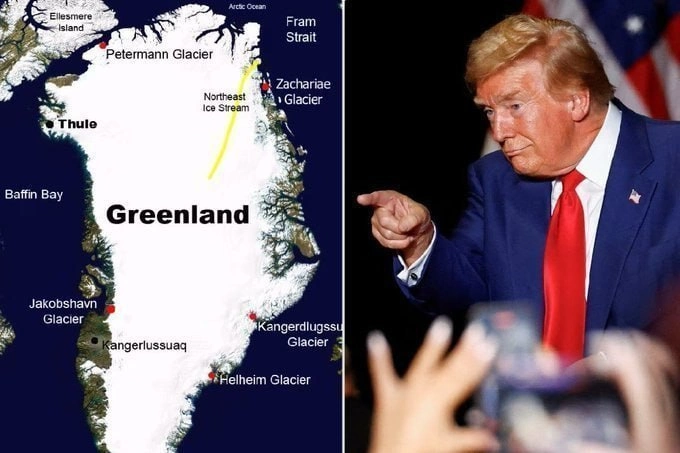
When people ask, “Why does Trump want Greenland?” Maybe the question isn’t just about geography anymore.
But let’s not get ahead of ourselves; there’s a lot to unpack here. From security arguments to economic angles (and yes, even some critics who think the motives are more about ego than strategy), the conversation around Greenland continues to evolve and it’s being shaped by some fresh headlines every day.
When people talk about Greenland, they’re usually thinking of ice, isolation, and not much else. But geopolitically? It’s kind of a big deal and has been quietly important for decades.
The island sits in a spot that global powers can’t really ignore anymore, especially as the Arctic heats up in more ways than one.
It seems the U.S. presence there was deliberate. Greenland sits right between North America and Europe, and not that far from Russia’s Arctic coastline either.
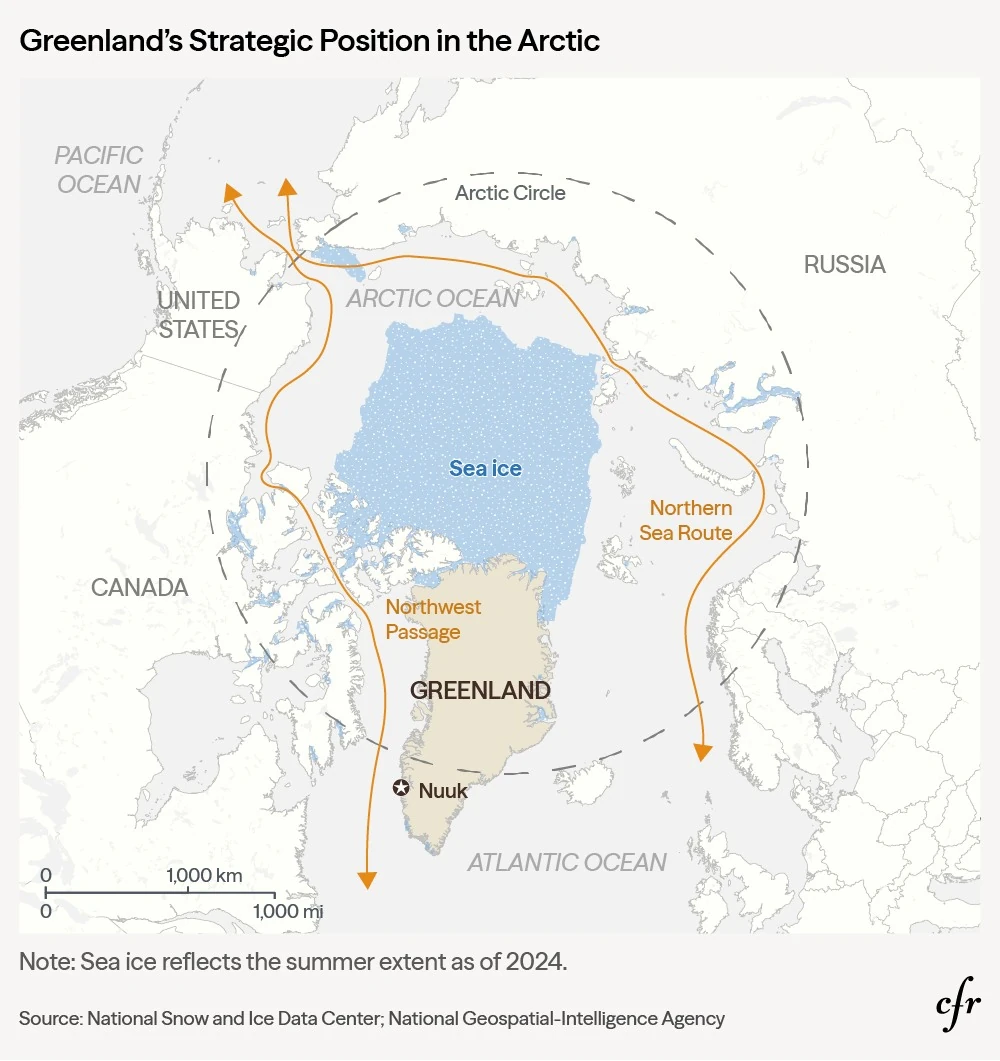
In practical terms, that puts it along some of the shortest air and missile routes between major powers. For decades, that mattered mostly to military planners thinking about early warning systems and airspace control.
It also gives influence over access to the Arctic itself. What’s changed is how exposed that position now feels.
As sea ice retreats, routes that were once theoretical are starting to look usable, and Greenland sits near key entry points into those northern waters. If you’re thinking about early warning systems, naval movement, or even just keeping an eye on who’s passing through, that location suddenly looks very valuable.
As explained earlier, climate change, uncomfortable as it is, has a huge influence. As Arctic ice melts, it’s opening up new Arctic shipping lanes that can shorten travel between Asia, Europe, and North America by thousands of miles (or kilometers).
At the same time, competition in the Arctic is clearly ramping up. Russia has been expanding its military footprint, China keeps calling itself a “near-Arctic state,” and the U.S. is trying not to fall behind.
So Greenland ends up looking like a forward position in a region everyone suddenly wants a stake in. That doesn’t mean every argument being made is purely strategic. But it does help explain why Greenland keeps resurfacing whenever Arctic power dynamics shift.
“National security” This is the argument U.S. officials tend to lean on first, and it’s also the one that feels the least speculative. If there’s a “safe” reason behind all this attention on Greenland, this is probably it.
Lately, Thule Air Base has quietly reappeared in defense discussions, especially as the U.S. updates Arctic warning systems and talks more openly about missile threats coming over the polar route. That renewed attention has naturally pulled Greenland back into the conversation.
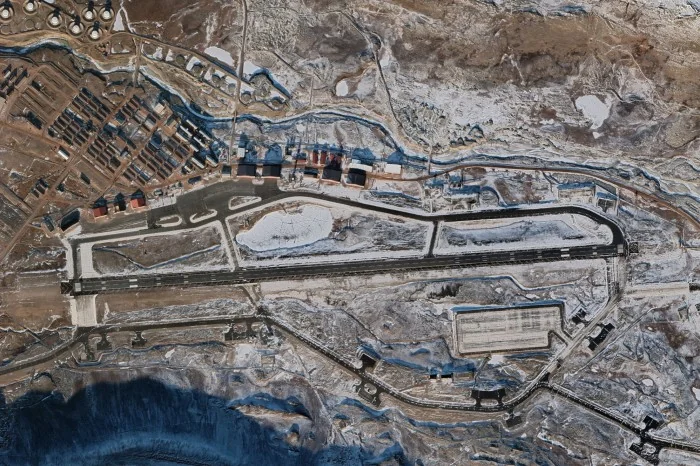
So why does everyone keep mentioning Thule Air Base? In simple terms, it’s one of the U.S. military’s most strategically placed installations anywhere in the world. Sitting way up in northern Greenland, it plays a key role in missile warning and space surveillance, especially for threats that would travel over the Arctic.
Because of Greenland’s position, missiles launched from parts of Russia would likely pass over this region first. That makes early detection here incredibly valuable.
The base has been around since the Cold War, but with modern missile technology and rising global tensions, its role arguably feels more relevant now than it has in years.
Short answer: probably, yes, at least in part. Russia has been expanding its military footprint across the Arctic, reopening old bases and investing heavily in Arctic-capable forces. That alone has made the region harder for the U.S. to ignore.
Then there’s China. While it’s nowhere near the Arctic geographically, Beijing has branded itself a “near-Arctic state” and has been actively pursuing influence through research stations, infrastructure projects, and long-term economic ties. None of that is overtly military, but it still raises flags in Washington.
So why do rare earth minerals keep coming up whenever Greenland is mentioned? Right now, China dominates much of the global rare earth supply chain. That dependence has made U.S. policymakers uneasy for years.
Greenland, meanwhile, is believed to hold significant rare earth deposits, which makes it tempting to view the island as a potential way to diversify supply and reduce reliance on Beijing.
The bigger question is whether Greenland’s resources are actually worth the effort. Estimates suggest the island holds substantial oil, gas, and mineral potential, much of it locked beneath ice or offshore in hard-to-reach areas.
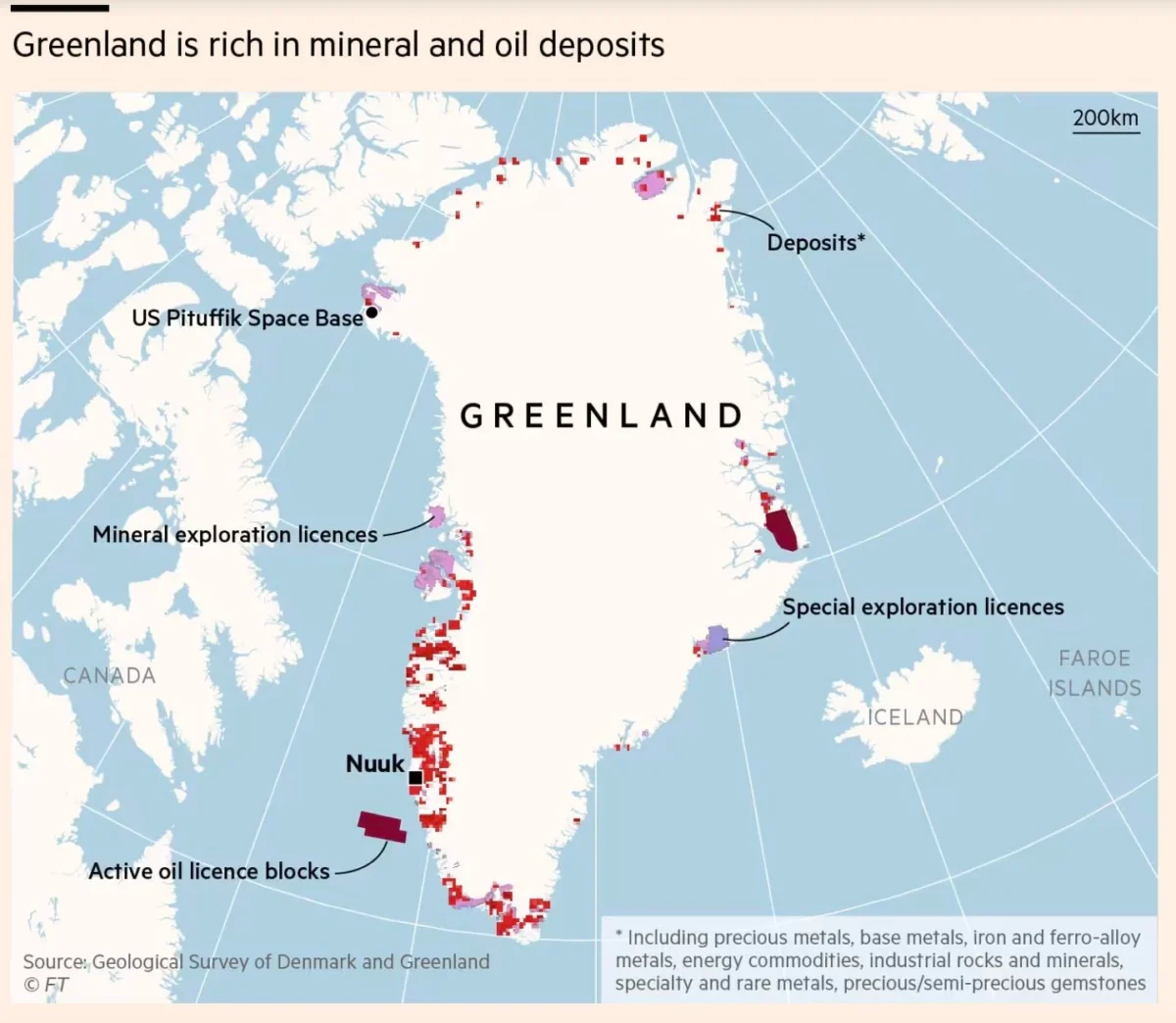
For a long time, that made extraction impractical and easy to ignore. Climate change complicates that picture. As ice retreats and access improves, areas that were once economically unrealistic start to look… possible.
You might hear people throw around phrases like “Greenland could be sitting on a $20 trillion resource trove,” but it’s worth taking that with a grain of salt; much of that number comes from broad, speculative estimates rather than fully surveyed, drill-tested deposits.
Here’s an estimation of Greenland’s natural resources:
Important note: those numbers aren’t small; they’re just far from a guaranteed payday. And much of what’s “there” is still under ice or logistically extremely hard to reach. That uncertainty is exactly why analysts tend to hedge when talking about Greenland’s resource value (promising on paper, but it’s also decades away from production reality).
So what’s the big deal with Arctic shipping routes? In simple terms, they’re shortcuts. Routes like the Northern Sea Route can shave thousands of miles (and kilometers) off trips between Asia, Europe, and North America compared to traditional paths like the Suez or Panama canals.
Less distance usually means lower fuel costs, faster delivery times, and fewer chokepoints.
For the U.S., that potentially translates into economic advantages, especially if Arctic routes become more reliable and commercially viable over time. It’s not a full replacement for existing trade lanes, but it’s enough of a shift to get policymakers thinking ahead.
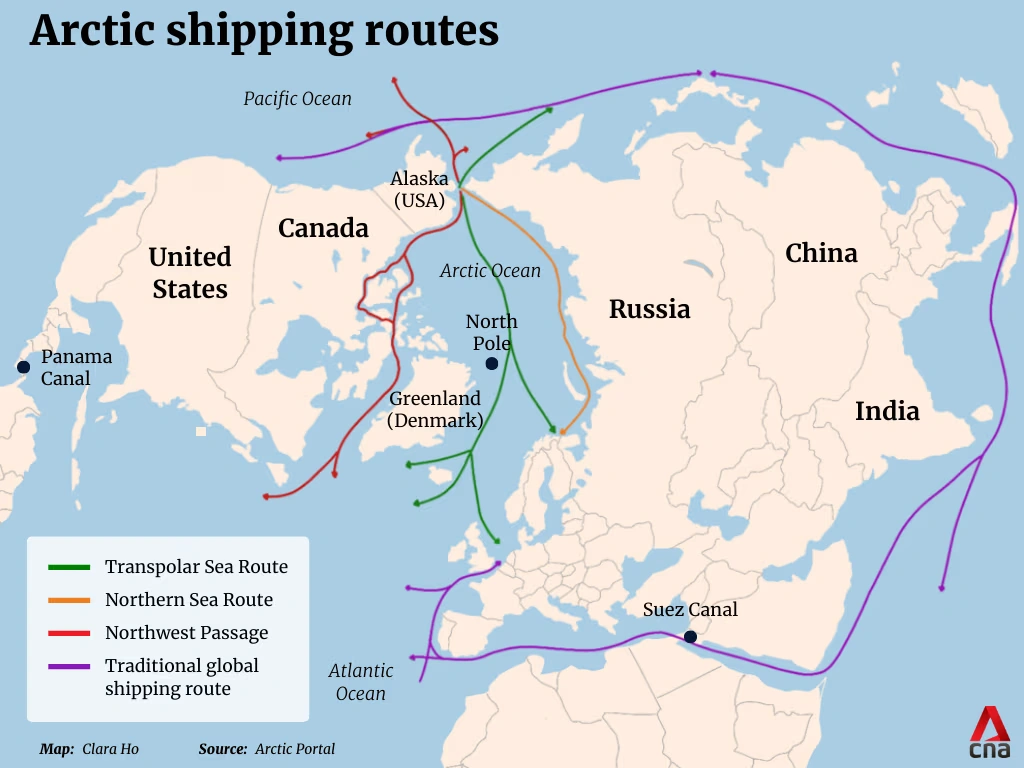
Shipping routes aren’t just about commerce; they’re about influence. Whoever helps shape access to ports, infrastructure, and maritime rules in the Arctic could end up with outsized leverage over future trade flows.
Greenland’s position near key Arctic entry points makes it a natural player in that equation. Control doesn’t necessarily mean owning ships or ports outright; it can also mean setting standards, monitoring traffic, and having a say in who operates where.
Over the long term, that kind of influence can translate into maritime dominance or at least a strong seat at the table.
Why Did This Raise Red Flags? What exactly was China interested in doing in Greenland?
Over the years, Chinese firms explored investments in airports, mining operations, and telecommunications infrastructure. On the surface, these looked like normal commercial projects.
But from Washington’s perspective, infrastructure isn’t neutral. Airports can have military value. Telecom networks can raise data and surveillance concerns.
And mining projects can translate into long-term strategic dependency. That combination made U.S. officials uneasy, especially given China’s track record of blending economic influence with political leverage.
The result was a quiet but firm pushback, with the U.S. stepping in diplomatically and financially to discourage some of those projects from moving forward.
Why Block Instead of React? Viewed through an “America First” lens, this approach makes a certain kind of sense. Rather than waiting for China to establish a foothold and dealing with it later, the idea is to block potential influence early, even if the threat isn’t immediate or obvious.
That mindset helps explain the unusually blunt rhetoric around Greenland. Instead of subtle diplomacy, Trump tended to frame the issue in transactional, almost real-estate terms, but the underlying logic was still about competition. Keep rivals out now, and you don’t have to push them out later.
Whether that strategy is effective or counterproductive is debatable. But in the context of U.S.–China rivalry, Greenland starts to look less like a side note and more like a pressure point Washington doesn’t want Beijing anywhere near.
It’s tempting to frame this as a Trump-only idea, but the logic behind it stretches further back and likely further forward. A useful comparison is the U.S. purchase of Alaska in 1867, which was mocked at the time as “Seward’s Folly” and later turned out to be a massive strategic win.
Greenland fits a similar pattern. Its value isn’t necessarily immediate or obvious, but in a world shaped by Arctic access, space defense, critical minerals, and great-power competition, it starts to look like a long-term asset rather than a short-term gamble. Even if the messaging was uniquely Trump-style, the underlying interest isn’t limited to one presidency.
What makes Greenland stand out is how many strategic lanes it touches at once: “it checks so many boxes”. Militarily, it supports missile defense and Arctic monitoring.
Economically, it offers access, or at least future access, to critical resources and trade routes. Diplomatically, deeper involvement strengthens U.S. influence in the Arctic at a time when that region is becoming more contested.
Very few places offer that kind of overlap. Greenland sits at the intersection of security, economics, and global influence. Seen that way, the idea isn’t just about acquiring territory. It’s about positioning for a future that’s still taking shape and making sure the U.S. isn’t left reacting after the rules of the game have already changed.
The biggest obstacle was simple: Greenland isn’t for sale. It’s a self-governing territory within the Kingdom of Denmark, with its own parliament and a strong sense of national identity. Any suggestion that it could be “bought” immediately ran into questions of sovereignty and self-rule.
Politically, the idea landed badly in both Denmark and Greenland. Leaders across the spectrum pushed back hard, not just because of the proposal itself, but because it felt dismissive of Greenlanders’ right to decide their own future. What might have been framed as strategic cooperation instead came across as transactional and that triggered instant backlash.
Things escalated quickly. After Denmark publicly rejected the idea, Trump canceled a planned state visit, which turned an already awkward situation into a visible diplomatic rift. Allies were caught off guard, and the episode became a global headline, often framed as an example of strained U.S.–European relations.
International reactions ranged from disbelief to outright criticism. Even countries that understood the strategic interest found the approach unusual, if not counterproductive.
In the end, the controversy overshadowed the underlying geopolitical discussion and made any serious negotiation politically impossible.
That’s the irony of it all: while Greenland raises legitimate long-term strategic questions, the way the idea was presented ensured it was never going to move beyond talk.