Follow Us:
Follow Us:

It’s easy to think of wars as being won by better weapons, stronger armies, or faster jets. But beneath the firepower lies something far less visible—and arguably just as decisive, “military doctrine”.
At its core, military doctrine is more like the brain behind the battlefield—the guiding framework that tells armed forces how to fight, when to engage, and what kind of war they’re even preparing for. And yet, for something so crucial, doctrine can be frustratingly hard to pin down. Is it a strategy? A philosophy? A political tool? The answer isn’t always clear—and that’s precisely why it matters.
In this analysis, we’ll unpack what military doctrine really is, how it evolves, and why countries like the U.S., Russia, and China approach it so differently.
Ask ten people to define military doctrine, and you might get ten different answers. Some may say it’s a playbook, others might call it a mindset. But broadly speaking, military doctrine can be defined as a formalized set of principles or guidelines that shape how a military plans and conducts operations. It doesn’t prescribe every move on the battlefield—but it does provide the conceptual foundation for how a military thinks it should fight.
The term itself traces back to the Latin doctrina, meaning teaching or instruction. Historically, doctrine was often implicit—passed down through tradition, experience, or military culture. But in the modern era, especially since the 20th century, doctrines have become increasingly codified into official documents and manuals. NATO, for example, regularly publishes joint military doctrines that are intended to align the thinking of member states.
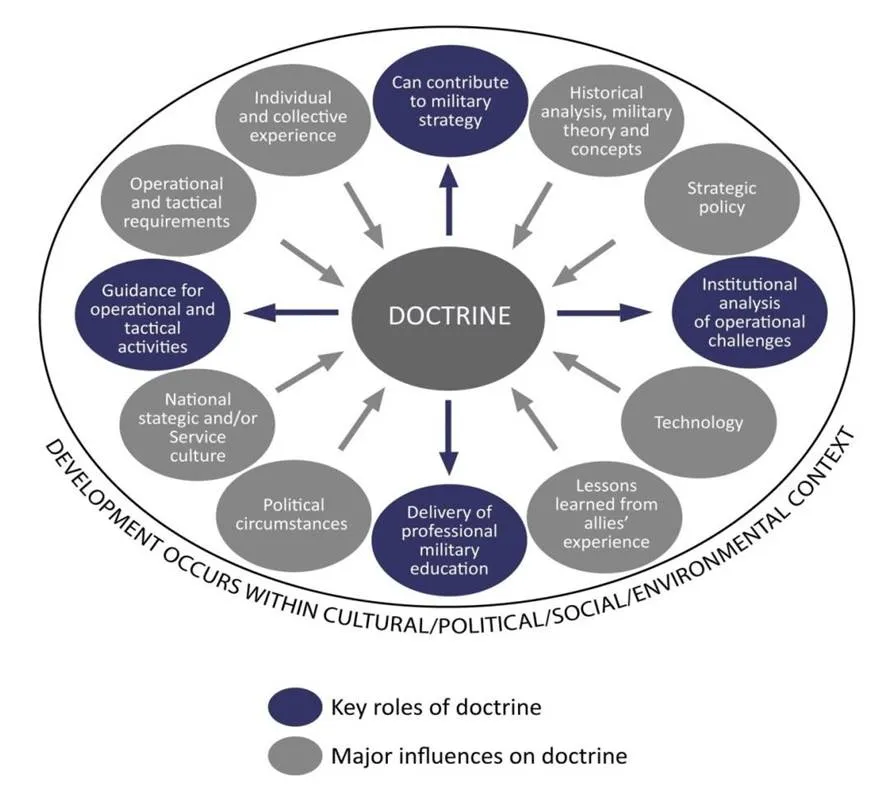
Now, it’s worth pausing to clarify what doctrine is not. People often confuse strategy, tactics, and doctrine—and while they’re closely related, they serve different roles in the hierarchy of military thinking:
This distinction matters because military doctrine influences everything from how forces are trained to how technologies are developed and deployed. For instance, a doctrine focused on rapid maneuver—like the U.S.’s AirLand Battle during the Cold War—will lead to different procurement and training priorities than one centered on attrition or asymmetric warfare.
And while doctrine isn’t a guarantee of success, it can shape outcomes in profound ways. A well-crafted doctrine can unify a military’s actions under a coherent vision, while a rigid or outdated one can lead to disaster. Consider how French doctrine failed to adapt before WWII, relying on static defenses like the Maginot Line, while German doctrine emphasized fast, mobile warfare—Blitzkrieg.
Of course, no doctrine is timeless. What worked in one era may not work in another. That’s why understanding the evolution of military doctrine is so essential—especially as we enter an age of modern warfare doctrine that must contend with cyber threats, space assets, and autonomous systems.
So when we talk about military doctrine, we’re really talking about the intellectual scaffolding of a nation’s military power. It’s not just theory. It shapes how wars are imagined, prepared for, and ultimately fought.
One of the most important roles of military doctrine is that it provides strategic guidance. Not in the same way a grand military strategy might outline political goals, but more as a framework that helps military planners think through how to achieve those goals with the tools available. Doctrine helps answer the big operational questions: Should we prioritize mobility or firepower? Is the goal to deter, to overwhelm, or to stabilize? In this sense, doctrine might be seen as the institutional “bridge” between political intent and tactical action.
Doctrine also serves a crucial role in ensuring interoperability—especially among allied forces. NATO is a prime example here. While individual nations within the alliance maintain their own military doctrines, NATO’s joint doctrine provides a common baseline. This helps ensure that when U.S., French, Polish, or German troops deploy together, they’re not just using compatible equipment—but operating under similar assumptions, procedures, and command structures. Without doctrinal alignment, even the best-equipped coalition could stumble over miscommunication and inconsistent practices.

Another key function—often overlooked—is how doctrine shapes military training and operations. When a doctrine prioritizes certain capabilities (like precision strike, electronic warfare, or counterinsurgency), training programs will inevitably follow suit. Troops aren’t just trained to fight—they’re trained to fight in the way their doctrine expects future wars will unfold. A doctrine emphasizing decentralized command, for instance, will produce different leadership styles and unit autonomy than one focused on strict top-down control.
It’s also worth noting that doctrine plays a somewhat stabilizing role within the defense establishment. In a world of rapidly evolving threats and technologies, doctrine can offer continuity. It allows militaries to coordinate across services—land, air, sea, cyber—while still adapting to change. That said, there’s a risk here: when doctrine becomes too rigid or slow to adapt, it can actually hinder innovation. This is where modern warfare doctrine must remain flexible—ready to evolve in response to emerging domains like cyber conflict or space-based warfare.
Not all wars are fought the same way—and not all militaries prepare to fight the same kind of war. That’s why there’s no single, universal doctrine. Instead, different types of military doctrine reflect different strategic realities, geopolitical conditions, and national priorities. Some nations prepare to strike first, others to hold the line, and some rely on indirect approaches when conventional war isn’t an option.
Let’s explore a few of the key doctrinal types—and when, or why, a state might lean toward one over the other.
An offensive military doctrine is centered on the idea of taking the initiative—shaping the battlefield through preemptive or aggressive action. Countries adopting this approach often believe that seizing the initiative is critical to achieving victory, particularly in the early phases of conflict. Germany’s Blitzkrieg in World War II is perhaps the most iconic example: a fast, mechanized doctrine built around overwhelming the enemy before they could respond.
Modern offensive doctrines—like some interpretations of Russian military doctrine—tend to emphasize rapid mobilization, layered fires, and integration of conventional and hybrid tactics. However, offensive doctrines are resource-intensive, and politically riskier. They often assume high initial success rates—something not always guaranteed in modern warfare.
By contrast, a defensive doctrine focuses on holding territory, delaying advances, and exhausting the enemy. It’s not necessarily passive—defensive strategies can include active counterattacks—but the core assumption is that survival and deterrence matter more than initiative. Countries facing superior adversaries, or operating in geographically constrained environments, often lean on defensive doctrines.
In many cases, conventional doctrines don’t work for weaker or non-state actors. That’s where guerrilla or asymmetric military doctrine comes into play. These doctrines emphasize mobility, surprise, and adaptability over brute strength. Think of insurgent groups, militias, or lightly equipped forces leveraging terrain, local support, and unconventional tactics to frustrate a stronger enemy.
This isn’t limited to non-state actors either—Chinese military doctrine has historically incorporated asymmetric elements, especially in maritime strategy and cyber operations, to counter U.S. technological superiority without engaging in a head-to-head conventional fight.
Then there’s nuclear deterrence doctrine, arguably the most abstract—and dangerous—of them all. Here, the doctrine isn’t about winning a battle, but preventing one from ever happening. The idea is that by maintaining credible nuclear capabilities, a state can deter existential threats.
Different countries adopt different nuclear doctrines. For instance, the U.S. and Russia maintain doctrines that include the possibility of first use under extreme circumstances, while China’s military doctrine generally adheres to a no first use policy. These differences reflect not just strategic preferences, but deeper political and philosophical views on war and survival.
It’s worth noting that most militaries don’t operate under just one doctrine—they often blend elements based on changing threats. A nation might adopt a defensive posture in peacetime, prepare for offensive operations in contingency plans, and still train for asymmetric threats at home or abroad. Similarly, modern doctrines increasingly include cyber and space domains, complicating the neat boundaries between these categories.
Military doctrine hasn’t always been a formal, written concept. In fact, for much of history, it was more instinct than instruction—passed from generals to subordinates, shaped by experience, culture, and the limits of contemporary technology. But over time, especially with the growing complexity of warfare, the doctrine has become a central pillar of modern military planning.
Take the Napoleonic era as a starting point. Napoleon didn’t invent military doctrine, but he arguably revolutionized it. His use of mass conscription, rapid maneuver, and coordinated artillery fire marked a clear departure from the rigid linear tactics of 18th-century warfare. In a way, his campaigns laid the groundwork for what would later be recognized as operational doctrine.
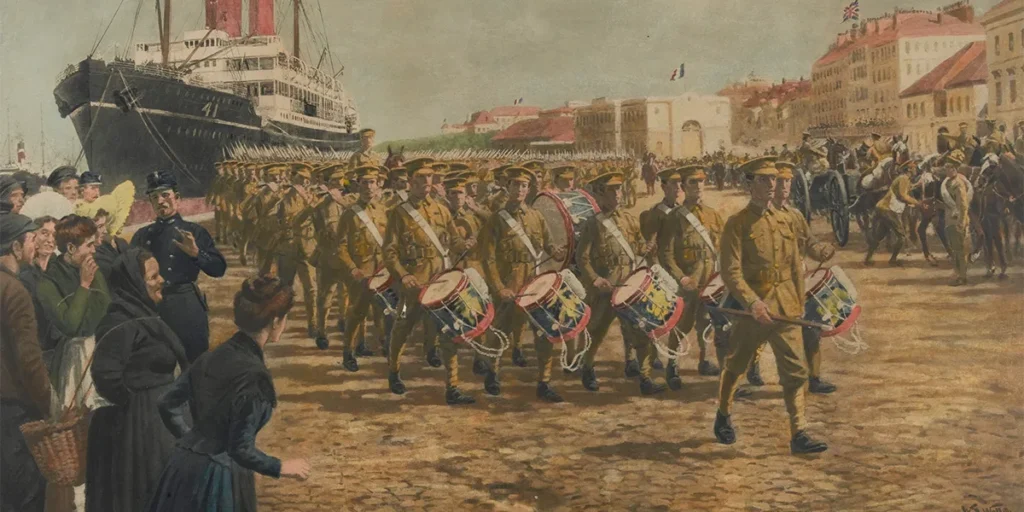
Fast forward a century, and World War I illustrated what happens when doctrine fails to keep up with technology. Generals across Europe clung to outdated offensive doctrines in the face of machine guns, barbed wire, and artillery barrages. The result was Trench warfare, stalemates, and catastrophic casualties. It wasn’t until late in the war—and even more so in WWII—that doctrine began adapting to industrial-age capabilities.
World War II, for example, saw the emergence of more dynamic doctrines like Germany’s Blitzkrieg and the U.S.’s combined arms approach. These innovations were directly tied to advances in mechanization, airpower, and communications. In other words, as technology evolved, so did doctrine—because it had to.
This pattern has held ever since. The Cold War brought nuclear weapons into the picture, forcing both NATO and the Soviet Union to craft strategic doctrines built not around winning wars, but avoiding them through deterrence. Doctrinal thinking in this period also became more institutionalized. Think tanks, military academies, and war colleges emerged as key players in developing and refining doctrine—not just based on theory, but grounded in political reality and combat experience.
By the time the U.S. entered Vietnam, and later Iraq and Afghanistan, the need for adaptable, modern warfare doctrine became clear. Traditional doctrines designed for state-on-state conflict struggled against insurgencies and asymmetric threats. This prompted a doctrinal shift—toward counterinsurgency (COIN), small-unit tactics, and hearts-and-minds campaigns. And just as importantly, it highlighted the role of combat experience in updating doctrine. Doctrines today are rarely static; they’re revised, critiqued, and rewritten based on what actually happens on the ground.
For example, after early setbacks in Iraq, the U.S. Army issued a revised Field Manual 3-24, emphasizing a population-centric approach to counterinsurgency. That change wasn’t just academic—it directly influenced how soldiers were trained, how missions were planned, and how units interacted with local populations.
In more recent years, the rise of cyber warfare, AI, and space-based systems has pushed doctrine even further. States are increasingly blending conventional, irregular, and informational tactics into what’s often referred to as hybrid warfare. Russia’s use of deniable proxies and information operations in Ukraine, or China’s focus on grey-zone tactics in the South China Sea, suggest that doctrine is once again evolving—perhaps faster than ever before.
The doctrine often begins in war colleges, defense universities, and military academies. These institutions function as intellectual engines for military thinking. They study past campaigns, dissect strategic failures, and simulate future threats. Their job is to ask What kind of war are we preparing for? Are we even thinking about the right kind of enemy?
Then come the think tanks—places like RAND, the Center for Strategic and International Studies (CSIS), or Russia’s Center for Military-Strategic Research. These institutions often operate at the intersection of academia, government, and the military. Their role is to shape the intellectual climate in which doctrine is formed. Through policy papers, wargames, and scenario analysis, they help generate new ideas—some of which eventually find their way into official military doctrine.
But perhaps the most powerful influence on doctrine is also the most painful: combat experience. There’s an old military saying: no plan survives contact with the enemy. And the same might be said for doctrine. No matter how well-designed a doctrine may be in theory, the battlefield always has a way of exposing its blind spots.
In some cases, militaries may know that a doctrine is outdated—but struggle to replace it because doing so would upend long-held traditions or require massive retraining and restructuring. This is why doctrine tends to evolve incrementally, often shaped by “lessons learned” reports, post-operation reviews, and internal debates rather than sweeping overhauls.
And while military doctrine is ultimately formalized in official manuals and documents, its development is an ongoing conversation—a tug-of-war between historical precedent, strategic forecasting, political reality, and real-world combat.
How do global powers think about war differently?
The United States, for instance, has long relied on Joint Doctrine, which emphasizes coordination across air, land, sea, space, and cyber forces. One of the most influential concepts was the AirLand Battle Doctrine, developed during the Cold War. It focused on integrated operations to strike deep behind enemy lines, particularly against Soviet forces in Europe.
While the U.S. has since moved toward multi-domain operations, the emphasis on rapid, networked warfare remains a core tenet of modern U.S. military doctrine. That said, there appears to be an increasing shift toward flexibility in contested environments—where U.S. forces may not always enjoy air superiority or logistical dominance.
Russia, by contrast, traditionally emphasized Deep Battle Doctrine, a Soviet-era concept designed to break through enemy defenses at multiple levels simultaneously. In recent years, this has evolved into a more fluid, hybrid warfare doctrine, blending conventional force with cyber attacks, disinformation, and proxy forces—as seen in Ukraine.
Russian doctrine often assumes conflict will involve both military and non-military tools, including psychological and economic dimensions. While critics argue that hybrid methods may not replace traditional force, they are increasingly seen as shaping the battlespace before open conflict begins.
China’s military doctrine, meanwhile, is rooted in the principle of Active Defense—a concept that appears defensive in name but supports offensive action when necessary. China has also embraced informatized warfare, focusing on electronic warfare, cyber operations, and space dominance. This reflects a growing belief in winning wars through control of information rather than just territory.
More recently, Chinese analysts have spoken about intelligentized warfare, potentially referring to the incorporation of artificial intelligence and autonomous systems—although how far this has developed remains somewhat uncertain.
Finally, NATO’s military doctrine is grounded in collective defense, enshrined in Article 5 of the alliance’s founding treaty. While individual member states maintain national doctrines, NATO doctrine serves to unify operations—ensuring interoperability among allies and forming a shared response to common threats, whether conventional or hybrid.
Joint exercises, shared command structures, and coordinated force posture all contribute to doctrinal cohesion, though alignment across 30+ member nations naturally requires ongoing adaptation and negotiation.