Follow Us:
Follow Us:

A fighter jet streaking across the sky at nearly three times the speed of sound is one of those sights that makes you stop whatever you’re doing. You don’t just watch it, you feel it.
The roar arrives a heartbeat later, and for a moment, it seems as if the aircraft has outrun its own noise. That’s exactly the kind of engineering marvel we’re talking about in this guide to the fastest fighter jets ever built.
For much of the 20th century, speed was the ultimate prize in military aviation.
During the Cold War, the United States and the Soviet Union competed to build aircraft that could intercept enemy bombers, dodge missiles, and protect their airspace at astonishing velocities. Every extra fraction of a Mach number mattered. A faster jet could climb quicker, reach a target sooner, and sometimes escape danger altogether.
Here’s where things get interesting. Many people assume the newest fighters must also be the fastest. Not true.
Modern aircraft such as stealth fighters are designed around a different philosophy, balancing speed with radar evasion, advanced sensors, fuel efficiency, and electronic warfare capabilities. Raw velocity isn’t the only measure of combat effectiveness anymore.
In this post, we’ll rank the top five fastest fighter jets in the world using verified top-speed data and operational history.
We’ll separate genuine combat aircraft from experimental speed machines, compare their performance, and explore the technology behind these incredible designs. You might even discover that a decades-old interceptor still holds a speed record that today’s cutting-edge fighters haven’t bothered to chase, and there’s a fascinating reason why.
Before diving into the list, it’s worth answering a simple question: what actually makes a fighter jet “fast”?
You’d think the answer would be obvious, just pick the aircraft with the highest top speed and call it a day. Aviation history, though, has a habit of making simple questions complicated.
For this ranking, we focused on operational fighter and interceptor aircraft that were built for combat missions. That means experimental aircraft, reconnaissance planes, and record-breaking research vehicles didn’t make the cut, no matter how impressive their numbers were.
The famous SR-71 Blackbird, for example, could fly above Mach 3, but it was a strategic reconnaissance aircraft, not a fighter jet designed to engage enemy aircraft.
Our primary ranking factor is verified maximum speed, measured in Mach numbers. One Mach equals the speed of sound, roughly 1,235 kilometers per hour (767 mph) at sea level, though it changes with altitude and temperature. When aircraft share similar speeds, operational capability and historical significance help separate them.
Here’s the framework we used:
| Ranking Factor | Why It Matters |
| Verified top speed | Measures peak performance |
| Combat role | Must be a fighter or interceptor |
| Operational service | Aircraft entered active duty |
| Production history | More than a one-off prototype |
| Historical impact | Influence on military aviation |
There’s another wrinkle. Many of these jets weren’t designed to dogfight like Hollywood would have you believe. Some were built to launch into the sky, race toward incoming bombers, fire missiles, and head home. Their incredible speed was less about showing off and more about solving a very real military problem.
With the ground rules set, it’s time to meet the aircraft that pushed fighter-jet speed to its absolute limits.
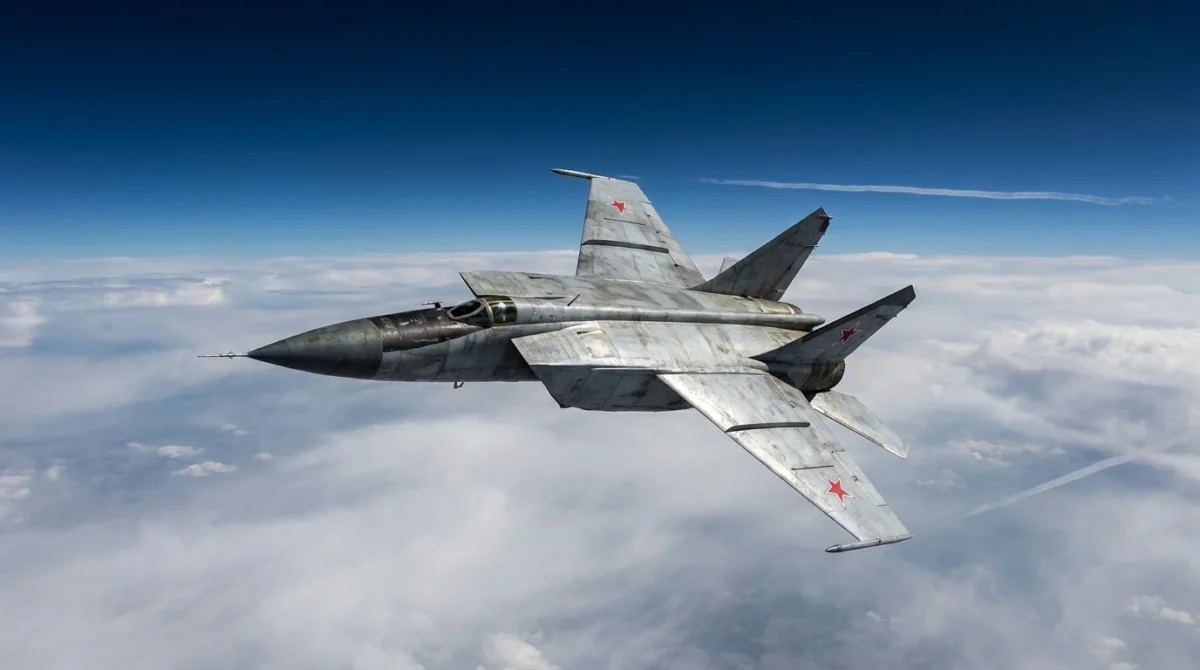
If there were a hall of fame for the fastest fighter jets, the Soviet-built MiG-25 Foxbat would have a front-row seat. Introduced in the late 1960s, this massive interceptor wasn’t created to win air shows or perform flashy aerobatics. Its job was brutally simple: climb fast, fly incredibly high, and catch anything that threatened Soviet airspace before it could escape.
At first, the West didn’t know exactly what the MiG-25 could do, and that uncertainty caused plenty of sleepless nights. Intelligence reports suggested it might be a highly maneuverable super-fighter.
When a Soviet pilot defected to Japan in 1976 with his MiG-25, analysts discovered the truth. It wasn’t a nimble dogfighter at all. Instead, it was a missile-carrying speed machine built around two enormous turbojet engines.
The Foxbat’s officially quoted top speed is Mach 2.83, or about 3,000 km/h (1,864 mph). Some pilots reportedly pushed the aircraft beyond Mach 3, but doing so risked permanent engine damage. In military terms, that’s a bit like driving your car flat out until the engine starts smoking, and then keeping your foot down.
| Specification | MiG-25 Foxbat |
| Country | Soviet Union |
| First Flight | 1964 |
| Top Speed | Mach 2.83 |
| Maximum Altitude | 24,000 m (78,740 ft) |
| Primary Role | High-speed interceptor |
Perhaps the MiG-25’s greatest achievement wasn’t its speed but its psychological impact. NATO spent years developing aircraft and tactics to counter it, influencing fighter design on both sides of the Cold War.
Even today, more than half a century after its first flight, the Foxbat remains one of the fastest operational fighter aircraft ever built, a record that modern stealth jets haven’t tried to beat.
If the MiG-25 Foxbat was a sprinter, the MiG-31 Foxhound is more like a marathon runner carrying a toolbox full of high-tech gadgets.
Built as the Foxbat’s successor, this Soviet interceptor took the blistering speed of its predecessor and added better radar, longer range, and the ability to hunt multiple targets at once. Not bad for an aircraft that first entered service in the early 1980s.
At a glance, the MiG-31 looks similar to the MiG-25, but the differences run deep. Engineers redesigned the airframe, strengthened the structure, and equipped it with more efficient D-30F6 turbofan engines.
The result was an interceptor capable of reaching Mach 2.83, roughly 3,000 km/h (1,864 mph), while carrying a heavier weapons load and more advanced electronics.
What really set the Foxhound apart wasn’t just its speed, it was how it used that speed.
During the Cold War, the Soviet Union faced the challenge of defending enormous stretches of territory. A fast interceptor could launch, cover hundreds of kilometers in a short time, and engage enemy bombers or reconnaissance aircraft long before they reached critical targets.
| Specification | MiG-31 Foxhound |
| Country | Soviet Union/Russia |
| First Flight | 1975 |
| Top Speed | Mach 2.83 |
| Crew | 2 |
| Primary Role | Long-range interceptor |
Here’s an interesting detail that often gets overlooked. The MiG-31 was among the world’s first fighter aircraft capable of tracking multiple airborne targets simultaneously while coordinating attacks with other interceptors. Think of it as a flying command center that just happened to travel at nearly three times the speed of sound.
More than forty years after entering service, upgraded versions of the MiG-31 are still flying. That longevity says something remarkable. Many military aircraft become outdated because technology moves on.
The Foxhound, however, combined extreme speed with practical combat capability, creating a design so effective that few aircraft have truly replaced it. Among the fastest fighter jets ever built, it’s one of the rare legends still earning its keep.
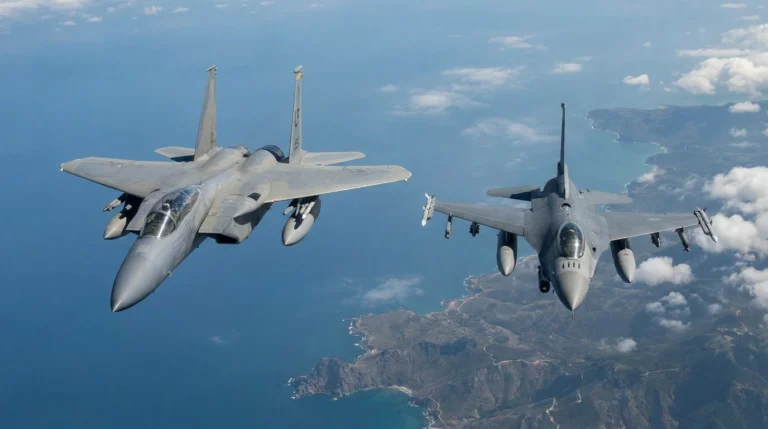
The F-15 Eagle proves that being one of the fastest fighter jets in history means very little if you can’t win a fight. Luckily for the Eagle, it does both. Since entering service in the 1970s, this American air superiority fighter has built a reputation that’s almost mythical in military aviation, a combat record of more than 100 aerial victories with no confirmed losses in air-to-air combat.
That statistic alone would make the F-15 famous. Add a top speed of Mach 2.5, or roughly 3,017 km/h (1,875 mph) at altitude, and you’ve got one of the most successful fighter aircraft ever produced.
The Eagle was born during the Cold War after the United States realized it needed a fighter that could dominate the skies against advanced Soviet aircraft.
Engineers gave it two powerful Pratt & Whitney engines, a lightweight yet durable airframe, and large wings that provided exceptional maneuverability. The goal wasn’t simply to build a fast aircraft. It was to create a machine that could climb rapidly, accelerate hard, and outfight almost anything it encountered.
| Specification | F-15 Eagle |
| Country | United States |
| First Flight | 1972 |
| Top Speed | Mach 2.5 |
| Crew | 1 or 2 |
| Primary Role | Air superiority fighter |
One of the Eagle’s most impressive features is its acceleration. Pilots often describe the aircraft as having almost endless power.
In fact, the F-15 can climb so quickly that it once reached an altitude of over 30,000 meters during a record-setting flight. That’s higher than many commercial airliners could dream of flying.
Yet speed is only part of the story.
The F-15 balanced raw performance with radar technology, heavy missile loads, and incredible agility. Unlike some high-speed interceptors that relied mainly on straight-line speed, the Eagle could chase, turn, and fight.
Decades after its first flight, upgraded versions remain in active service, proving that sometimes the best fighter jet isn’t the absolute fastest, it’s the one that combines speed with skill.
Some fighter jets are built to run. Others are built to fight.
The Sukhoi Su-27 Flanker somehow managed to do both, and that’s a big reason it remains one of the most respected combat aircraft ever designed.
While it may not match the outright velocity of the MiG-25 or MiG-31, its combination of speed, agility, and range changed the balance of air power during the final years of the Cold War.
The Soviet Union developed the Su-27 in response to the American F-15 Eagle. Military planners wanted an aircraft that could defend vast airspace while matching, or even surpassing, Western fighters in performance. The result was a sleek twin-engine aircraft capable of reaching Mach 2.35, equivalent to around 2,500 km/h (1,550 mph).
On paper, those numbers are impressive. In the air, they become even more remarkable.
The Su-27 wasn’t designed to rely solely on speed. Its large wings and aerodynamic layout gave pilots exceptional control at both high and low speeds, allowing the aircraft to perform dramatic maneuvers that became crowd favorites at international air shows.
| Specification | Su-27 Flanker |
| Country | Soviet Union/Russia |
| First Flight | 1977 |
| Top Speed | Mach 2.35 |
| Crew | 1 |
| Primary Role | Air superiority fighter |
One maneuver in particular turned the Flanker into an aviation legend.
The “Pugachev’s Cobra” involves the aircraft suddenly raising its nose to an extremely steep angle before leveling out again. It looks almost impossible, like a bird briefly forgetting the rules of flight. While the maneuver’s combat value is debated, it showcased the Su-27’s extraordinary aerodynamic capabilities.
The Flanker’s influence extends far beyond its own service career. It became the foundation for an entire family of advanced fighters, including the Su-30, Su-33, Su-35, and several export variants flown around the world. Its blend of high speed, long range, and exceptional maneuverability ensures that the Su-27 isn’t just one of the fastest fighter jets ever built, it’s one of the most influential.
The MiG-23 Flogger rarely gets the spotlight when people talk about the fastest fighter jets. That’s a little unfair.
While aircraft like the MiG-25 and F-15 became aviation celebrities, the MiG-23 quietly built an impressive career as one of the most widely used supersonic fighters of the Cold War. It was fast, adaptable, and, perhaps most importantly, designed to be practical.
Introduced in the early 1970s, the MiG-23 was the Soviet Union’s answer to a changing battlefield. Earlier fighters offered excellent speed but often struggled with short runways or complex missions.
Engineers tackled that problem with a clever feature: variable-sweep wings. At low speeds, the wings could spread out to improve stability during takeoff and landing.
At high speeds, they swept backward, reducing drag and helping the aircraft reach an impressive Mach 2.35, or roughly 2,500 km/h (1,550 mph).
| Specification | MiG-23 Flogger |
| Country | Soviet Union |
| First Flight | 1967 |
| Top Speed | Mach 2.35 |
| Crew | 1 |
| Primary Role | Fighter and interceptor |
The variable-wing design made the MiG-23 look almost alive. On the ground, its wings stretched outward like a seabird resting by the shore. In flight, they tucked back, transforming the aircraft into a sleek high-speed missile with a cockpit.
What made the Flogger particularly significant wasn’t just its speed, it was its reach. More than 5,000 MiG-23s were built, and the aircraft served with dozens of air forces across Europe, Asia, the Middle East, and Africa. It participated in numerous regional conflicts, proving that high performance didn’t have to come with an impossibly high price tag.
The MiG-23 may not hold the absolute speed record, and it doesn’t have the glamorous reputation of some rivals.
Yet its blend of Mach 2+ performance, innovative engineering, and global service history earns it a well-deserved place among the world’s fastest fighter aircraft. Sometimes the quiet achievers leave the biggest footprint.
After looking at these incredible aircraft one by one, a pattern starts to emerge.
The fastest fighter jets weren’t all built with the same mission in mind. Some were designed to chase enemy bombers across vast distances. Others were meant to dominate dogfights or defend national airspace. Speed was the common thread, but the stories behind those numbers are surprisingly different.
Take the MiG-25 and MiG-31. Their nearly identical top speeds of Mach 2.83 weren’t accidents. Soviet engineers needed interceptors that could cover enormous stretches of territory in a hurry.
The F-15 Eagle took a different path, sacrificing a little top-end speed to become one of the most successful air superiority fighters ever built. Meanwhile, the Su-27 and MiG-23 proved that agility and versatility could go hand in hand with blistering performance.
Here’s how the five aircraft stack up.
| Rank | Fighter Jet | Country | Top Speed | Primary Role |
| 1 | MiG-25 Foxbat | Soviet Union | Mach 2.83 | Interceptor |
| 2 | MiG-31 Foxhound | Soviet Union/Russia | Mach 2.83 | Long-range interceptor |
| 3 | F-15 Eagle | United States | Mach 2.5 | Air superiority fighter |
| 4 | Su-27 Flanker | Soviet Union/Russia | Mach 2.35 | Air superiority fighter |
| 5 | MiG-23 Flogger | Soviet Union | Mach 2.35 | Fighter/interceptor |
A few interesting facts jump out from the table.
First, Soviet designers dominate the speed race, claiming four of the five spots. During the Cold War, defending massive borders against high-altitude threats made extreme speed a military necessity.
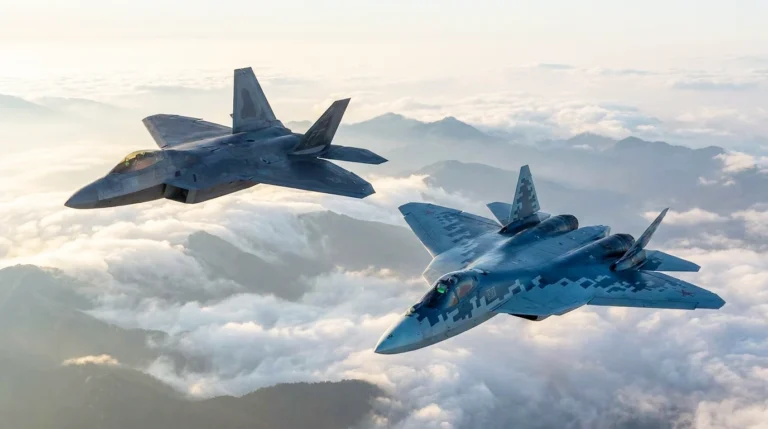
Second, newer doesn’t always mean faster. The F-22 Raptor and F-35 Lightning II, despite being among the world’s most advanced fighters, don’t crack this top five because modern combat priorities have shifted.
Third, there’s a trade-off hidden behind every Mach number. Flying faster requires more fuel, creates intense heat, and puts enormous stress on engines and airframes.
At some point, engineers realized that better radar, stealth technology, and long-range missiles could offer a greater battlefield advantage than squeezing out another few hundred kilometers per hour.
Looking at these aircraft together, one thing becomes clear. The quest for speed produced some of the most extraordinary fighter jets ever built, but it also taught military planners that in air combat, being the fastest is only part of the equation.