Follow Us:
Follow Us:

The Vought F-8 Crusader tends to resurface every so often in aviation conversations, usually when people start revisiting the era when air combat was still up close, fast, and a little unforgiving.
Even today, the jet pops back into the spotlight through museum restorations, anniversary discussions around Cold War naval aviation, and renewed interest in how early supersonic fighters shaped modern air combat thinking.
First flown in the mid-1950s, the F-8 fighter jet was built for a Navy that still expected dogfights to be decided visually, not from beyond the horizon. It pushed past Mach 1, roughly 1,600 km/h (1,000 mph), while operating from aircraft carriers, which was no small feat at the time.
Instead of relying primarily on missiles, the Crusader doubled down on internal cannons, earning its long-standing reputation as the last true gunfighter.
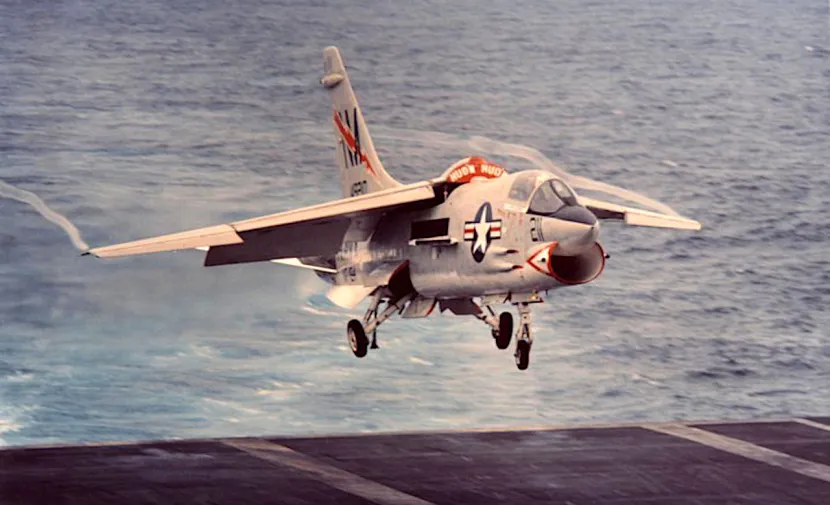
What makes the F-8 especially interesting, though, is its unconventional design choices (like the variable-incidence wing and a cockpit that demanded real pilot skill), hint at a transitional moment in fighter development, when engineers were still figuring out what jet combat at sea should look like.
In hindsight, some of those ideas worked brilliantly, while others caused problems that would eventually push the aircraft toward retirement.
Even so, decades after it left frontline service, the F-8 Crusader still feels relevant because it represents the point where air combat began shifting from guns to guided weapons, from instinct to systems, and from close-in fights to long-range engagements.
The F-8 Crusader fighter jet was a carrier-based supersonic fighter built for the U.S. Navy at a time when air combat was still expected to happen up close.
Introduced in the late 1950s, the F-8 was designed to be fast, agile, and tough enough to operate from aircraft carriers. It served primarily as a fleet air-defense fighter, protecting carrier groups from enemy aircraft, and later saw real combat over Vietnam.

The Navy flew the Crusader the most, but the U.S. Marine Corps also operated it, mainly from land bases, where it handled air defense and limited ground-attack duties.
In practice, it filled that in-between role, fast interceptor first, dogfighter when needed, right before missiles and radar-centric combat fully took over naval aviation.
The nickname mostly comes down to one deliberate design choice.
Unlike later fighters that leaned heavily on missiles, the F-8 Crusader was built around its guns. It carried four internal 20 mm cannons built directly into the fuselage, and those weren’t treated as a backup option. They were central to how the aircraft was expected to fight.
At the time, that made sense; early air-to-air missiles were still unreliable, and close-range engagements were very much expected.
In Vietnam, that philosophy paid off. Crusader pilots scored most of their aerial victories using cannon fire rather than missiles, which was already becoming unusual by the 1960s.
Fighters that followed, like the F-4 Phantom II and later generations, shifted hard toward missile-focused combat, with guns either added later or treated as secondary.
The Crusader sits right at that turning point. It was the last U.S. fighter designed with the assumption that guns would decide air combat. That’s what really cemented its reputation as the last gunfighter in American service.
From a design standpoint, the F-8 Crusader was very much a product of its moment.
The overall airframe philosophy leaned heavily toward speed and climb performance, which is why the jet ended up long, slim, and built around a powerful engine.
The Navy wanted a carrier fighter that could intercept threats quickly, and the Crusader was shaped to do exactly that, even if it meant accepting some complexity along the way.
One of its most distinctive features was the variable-incidence wing. Instead of lowering flaps alone for landing, the entire wing could tilt upward by about 7 degrees. This let the aircraft approach the carrier at slower speeds without forcing the nose too high, so pilots could still see the deck.
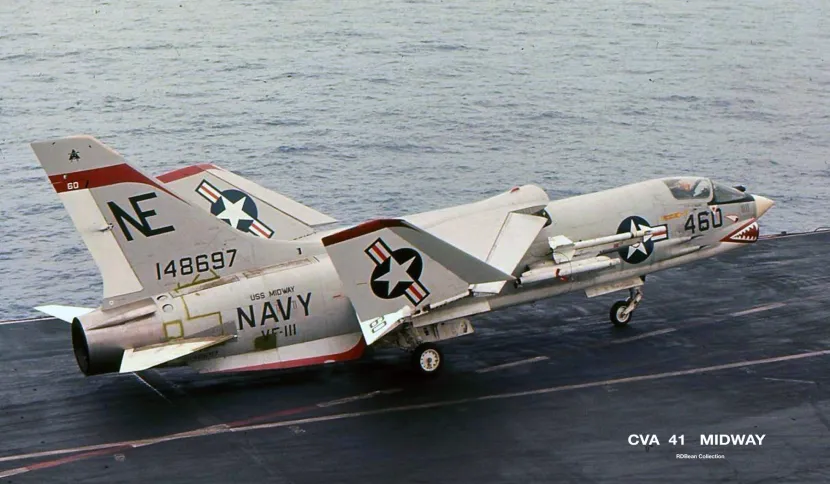
On paper, it was a clever solution and when everything worked, it genuinely helped with carrier landings.
Of course, being carrier-based set tough requirements across the board. The F-8 had to survive hard landings, tight deck space, salty air, and constant maintenance cycles at sea. That pressure shaped almost every part of the aircraft, sometimes in ways that made it impressive, and sometimes in ways that caused trouble.
As capable as it was, the F-8 Crusader definitely had its rough edges.
Early versions suffered from reliability and maintenance issues, partly because the design pushed the limits of what naval aviation could comfortably support at the time. Keeping the jet mission-ready often took more effort than planners initially expected.
Carrier landings were another pain point. The landing gear, especially in early models, could be fragile, and the Crusader had a reputation for being less forgiving on approach compared to later naval fighters. If a pilot came in even slightly off, things could get tense quickly.

Pilot workload was also a real concern. The F-8 demanded constant attention, like managing speed, angle of attack, engine behavior, and that variable-incidence wing all at once.
In high-stress situations, especially at sea, that workload increases safety risks. None of this made the Crusader a bad aircraft, but it did mean it wasn’t an easy one. In many ways, those challenges highlight why later fighters shifted toward designs that reduced pilot strain and favored simpler, more missile-centric combat systems.
The F-8 Crusader cockpit was very much built around the idea that the pilot was the primary sensor and decision-maker.
The layout was fairly traditional for a 1950s fighter, mostly analog gauges, mechanical switches, and a straightforward instrument panel that emphasized engine performance, airspeed, altitude, and weapons status.
Everything important was right in front of the pilot, which helped in fast-moving situations, but it also meant there was a lot to monitor manually.
Visibility was one of the Crusaders’ stronger points. The cockpit sat high on the fuselage, and combined with the variable-incidence wing, it gave pilots a relatively good view during carrier approaches and in air combat.
Ergonomically, though, it could be demanding. Controls were responsive but required constant input, and long missions or high-stress situations could be physically and mentally tiring.
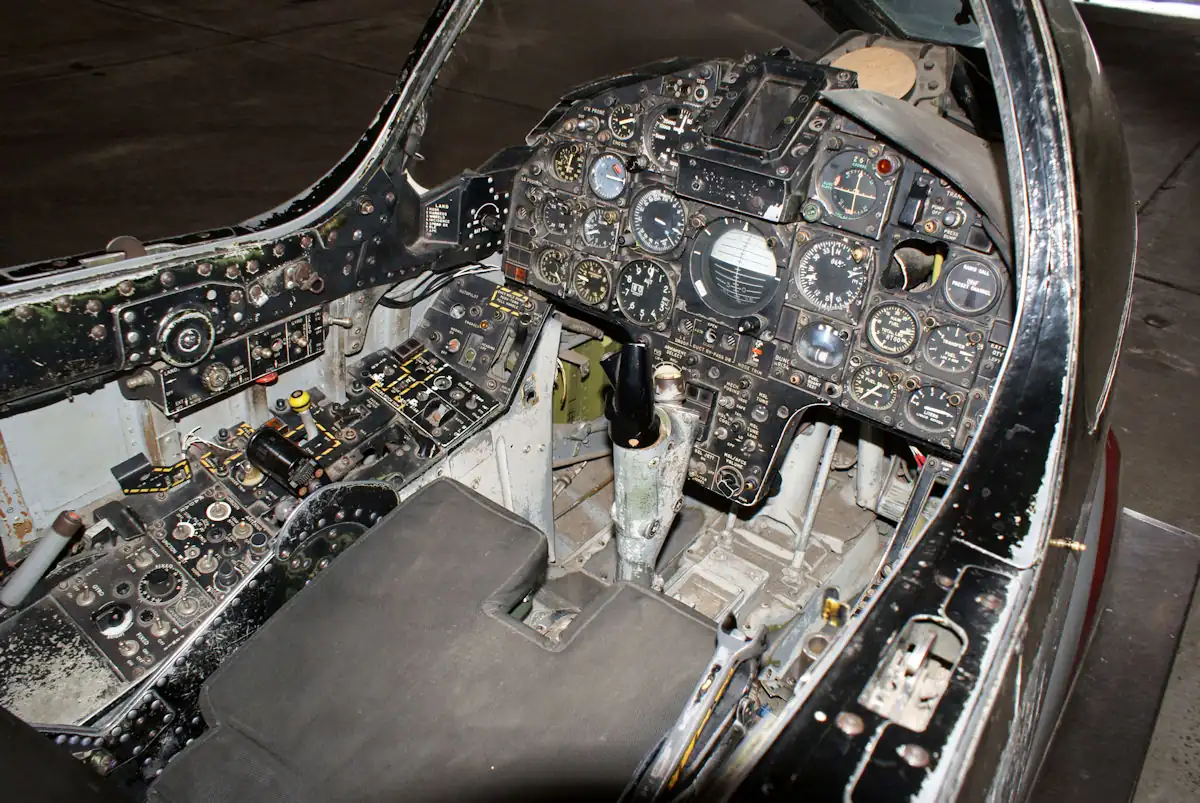
In combat, the cockpit’s biggest impact came down to situational awareness. With no advanced sensors or data fusion, Crusader pilots relied heavily on what they could see and interpret in real time.
In close-in dogfights, that actually worked in the jet’s favor. Clear forward visibility and responsive controls made it easier to track targets visually and line up gunshots.
At the same time, everything was manual. There were no modern avionics to manage workload or prioritize threats, so the pilot had to juggle flying, navigating, and fighting all at once.
For skilled pilots, that hands-on control could be an advantage. For others, especially in chaotic combat environments, it added pressure and fatigue.
So while the F-8 cockpit supported classic dogfighting well, it also highlighted why later fighters moved toward systems designed to reduce pilot strain and improve awareness beyond the visual range.
At its peak, the F-8 Crusader’s top speed sat around Mach 1.8, roughly 1,225 mph (1,970 km/h) at altitude. That made it seriously quick for a carrier-based fighter of its era.
Earlier variants were a bit slower, while later models, especially those with improved engines and aerodynamics, squeezed out slightly better performance.
Even so, the Crusader was never just about raw speed; it was built to climb fast and intercept threats quickly, which mattered just as much in naval operations.

Against the MiG-17 Fresco, the Crusader had a clear speed advantage. The MiG-17 topped out around Mach 0.9–1.0, or about 715 mph (1,150 km/h), so the F-8 could usually dictate the fight in terms of engagement and disengagement.
The comparison with the MiG-21 was more even. Early MiG-21 variants could reach about Mach 2.0, roughly 1,385 mph (2,230 km/h), giving them an edge in straight-line speed.
However, the Crusader often held its own through better low-speed handling and strong gun-based dogfighting performance.
As for the early F-4 Phantom II, the Phantom was faster overall, also capable of around Mach 2.0, and packed more missiles and radar capability. In short, the Crusader was not the fastest jet of its generation, but fast enough, and often better suited for classic dogfights than the missile-heavy fighters that followed.
The F-8 Crusader saw its most serious combat during the Vietnam War, where it was used mainly for air superiority missions. In those engagements, Crusader pilots scored a strong kill ratio, with most victories coming from gun kills rather than missiles, which was already becoming unusual at the time.
While it didn’t see the same volume of combat as some other fighters, the F-8 built a solid reputation as a reliable dogfighter when air-to-air combat actually turned close and personal.
The F-8 Crusader excelled in dogfights mostly because it was built for that exact kind of fight. It had strong maneuverability, especially at the speeds where close-in engagements usually happened. The aircraft could turn tightly and respond quickly, which gave pilots a real edge once a fight went visual.
Another factor that makes the F-8 Crusader excelled in dogfights largely because it made its guns count and because the pilots flying it knew how to use them.
The aircraft’s four internal 20 mm cannons were tightly integrated into the nose, which helped improve gun accuracy compared to external pods or mixed weapon layouts. In close-range fights, that mattered a lot, especially when early missiles proved unreliable.
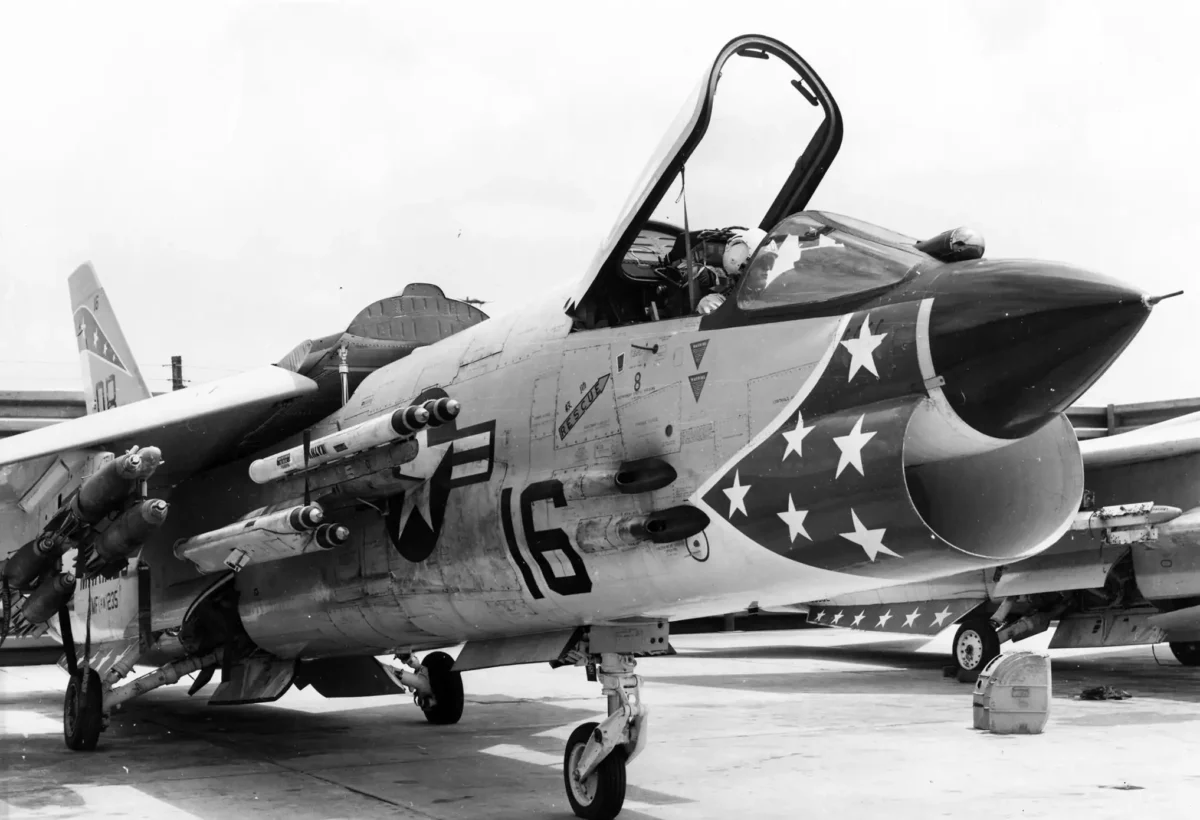
Pilot training played just as big a role. Navy and Marine Corps Crusader pilots were trained with the expectation that engagements would turn visual and dynamic.
Tactics emphasized energy management, positioning, and getting the nose on target quickly rather than relying on electronics or long-range shots. That mindset fit the F-8’s strengths almost perfectly.
At a glance, the F-8 Crusader and A-7 Corsair II may look related, but they were built for very different jobs. The F-8 was a pure fighter, focused on speed, interception, and air-to-air combat.
The A-7, on the other hand, was designed as an attack aircraft, optimized for striking ground targets accurately and bringing a heavy payload back to the carrier. In many ways, the A-7 reflects how Navy priorities shifted during the Vietnam era.
From a design standpoint, the A-7 evolved from lessons learned with the Crusader. It kept some family traits but traded raw speed for better range, improved avionics, and a more forgiving carrier landing profile.

In terms of performance, the F-8 was clearly faster. It could fly at supersonic speeds, while the A-7 was subsonic by design. That speed advantage helped the Crusader in air combat but mattered less for the A-7’s mission set.
The A-7 replaced the F-8 in some squadrons because the Navy no longer needed as many dedicated gunfighters and instead wanted aircraft that could carry more weapons, stay on station longer, and operate more efficiently.
The A-7’s success mostly came down to practicality. It could carry a heavier payload over longer distances, cost less to operate, and place less strain on pilots and maintenance crews.
While the F-8 excelled in fast, high-skill air combat, the A-7 fit better into a Navy that was shifting toward precision strike, multirole efficiency, and lower operational costs.
The F-8 Crusader is no longer in active military service anywhere today.
The U.S. Navy retired it in the mid-1970s, and while a few other countries kept it flying longer, the era of the Crusader has pretty clearly passed. These days, surviving aircraft are mostly found in museums or with collectors, serving more as historical icons than operational fighters.
After the U.S. stepped away, France became the Crusaders’ most notable late operator. The French Navy flew upgraded F-8 variants well into the late 1990s, finally retiring them around 1999, which made France the last country to operate the jet in frontline service.
The Philippines also briefly operated second-hand F-8s acquired from the U.S., though their service life there was shorter and more limited.
Beyond that, the Crusader never saw widespread export use, which helps explain why its story feels tightly linked to U.S. and French naval aviation rather than a long global footprint.
One thing that stands out is the Crusader’s longevity compared to similar fighters from the same era. Many first-generation supersonic jets were retired relatively quickly as missile technology advanced, but the F-8 managed to stay relevant for decades, especially in French service.
That long lifespan suggests the basic design aged better than expected, even as air combat doctrine moved away from classic dogfighting.