Follow Us:
Follow Us:

If tanks had a moment where they stopped being blunt instruments and started behaving like thinking machines, the Leopard 2A8 would be that moment.
At first glance, it’s still unmistakably a main battle tank, low, heavy, unapologetically armored. But spend a little time with what’s under the skin, and you realize this isn’t just another incremental upgrade.
The Leopard 2A8 is Germany’s answer to a battlefield that no longer plays by old rules. Drones hover overhead. Missiles strike from above, not head-on. Data matters as much as steel. And survival depends on seeing the threat before it sees you.
What makes the Leopard 2A8 fascinating isn’t just its firepower or armor thickness; those are expected. It’s how the tank behaves like a node in a network rather than a lone brawler.

Think of it less as a medieval knight and more as a quarterback, constantly scanning, processing, reacting. Sensors feed data. Systems talk to each other. Decisions happen fast, sometimes faster than a human could manage alone.
This tank also signals a shift in mindset. After decades of upgrades to older Leopard platforms, the 2A8 represents something rare: a newly built main battle tank designed specifically for today’s threats, not yesterday’s wars. That alone makes defense analysts sit up a little straighter.
In this post, we’ll unpack what the Leopard 2A8 really brings to the table, how it’s built, why it matters, and what it says about the future of armored warfare.
The Leopard 2A8 isn’t just the next letter-and-number combo in a long-running tank family. It’s something rarer: a deliberate reset.
For decades, the Leopard 2 line evolved the way many successful machines do, by upgrading what already worked. Better optics here. Thicker armor there. New software layered onto old bones. Effective, yes. But eventually, you hit a ceiling. The 2A8 exists because that ceiling arrived.
Unlike earlier variants, the Leopard 2A8 is a new-build platform, not a refurbishment of Cold War-era hulls pulled from storage. That matters more than it sounds.
Designing a tank from scratch, while still respecting the Leopard DNA, allows engineers to rethink internal layouts, digital architecture, power distribution, and protection systems as a unified whole instead of a patchwork.

At its core, the Leopard 2A8 is a response to how modern combat actually unfolds. Missiles don’t politely fly straight anymore. Drones spot targets from above. Artillery fires faster, farther, and smarter. The tank, once king of the battlefield, had to learn humility and adaptability.
Germany’s Bundeswehr frames the 2A8 as the backbone of future heavy brigades, particularly within NATO’s eastern defense posture. That’s not symbolic. It’s practical.
The tank is meant to deploy, communicate, survive, and fight inside a fully networked force where information moves as quickly as steel.
Another quiet shift: sustainability. Maintenance access, modular components, and digital diagnostics are baked in. Crews don’t just drive and shoot; they manage systems, interpret data, and collaborate with other platforms in real time.
In short, the Leopard 2A8 isn’t trying to look revolutionary. It’s trying to function that way, calm, methodical, and very hard to kill.
Let’s talk numbers, but not the dry, brochure kind. The Leopard 2A8’s specifications tell a story about priorities, and those priorities aren’t accidental.
At roughly 67–70 metric tons (exact figures vary by configuration), the Leopard 2A8 is heavy, yes, but deliberately so. Weight here isn’t excess; it’s carefully allocated protection.
Under the hood sits the familiar MTU MB 873 Ka-501 diesel engine, pushing out around 1,500 horsepower. That gives the tank a respectable power-to-weight ratio, allowing road speeds of up to 68 km/h and cross-country mobility that’s better than its mass suggests. Range? About 450 km on roads, more with external fuel support.
| Category | Leopard 2A8 Data |
| Crew | 4 (Commander, Gunner, Loader, Driver) |
| Main Gun | 120 mm Rheinmetall L55A1 smoothbore |
| Engine | MTU MB 873 diesel, ~1,500 hp |
| Top Speed | ~68 km/h (road) |
| Operational Range | ~450 km |
| Weight | ~67–70 tons |
| Protection | Composite armor + Active Protection System |
Firepower remains centered on the 120 mm L55A1 gun, capable of firing modern APFSDS and programmable high-explosive rounds with pinpoint accuracy beyond 4–5 kilometers. The difference isn’t the gun itself—it’s how the Leopard 2A8 uses it. Digital fire control systems shorten engagement time, and stabilized optics mean accurate fire while moving, even over rough terrain.
Then there’s survivability. Composite armor has been refined, but the real leap is layered protection: passive armor working in concert with electronic countermeasures and active defense systems designed to intercept incoming threats before impact.
The takeaway? The Leopard 2A8 isn’t optimized for one metric. It balances firepower, mobility, and protection in a way that reflects how tanks are actually used today, rarely alone, often moving, always hunted.
If older tanks were built to absorb punishment, the Leopard 2A8 is built to avoid it, and that philosophical shift changes everything.
Modern battlefields are saturated with threats that don’t care how thick your frontal armor is. Top-attack missiles dive from above. Loitering munitions circle patiently. Cheap drones cue expensive weapons.
The Leopard 2A8 responds with a layered survivability approach that feels less like medieval plate armor and more like a modern cybersecurity system, multiple defenses, overlapping, always on.

At the base is advanced modular composite armor, refined from earlier Leopard designs but rebalanced for today’s threat vectors. Special attention has been paid to the turret roof and upper hull, areas historically thinner, and now prime targets. Add-on armor packages allow operators to tailor protection depending on mission profile, urban or open terrain.
The headline feature, though, is the integration of the Trophy Active Protection System (APS).
Instead of waiting to be hit, Trophy detects incoming anti-tank guided missiles and rocket-propelled grenades, calculates their trajectory, and physically intercepts them mid-air.
In testing and combat use elsewhere, Trophy has shown interception success rates well above 90% against certain threats, numbers that fundamentally alter crew survival odds.

But survivability isn’t just about armor and countermeasures.
The Leopard 2A8 also focuses on not being seen. Reduced thermal signature management, improved exhaust handling, and better battlefield awareness help crews avoid detection in the first place.
Inside the tank, spall liners, fire suppression systems, and improved ammunition storage further stack the odds in the crew’s favor. It’s not glamorous, but it’s decisive.
In simple terms: the Leopard 2A8 doesn’t assume it can take a hit. It assumes it won’t have to—and that’s a very modern way to stay alive.
Yes, the Leopard 2A8 carries a formidable cannon. But focusing only on caliber misses the point. In modern armored warfare, firepower isn’t about who has the biggest gun, it’s about who can find, decide, and fire first.
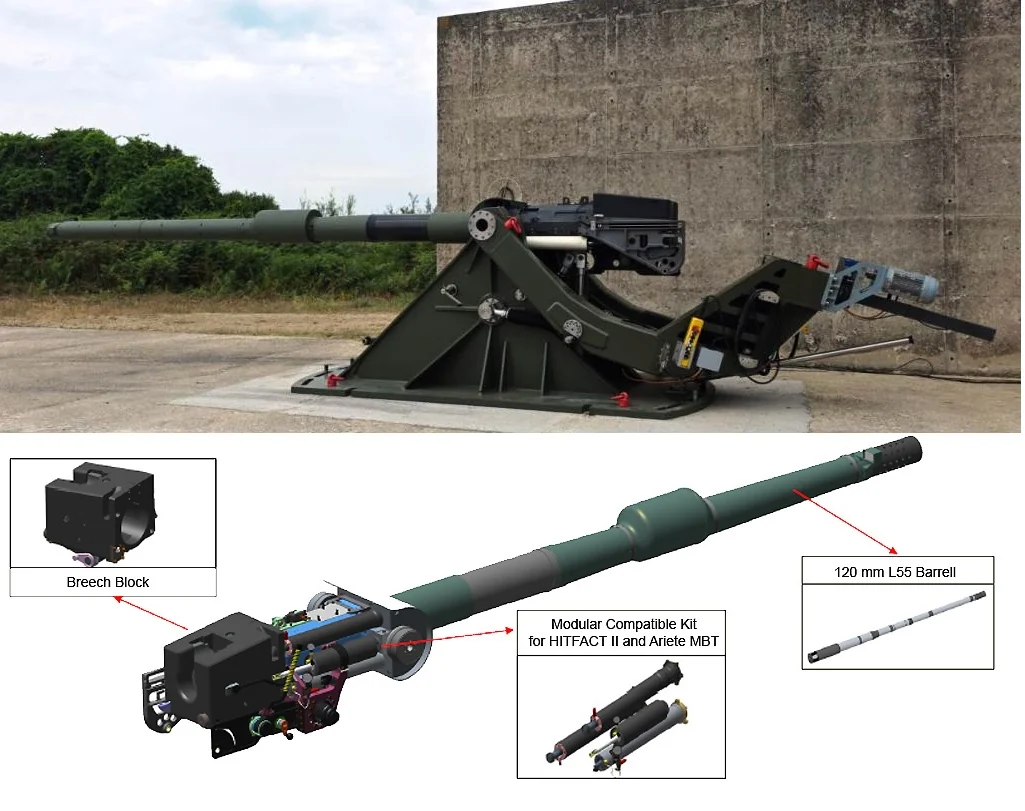
The tank’s primary weapon remains the proven 120 mm Rheinmetall L55A1 smoothbore, a long-barrel system optimized for high-velocity kinetic rounds and advanced multi-purpose ammunition. With modern APFSDS rounds, the Leopard 2A8 can defeat heavily armored targets at distances exceeding 4 kilometers, depending on conditions. Programmable high-explosive rounds allow crews to switch effects, airburst, delayed, and impact on the fly. One shell, many jobs.
But the real upgrade lives behind the optics.
The Leopard 2A8 uses a fully digital fire control system that fuses data from thermal sights, laser rangefinders, and stabilized day optics. Targets aren’t just spotted; they’re tracked. The system predicts movement, adjusts for wind and vehicle motion, and presents firing solutions almost instantly. For the crew, it feels less like aiming and more like confirming.
Secondary weapons add flexibility. A coaxial 7.62 mm machine gun handles infantry threats, while a remotely operated weapon station allows engagement without exposing the commander—an underrated but lifesaving feature in urban combat.

What’s different here is tempo. Engagement cycles are faster. Target handoff between commander and gunner is smoother. And because the Leopard 2A8 is networked, targets can be shared digitally with other units—tanks, infantry, or drones, turning isolated firepower into coordinated lethality.
Think of it this way: the Leopard 2A8 doesn’t shout louder than other tanks. It speaks sooner—and that often decides the fight.
A tank that can’t get where it needs to go is just an expensive bunker. The Leopard 2A8, despite tipping the scales near the 70-ton mark, refuses to play that role.
At the heart of its mobility is the well-tested MTU MB 873 diesel engine, delivering roughly 1,500 horsepower. On paper, that sounds familiar, and it is, but the difference lies in how efficiently that power is managed.
Improved transmission tuning, suspension refinements, and smarter onboard diagnostics help convert raw output into usable movement. The result? A tank that accelerates confidently, handles uneven ground without drama, and keeps pace with mechanized infantry units.
On roads, the Leopard 2A8 can reach speeds close to 68 km/h, but speed isn’t the headline. Control is. The advanced torsion-bar suspension absorbs terrain shocks, keeping the gun stable even while moving cross-country. That stability translates directly into combat effectiveness: accurate fire without stopping, faster repositioning, and fewer crew fatigue issues during long operations.
Operational range sits around 450 kilometers, enough for sustained missions without constant refueling. An auxiliary power unit (APU) plays a quiet but crucial role here. When stationary, crews can run sensors, radios, and thermal sights without idling the main engine—saving fuel, reducing noise, and cutting thermal signatures. Small detail, big survival boost.
Then there’s endurance in the broader sense. The Leopard 2A8 is designed for long deployments, with modular components that simplify maintenance and digital health monitoring that flags issues before they become breakdowns.
In practice, this means commanders can plan movements with confidence. The tank isn’t just powerful—it’s reliable. And in war, reliability is a form of speed.
Here’s where the Leopard 2A8 quietly pulls ahead of many of its peers. Not with thicker steel. Not with louder guns. But with how it thinks.
Older tanks were largely self-contained, crew, optics, radio, repeat. The Leopard 2A8 breaks that mold by functioning as a digitally networked battlefield node. Every sensor, sight, and subsystem feeds into a shared architecture. Information doesn’t sit in silos; it flows.
At the crew level, this means dramatically improved situational awareness. Commander and gunner operate with independent thermal sights, both stabilized and high-resolution, allowing simultaneous target searching and engagement. The commander can scan for threats while the gunner finishes an engagement, no pause, no tunnel vision. It feels less like taking turns and more like parallel processing.

The real leap comes from sensor fusion. Data from optics, navigation systems, and external sources, such as drones or nearby units, can be combined into a coherent picture. Instead of guessing what’s beyond the next ridge, crews often already know. Targets can be marked digitally, shared across the network, and prioritized in seconds.
This digital backbone also supports modern battle management systems (BMS). Orders arrive visually, not just over radio chatter. Friendly units appear on the map. Danger zones update in real time. It reduces confusion, speeds decision-making, and, perhaps most importantly, lowers cognitive load on the crew.
There’s a subtle human factor at play here. When crews aren’t overwhelmed by raw data, they perform better under stress. Mistakes drop. Reaction times shrink.
The Leopard 2A8 doesn’t replace human judgment. It sharpens it. And in a battlefield saturated with information, that sharpening may be one of its most lethal features.
In a world crowded with capable main battle tanks, the Leopard 2A8 carves out its niche not by sheer size or gun power, but by the synergy of protection, firepower, and digital sophistication.
Take the M1A2 Abrams SEP v3, for instance. Both tanks boast 120 mm main guns and layered armor. The Abrams edges slightly in raw engine power with its gas turbine, but the Leopard 2A8 often outperforms in sensor integration and digital battlefield connectivity. European export considerations also give the 2A8 an advantage: lower logistical footprint, compatibility with NATO European allies, and modular maintenance systems.
Compare it to France’s Leclerc XLR, which emphasizes speed and high-tech automation. While the Leclerc can dash and fire with impressive agility, the Leopard 2A8 prioritizes survivability with integrated Active Protection Systems like Trophy, advanced sensor fusion, and improved turret roof protection. In high-threat environments, this layered defense often outweighs slight differences in mobility.
Even older Leopard variants like the 2A7+ are noteworthy for reliability, but the 2A8 represents a generational leap. Everything from ergonomics to digital communication is reimagined. Crews can operate with higher efficiency, and the tank can coordinate seamlessly within networked units—something legacy models simply can’t match without retrofits.
Essentially, the Leopard 2A8 doesn’t need to dominate one statistic. It wins by balance: firepower, protection, mobility, and digital integration all working in concert. It’s a tank designed for modern warfare’s messy, unpredictable environment—one that emphasizes not just surviving hits, but avoiding them while striking first.
It’s not the loudest tank on the field—but often, it’s the most effective.