Follow Us:
Follow Us:

Picture this: a machine so quiet that the ocean itself struggles to notice it, yet so powerful that its mere existence reshapes global strategy. That’s not sci-fi. That’s the Columbia-class submarine, arguably the most consequential naval platform the United States has designed since the Cold War went cold… and then quietly heated back up again.
Unlike flashy fighter jets or hypersonic missiles that dominate headlines, the Columbia class works in silence. No flyovers. No launch videos. Just deterrence, humming along beneath thousands of feet of water. If everything goes right, you’ll never hear about it again. And that’s exactly the point.
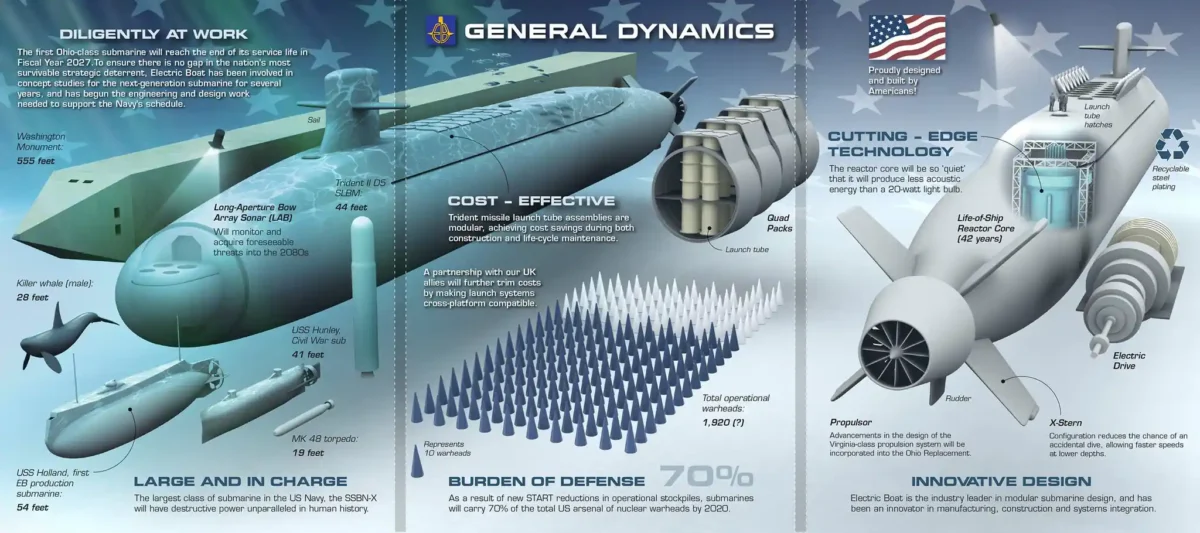
The Columbia-class submarine isn’t just a replacement for the aging Ohio class. It’s a generational reset. Twelve boats. Each designed for a 42-year service life without nuclear refueling, a first for U.S. submarines. That alone reshapes how the Navy thinks about maintenance, crew rotation, and long-term cost control. Instead of stopping mid-life for refueling, these submarines are built to keep going, like marathon runners who never need a water break.
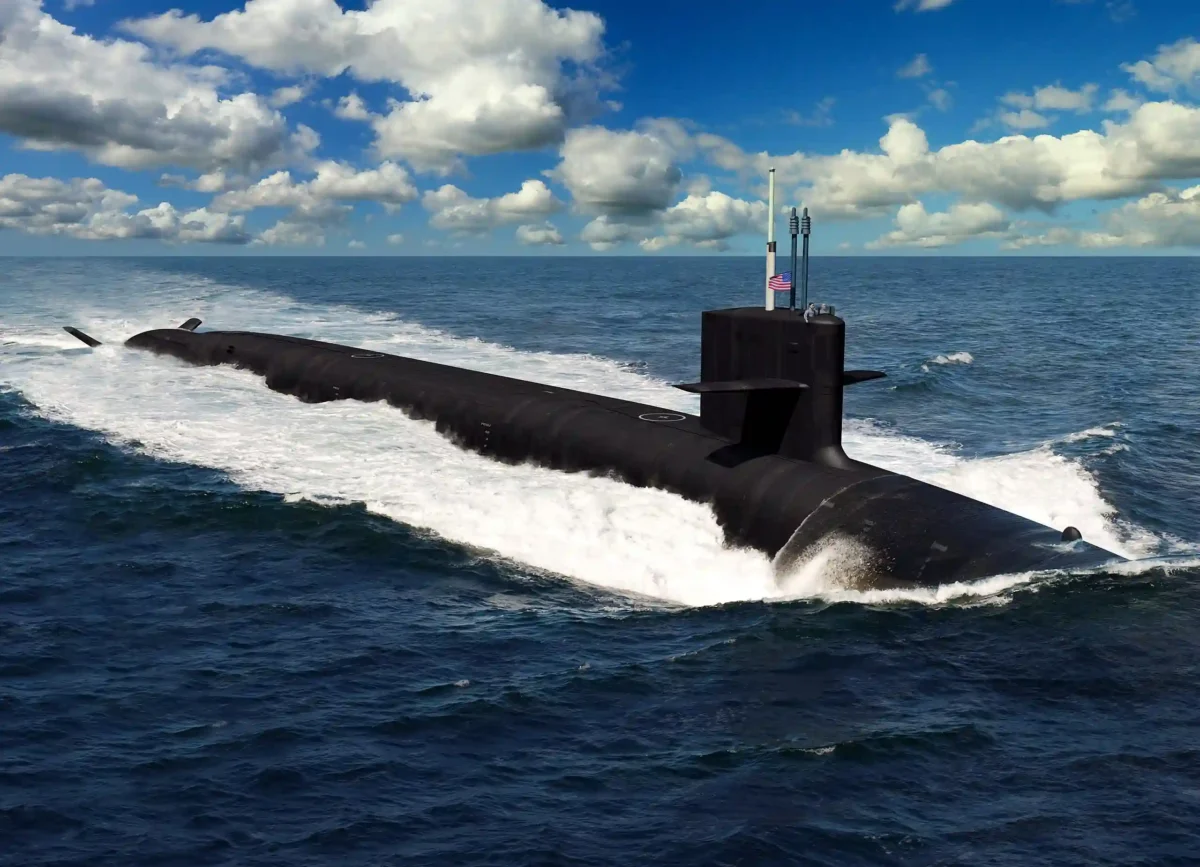
At its core, the Columbia class carries the sea-based leg of America’s nuclear triad. Translation: if the unthinkable ever happens, these submarines ensure there’s always a response. Hidden. Survivable. Credible. Each boat carries 16 Trident II D5 ballistic missiles, fewer than the Ohio class, but that reduction is deliberate, tied to arms control agreements and modern deterrence logic rather than raw firepower.
At a basic level, the Columbia-class submarine is the U.S. Navy’s next generation of ballistic missile submarines, known in Navy shorthand as SSBNs. But stopping there misses the bigger story. This class wasn’t designed to be impressive. It was designed to be inevitable.
The Columbia class exists for one blunt reason: the Ohio-class submarines are aging out. Steel fatigues. Reactors wear down. Electronics become museum pieces.
By the early 2030s, the Navy faced a hard truth, without a replacement, the most survivable leg of the nuclear triad would quietly erode. The Columbia program is the answer to that deadline.
Think of it less like buying a new car and more like replacing the foundation of a house while you’re still living in it. There can be no gaps. No delays. Deterrence doesn’t tolerate “out of service” signs.
Read also: Dreadnought-Class Submarines: UK’s Next-Gen Nuclear Deterrent
What makes the Columbia-class submarine different is its design philosophy. Instead of chasing speed records or experimental weapons, engineers focused on availability.
These boats are expected to spend a higher percentage of their lives on patrol than any previous U.S. SSBN. Fewer major maintenance interruptions. Longer continuous deployments. More days at sea where it actually counts.
Another defining feature: collaboration. The missile compartment, called the Common Missile Compartment—is shared with the UK’s Dreadnought-class submarines. That’s rare in a world where nuclear deterrence is usually guarded like a state secret. Here, interoperability isn’t a buzzword; it’s baked into the hull.
In short, the Columbia class isn’t about dominance through visibility. It’s about strategic patience. A submarine designed to sit quietly in the background of history, making sure certain conversations never happen at all.
Numbers don’t tell the whole story, but with submarines, they get you surprisingly close.
The Columbia-class submarine is a study in deliberate scale. Big enough to be formidable. Controlled enough to stay invisible. Every dimension reflects a tradeoff made on purpose.
Let’s start with size.
The Columbia class is the largest submarine ever built by the United States, edging past even the Ohio class. That extra volume isn’t about comfort or speed; it’s about acoustic isolation, reactor longevity, and systems redundancy. Quiet submarines need space. Silence, it turns out, is bulky.
Here’s a snapshot of the core specs, the kind defense analysts scribble in notebooks and shipbuilders memorize by heart:
| Specification | Columbia-Class SSBN |
| Submerged displacement | ~20,810 long tons |
| Length | ~560 feet (171 meters) |
| Beam (width) | ~43 feet |
| Missile tubes | 16 |
| Missile type | Trident II D5 / D5LE |
| Reactor | Life-of-ship nuclear reactor |
| Expected service life | 42 years |
| Crew | ~155 sailors |
A detail worth pausing on: life-of-ship reactor. Previous submarines required a mid-life nuclear refueling—an expensive, years-long process. Columbia doesn’t. That decision alone removes billions in future maintenance costs and reduces time stuck in dry dock. More time at sea, less time on spreadsheets.
The reduction from 24 missile tubes (Ohio class) to 16 sometimes raises eyebrows. But this isn’t downsizing—it’s optimization. Modern deterrence values survivability and accuracy over raw missile count, and arms control agreements helped shape that number.
Taken together, these specs paint a picture of a submarine built less like a weapon and more like an infrastructure project, quiet, durable, and meant to work flawlessly for generations.
If the Columbia-class submarine had a superpower, it wouldn’t be speed or firepower. It would be silence. Not metaphorical silence, real, measured-in-decibels, obsessively-engineered quiet.
Start with propulsion. Unlike older submarines that rely on traditional mechanical linkages, the Columbia class uses electric-drive propulsion.
In simple terms, the nuclear reactor doesn’t directly spin the propulsor. Instead, it generates electricity, which then powers electric motors. Fewer moving parts. Less vibration. Less noise leaking into the ocean like an accidental confession.
Then there’s the propulsor itself. The familiar propeller is gone, replaced by a pump-jet system. Picture a ducted fan rather than spinning blades. It’s smoother, harder to detect, and dramatically reduces cavitation, the tiny bubbles that sonar loves to pick up. This isn’t new tech, but on the Columbia class it’s refined to an almost obsessive degree.
Inside the hull, silence gets architectural. Major machinery is mounted on isolated platforms, floating—yes, floating, on vibration-damping systems. Even the layout of piping and cabling is designed to avoid resonance. Engineers spend years chasing noises humans can’t hear but sensors can.
Sensors, of course, matter too. The Columbia-class submarine features an advanced sonar suite designed to listen more than it speaks. Passive detection is prioritized. It’s the naval equivalent of turning off your phone and just watching the room.
Here’s the subtle insight people miss: stealth isn’t about hiding once. It’s about staying hidden for decades as detection technology improves.
The Columbia class is built with growth margins, extra space, power, and cooling, so future upgrades don’t compromise its acoustic profile.
In other words, this submarine isn’t just quiet today. It’s betting on being quiet in 2055.
It’s tempting to judge a ballistic missile submarine by a single number: how many missiles it carries. By that measure, the Columbia-class submarine looks restrained. Just 16 missile tubes, down from the Ohio class’s 24. But that’s a surface-level read, and submarines live for depth.
Each of those 16 tubes houses a Trident II D5 ballistic missile, widely considered the most reliable sea-launched nuclear missile ever deployed.
The D5, and its life-extended variants, D5LE and D5LE2, isn’t new, but it’s been quietly upgraded for decades. Think less “Cold War relic,” more “continuously updated operating system.” Accuracy has improved. Reliability remains near-flawless. Deterrence credibility stays intact.
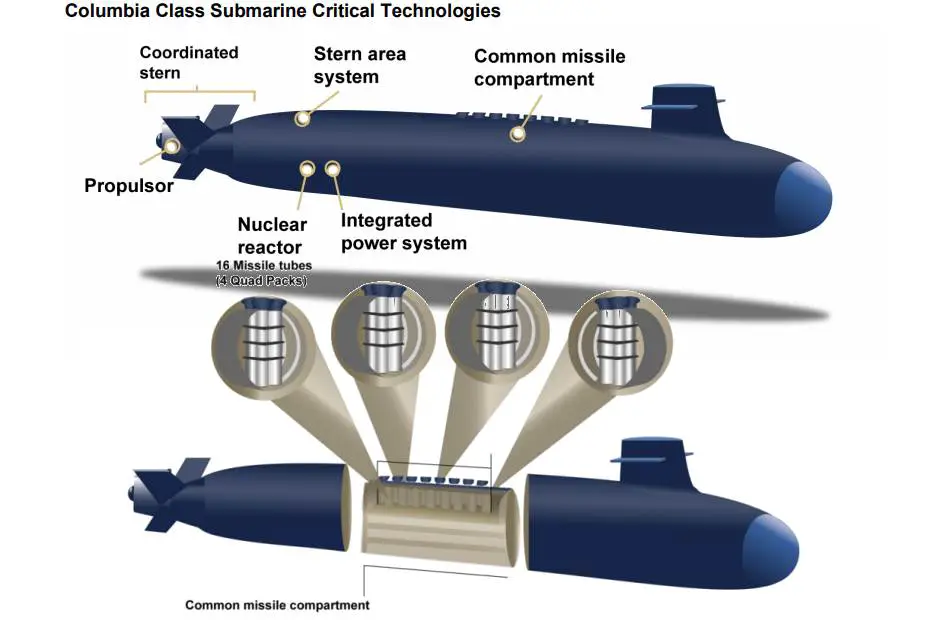
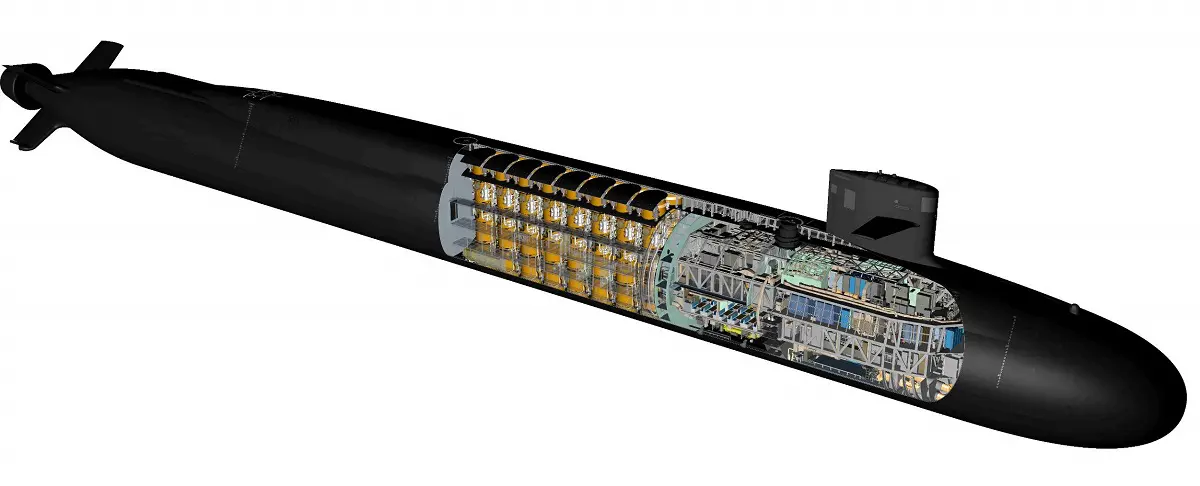
What really matters is the Common Missile Compartment (CMC). This modular system, jointly developed with the United Kingdom, standardizes missile tube design across U.S. Columbia-class and UK Dreadnought-class submarines. That sounds bureaucratic until you realize what it enables: shared upgrades, shared testing, and smoother modernization over a 40-plus-year lifespan.
Here’s the strategic twist. Modern deterrence isn’t about overwhelming numbers; it’s about assured survivability.
A hidden submarine with fewer missiles is still infinitely more valuable than a visible platform with more. Sixteen survivable missiles, each carrying multiple warheads, remains a devastating, yet stabilizing, force.
There’s also arms control logic at play. Tube reductions align with treaty frameworks while maintaining operational effectiveness. It’s restraint by design, not weakness.
So no, the Columbia-class submarine doesn’t shout. It doesn’t need to. Its weapons are built around a quieter truth: deterrence works best when it’s unquestionable—and rarely discussed.
The Columbia-class submarine program isn’t running on a normal shipbuilding clock. It’s running on a biological one, the slow, unavoidable aging of the Ohio-class boats it must replace. Miss the timing, and the U.S. risks a gap in continuous at-sea deterrence. That’s the nightmare scenario planners lose sleep over.
The timeline started quietly in the early 2010s with concept studies and design freezes that felt painfully slow from the outside. But that pace was intentional.
Every design choice had to survive a brutal question: Will this still work in 2065? Once construction begins on a nuclear submarine, improvisation is no longer your friend.
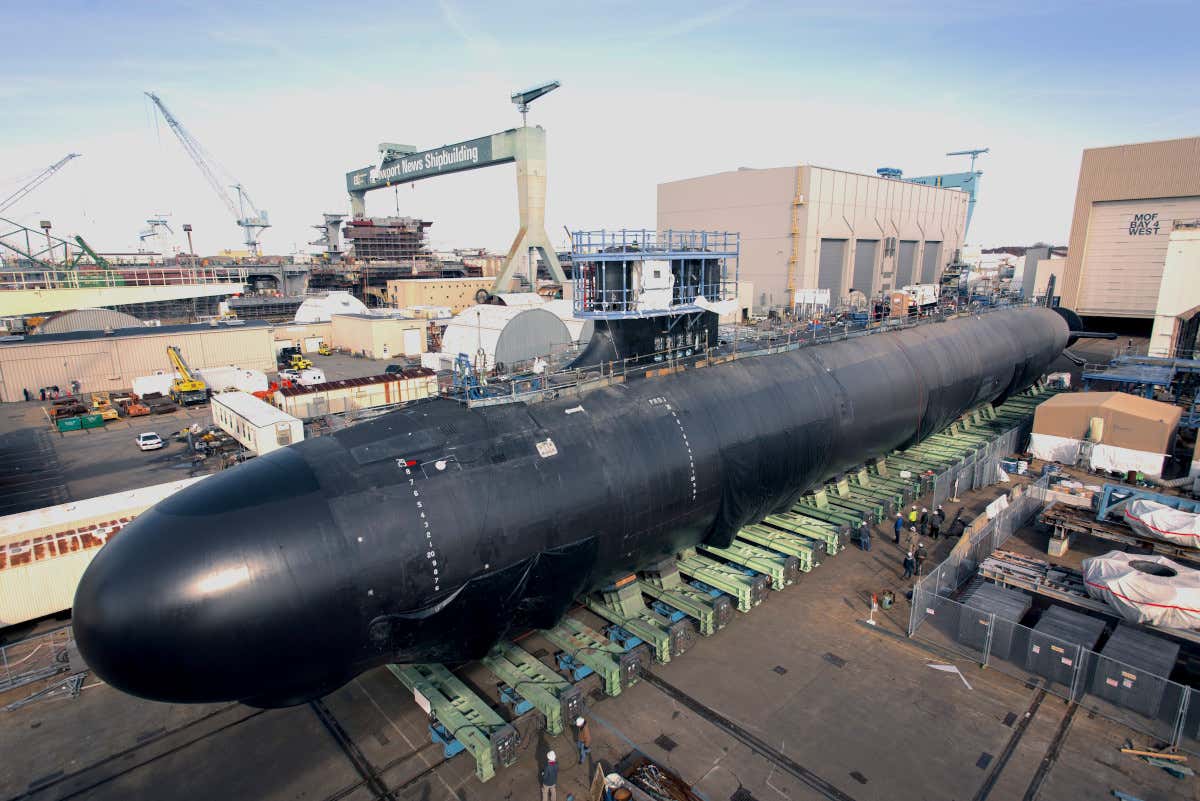
The lead boat, USS Columbia (SSBN-826), officially began construction in the early 2020s. Unlike aircraft programs that chase rapid iteration, submarine procurement is about disciplined sequencing.
Long-lead items—reactor components, missile tubes, specialized steel—are ordered years in advance. Some parts were being fabricated before the public even knew the program’s name.
Here’s a simplified timeline snapshot:
| Milestone | Approximate Timing |
| Program concept & early design | Early 2010s |
| Detailed design finalized | Late 2010s |
| Lead boat construction begins | Early 2020s |
| Sea trials (planned) | Late 2020s |
| First deterrent patrol | Early 2030s |
Only one Columbia-class submarine is planned for delivery roughly every year once full production ramps up. That cadence is tight, deliberate, and unforgiving. Delays don’t stack neatly, they cascade.
What makes this program unusual is that it’s treated less like a typical defense acquisition and more like national infrastructure. Roads crack. Bridges age. Submarines, apparently, do too. The Columbia class exists because waiting wasn’t an option.
Talking about the Columbia-class submarine without talking about money is like discussing a skyscraper without mentioning concrete. This program is expensive, deliberately so, and understanding why helps explain how modern deterrence actually works.
The full Columbia-class program is estimated to cost well over $100 billion across its lifecycle, including design, construction, operations, and long-term sustainment.
The procurement cost per submarine lands in the neighborhood of $8–9 billion for the early boats, with later hulls expected to come down slightly as production stabilizes. Eye-watering numbers, yes. But context matters.
Each submarine is expected to serve for 42 years without a reactor refueling. Spread that cost over four decades of continuous deterrence patrols, and the annual price tag starts to resemble insurance premiums—astronomical if you stare at the total, reasonable if you consider what’s being insured.
The industrial backbone of the program is General Dynamics Electric Boat, partnered with HII’s Newport News Shipbuilding. This isn’t a prime-and-sub arrangement so much as a marriage of necessity.
One yard builds certain modules, the other builds others, and final assembly becomes a carefully choreographed dance of steel sections moving up and down the U.S. East Coast.
Recent contracts, some exceeding $2 billion in single awards, aren’t just about hulls. They fund workforce expansion, supplier stabilization, and tooling upgrades. Translation: welders, engineers, machinists, and software specialists who don’t exist yet must be trained years in advance.
Here’s the rarely discussed angle: the Columbia-class submarine isn’t just buying boats. It’s buying industrial continuity. Lose the skilled workforce, and no amount of money fixes that quickly.
Strip away the steel, the reactors, the spreadsheets, and the Columbia-class submarine reveals its real job: making sure nuclear weapons never get used.
That sounds paradoxical, but it’s the core logic of deterrence. The sea-based leg of the nuclear triad exists because it’s the hardest to find and the hardest to destroy. Land-based missiles sit in known locations. Bombers need runways. A ballistic missile submarine, on patrol, is a question mark drifting through thousands of square miles of ocean.
The Columbia class is designed to preserve that uncertainty well into the second half of this century. Its stealth ensures that no adversary can confidently believe they’ve neutralized U.S. retaliatory capability. And in deterrence theory, confidence, not capability, is the dangerous thing.
Doctrine has shifted, too. During the Cold War, quantity mattered. Today, assured survivability and command-and-control resilience matter more. The Columbia-class submarine integrates modern communications systems that allow it to remain connected without betraying its position, no small feat in an age of satellites, undersea sensors, and AI-assisted tracking.
There’s also a geopolitical layer. As peer competition intensifies, especially in the Indo-Pacific, SSBN patrol areas and patterns quietly adapt. The Columbia class isn’t tied to a single theater; it’s a global asset that complicates planning for any potential adversary.
An overlooked insight: these submarines stabilize alliances. Allies don’t need their own nuclear forces when they trust extended deterrence. The mere existence of the Columbia class underwrites that trust.
So while the Columbia-class submarine never appears in press briefings or victory parades, it shapes strategic behavior every day, by convincing everyone involved that escalation is a bad idea.