Follow Us:
Follow Us:

When the first bombs lit up Baghdad’s night sky in January 1991, the world was watching something entirely new. For the first time, war looked clean, almost surgical. Laser-guided bombs hit their marks with eerie precision, stealth jets slipped past radar, and TV networks beamed the action live into living rooms. Operation Desert Storm felt like a proof that high-tech warfare had arrived.
The campaign was fast, Kuwait was liberated in just 43 days, yet the picture wasn’t as perfect as it looked from a distance. Behind the “shock and awe,” there were blind spots, missteps, and lessons the military would spend years unpacking. Technology dazzled, but it didn’t answer every question.
More than thirty years later, Desert Storm still hangs over every modern conflict like a shadow. It changed how generals planned wars, how politicians sold them, and how the public saw them.
In many ways, it was the first modern war and the last one that still felt simple. From Ukraine to the South China Sea, strategists quietly study it to ask: What did we really learn from the first high-tech war? And what does “victory” really mean in modern conflicts?
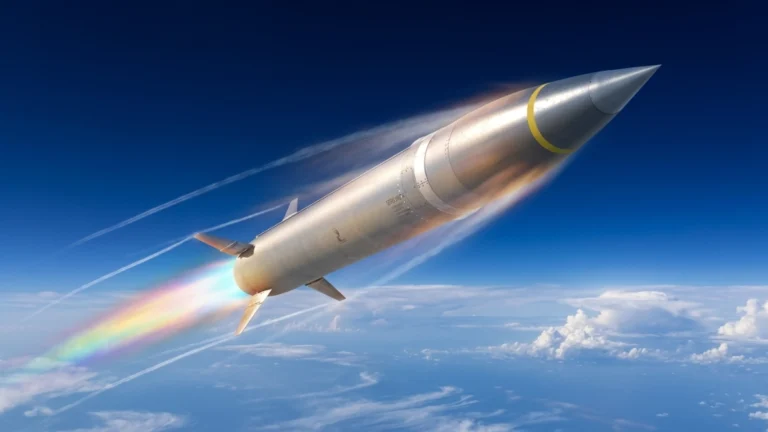
One of the biggest game-changers in Operation Desert Storm was precision airpower. For the first time, the world saw bombs that could hit a specific building or even a single window, at least, that was the idea.
The U.S.-led coalition used what were called precision-guided munitions (PGMs), or “smart bombs.” These weren’t exactly new, but in 1991 they were finally used on a massive scale.
Read also: How Does a Smart Bomb Work? The Tech Behind It
Now, to be fair, not every bomb was that precise. In fact, only about 7–8% of all the bombs dropped during Desert Storm were “smart.” The rest were still traditional, unguided ones (the kind that rely more on skill and luck than sensors). But even that small percentage made a big impression.
Those so-called “smart bombs” in Desert Storm did more than just hit their targets; they changed how people saw war.
On the battlefield, they were a game-changer, taking out radar stations, bunkers, and bridges with a level of accuracy that older bombing runs could only dream of. But the real power was psychological.
On TV screens back home, viewers watched those ghostly, black-and-white clips of bombs gliding neatly into targets. It made modern warfare look almost clean, almost clinical.

Of course, the truth was messier. Those precision-guided munitions didn’t work alone. Behind every “perfect hit” was a massive system: satellites feeding data, reconnaissance planes mapping targets, pilots flying dangerous routes, and crews coordinating every step in real time. Without that whole network, those “smart” weapons weren’t so smart after all.
Fast-forward to now, and the same idea still drives modern air power, from drone strikes to laser-guided missiles.
The tools have improved, but the problems haven’t disappeared. GPS can be jammed, targets can move, and cities make everything harder. Civilian areas are still where most wars get fought, and precision only goes so far when the line between soldier and bystander blurs.
So maybe that’s the takeaway. Desert Storm didn’t give us perfect warfare. It gave us a glimpse of what happens when technology, ambition, and human judgment try to work in sync. The precision was real, but the fog of war never really lifted.
If Desert Storm proved anything, it’s that you don’t win a modern war alone. The coalition that came together in 1991 was one of the most diverse in history, around 34 countries, from the U.S. and U.K. to Egypt, Saudi Arabia, and even smaller contributors like New Zealand.
On paper, that sounds like a logistical nightmare. Different languages, equipment, and command structures, it could’ve been chaos. But somehow, it worked.
The reason it worked, many would argue, came down to leadership and coordination. Sure, the U.S. led the charge in Desert Storm, but it wasn’t a one-country show. The coalition that came together was a patchwork of armies, air forces, and support crews from all over the world.
Some nations sent ground troops, others opened up their bases, and quite a few wrote the checks that kept the whole machine running. It was messy at times, different languages, different command styles, but somehow, it worked.
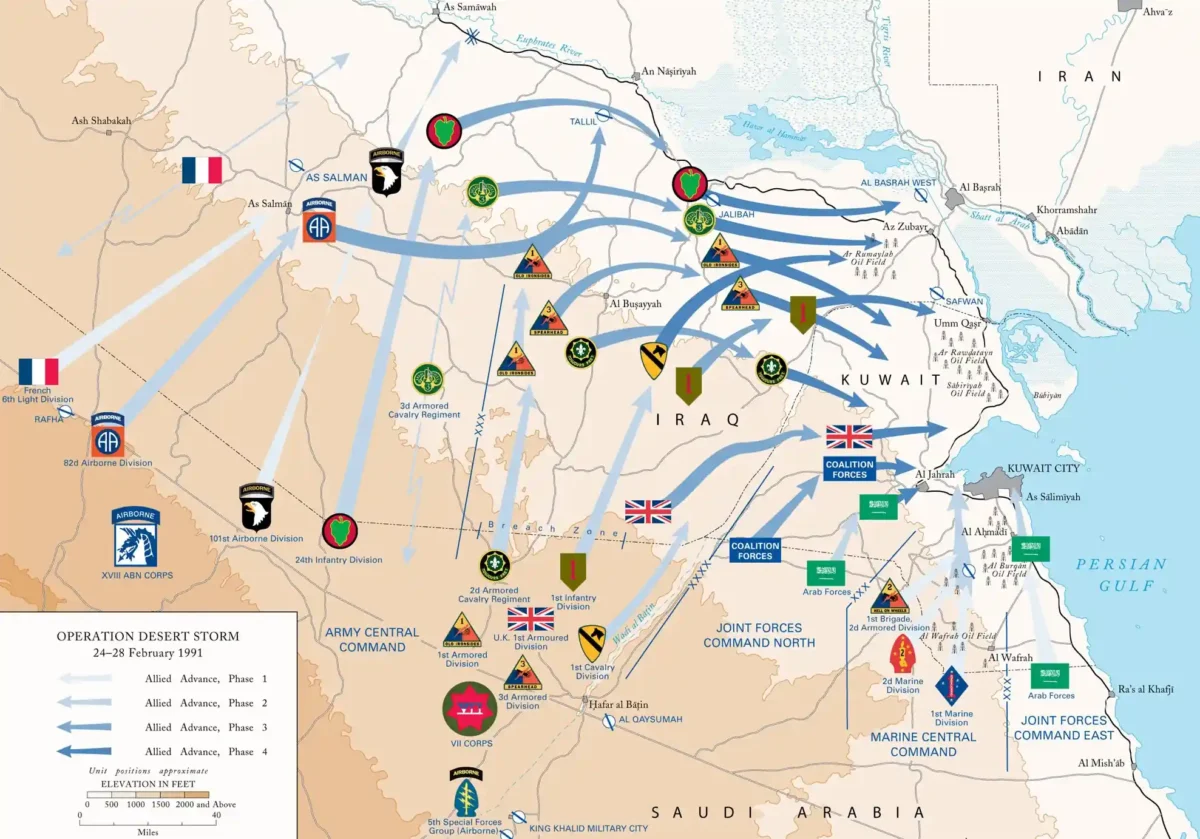
What really made Desert Storm stand out was that sense of unity. This wasn’t just America flexing its muscle; it was a UN-backed mission with a clear goal: push Iraq out of Kuwait. That legitimacy mattered. It gave the campaign political cover and made it harder for Saddam Hussein to spin the story his way. For once, the world mostly agreed on who the aggressor was and that made decisive action possible.
Looking back now, that kind of coordination feels almost rare. Modern warfare is a whole different beast. It’s not just troops and tanks anymore, it’s cyber teams, satellites, and even private tech companies working in the mix. Getting everyone to move in sync is harder than ever, especially when national interests and egos start pulling in different directions.
Maybe that’s why Desert Storm still gets studied. It proved that coalition warfare can work, but only when trust runs deep and the mission stays clear. For a brief moment, that balance existed. And it’s been hard to recreate ever since. Today’s alliances could learn a lot from how that balance was managed, and maybe also from how fragile it really was once the shooting stopped.
There’s a saying in the military: “Amateurs talk strategy; professionals talk logistics.” And nowhere was that truer than in Operation Desert Storm.
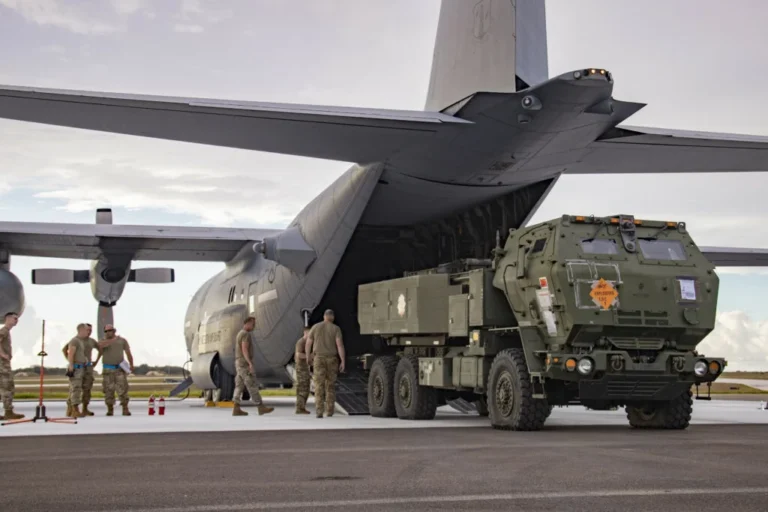
What really kept Desert Storm running wasn’t the tanks or the fighter jets. It was the movement behind them. All that power only mattered because someone figured out how to move it halfway across the planet and make it work once it got there.
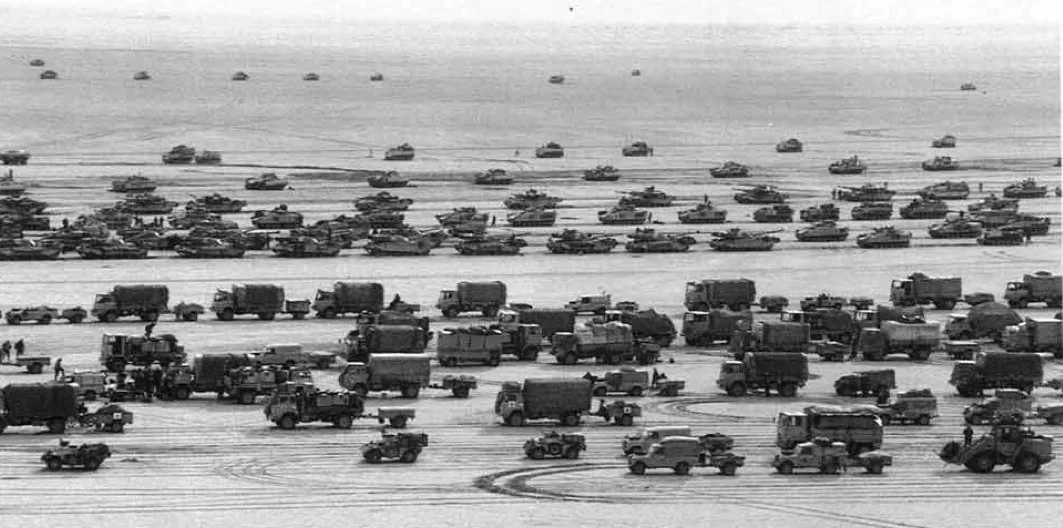
Think about it; half a million troops, endless rows of trucks, pallets of food, stacks of ammunition, fuel drums, spare parts, and tents stretching across the Saudi desert. Every bolt, every meal, every gallon of fuel had to arrive at the right place, at the right time, for the whole thing to work. On paper, it looked impossible. In reality, it became one of the most impressive military mobilizations ever pulled off.
It’s the kind of effort that doesn’t make headlines but defines everything that follows. The soldiers who fixed engines, unloaded cargo, and kept convoys rolling rarely get remembered, yet they were the reason the campaign looked effortless from the outside.
That kind of global-scale movement had never been done so smoothly before. It relied on a massive network of airlift and sealift operations, precision scheduling, and a level of coordination that, frankly, could’ve gone off the rails at any moment.
What made it work was preparation, years of planning under the Rapid Deployment Force concept, which had been quietly developed after the 1970s oil crisis.
The U.S. had already invested in pre-positioned equipment. Tanks and supplies were stored overseas, so troops could fly in and start fighting without waiting for ships to arrive. That forward-thinking logistics strategy paid off big time in 1991.
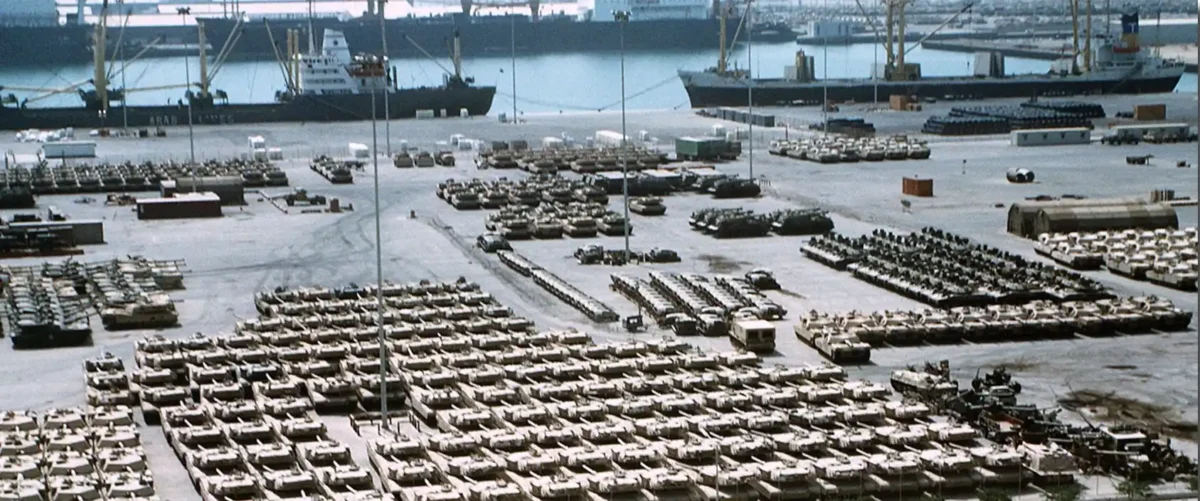
Not everything went perfectly, though. Some units arrived without their gear, and sandstorms made movement unpredictable. Communication between ground convoys and command wasn’t always smooth either. But overall, the logistics effort showed what was possible when military mobility and supply chain discipline worked together.
If we fast-forward to today, logistics remains the invisible heart of military power. Modern readiness isn’t just about how fast you can fight, it’s about how fast you can get there. The U.S. and NATO still rely heavily on the airlift principles proven in Desert Storm, but now the challenge is different.
Global supply chains are more fragile, and high-tech forces depend on specialized parts that can’t always be replaced quickly. Even advanced militaries are realizing that efficiency can be a double-edged sword, lean systems break under pressure.
If Desert Storm was the first “high-tech war,” it was also the first televised war of the satellite age. For the first time, people around the world could watch bombs falling in real time, usually framed as clean, precise, and strangely enough, almost cinematic.
CNN ran 24-hour coverage, reporters broadcast live from hotel rooftops in Baghdad, and suddenly, the public wasn’t just reading about a war, they were watching it.
That kind of exposure changed everything. The U.S. military learned that information could be just as powerful as firepower. The Pentagon carefully managed what reporters saw, often emphasizing successful airstrikes and clean hits from “smart bombs.”
To be fair, it wasn’t all propaganda; the technology really was impressive. But the way it was shown to the world changed how millions of people understood what war looked like. On TV, Desert Storm came across as quick, precise, and almost clean; missiles sliding neatly into targets, explosions viewed from miles away through grainy night vision. The reality, of course, was far less tidy.
This was also the war where psychological operations really took center stage. Coalition planes dropped millions of leaflets urging Iraqi troops to surrender. Radio broadcasts promised safe treatment for those who gave up.
Fake transmissions made it sound like enemy units were collapsing. It might sound like old-fashioned trickery, but it worked. Whole groups of Iraqi soldiers laid down their arms before a shot was fired, convinced they didn’t stand a chance against such overwhelming firepower.
Still, the picture people saw back home was carefully managed. Reporters had limited access, and the coverage felt polished, sometimes too polished. Civilian casualties, confusion on the ground, and the uglier sides of the campaign barely made it to air. That control shaped expectations for years to come.
A lot of people walked away thinking future wars could be just as fast, just as precise, and just as clean. They weren’t. That illusion didn’t hold up in later conflicts like Iraq in 2003 or Afghanistan.
In today’s world, that lesson has only grown sharper. Modern militaries don’t just manage the battlefield; they manage the narrative. Social media, misinformation, and viral footage can shape public opinion faster than any official statement. Controlling perception has become a strategic objective all by itself.
Desert Storm taught militaries the power and danger of information dominance. The war was fought in the desert, yes, but it was won just as much on TV screens and in the minds of millions watching at home and perception became another battlefield.
One of the most striking things about Operation Desert Storm was how seamlessly air and ground forces worked together, or at least, that’s how it looked from the outside. Jets hammering Iraqi positions from above while tanks surged across the desert in perfect sync.
In reality, it was anything but effortless. What made it work was that, for the first time, both halves of the military machine, the flyers and the grunts, were finally learning to fight as one.
For more than a month, coalition aircraft owned the skies. Day after day, bombers shredded supply lines, radar sites, and command centers. By the time ground troops moved in on February 24, 1991, the Iraqi army was already reeling, cut off, demoralized, and running on fumes. The ground war wrapped up in just 100 hours, something few thought possible at the start.
That level of coordination didn’t just happen overnight. It came from hard lessons from Vietnam’s tangled command chains to smaller operations where pilots and ground commanders often couldn’t get on the same page.

In Desert Storm, new systems like the Joint Tactical Information Distribution System (JTIDS) changed the game. For the first time, pilots and commanders could share data in near real time. Targets could be updated mid-flight, and airstrikes could pivot instantly to clear a path for ground units.
A perfect example was the famous “left hook” maneuver. This was a sweeping flanking move where U.S. and coalition armor looped wide through the desert to trap retreating Iraqi forces. It only worked because airpower and ground troops were talking to each other constantly. Jets softened up defenses while armored columns moved under cover from above. It wasn’t flawless, no operation ever is, but it showed what true joint warfare could look like.
Still, even that success had limits. Communication wasn’t seamless, and friendly fire incidents did happen. Not every coalition partner had the same gear or training, which made coordination tricky. And despite the high-tech image, plenty of the work still came down to people reading maps, making calls, and trusting each other’s judgment.
Today, that kind of integration has gone digital. Drones, shared networks, and AI-assisted systems link everything, air, land, sea, and even cyberspace, into one continuous operation. But the core lesson from Desert Storm still rings true: no matter how advanced the tech gets, it’s only as strong as the people using it, and the trust that holds them together when the pressure hits.
If airpower was the muscle of Operation Desert Storm, then intelligence and electronic warfare were the nervous system holding it all together.
The coalition didn’t just outgun Iraq, it out-saw and out-listened it. This was one of the first conflicts where satellites, reconnaissance aircraft, and electronic sensors created what the military calls a “real-time battlefield picture.”
Read also: Electronic Warfare: Why It’s the Game-Changer in Modern War
Reconnaissance planes like the E-8 Joint STARS and U-2 spy aircraft provided detailed radar imagery of enemy troop movements. High above the desert, AWACS planes acted like flying nerve centers. From up there, crews could watch the entire battlefield unfold in real time, tracking friendly and enemy aircraft across hundreds of miles of sand.
That constant flow of information gave commanders something no army had ever really had before: a live, moving map of the war. In theory, it made planning strikes faster and more precise.
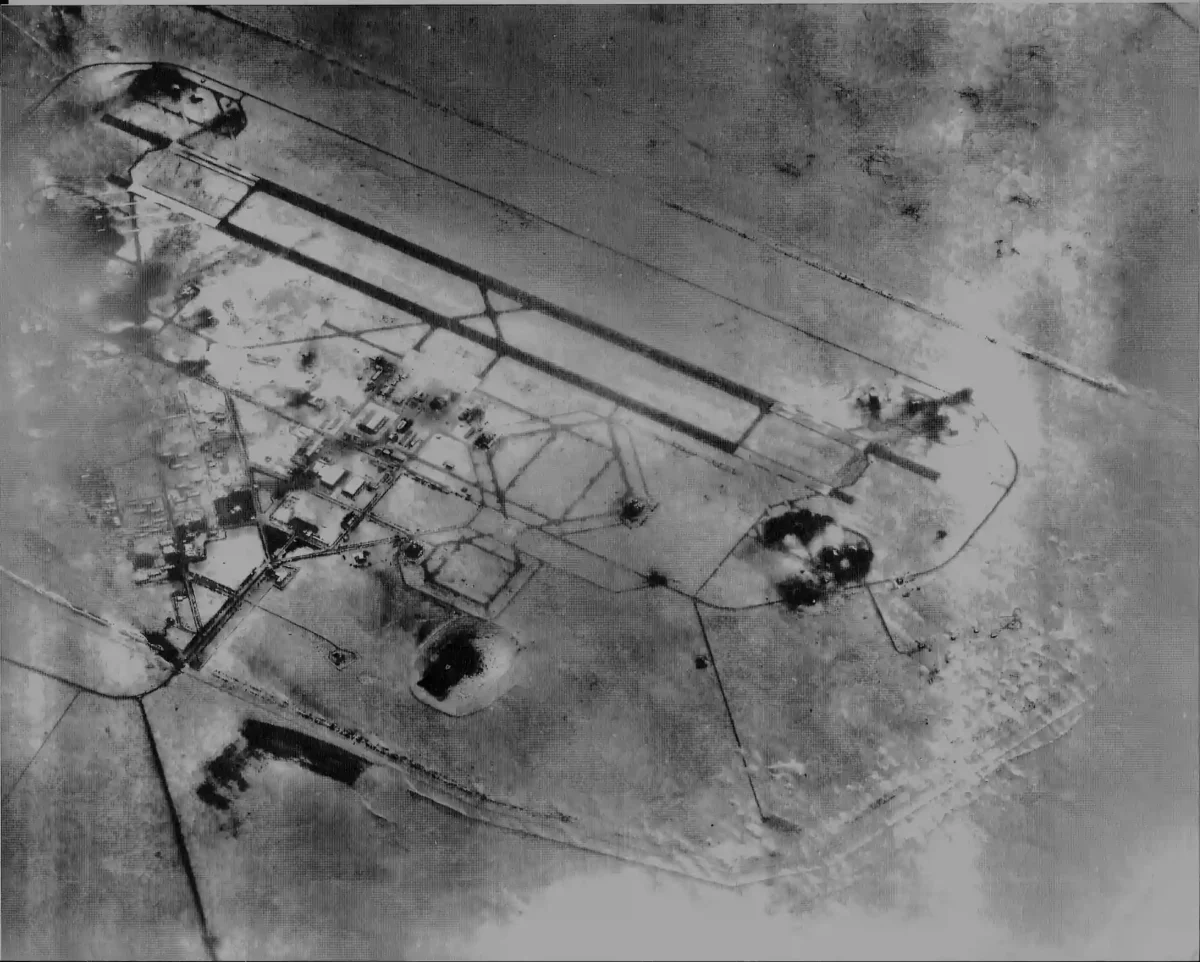
For the early ‘90s, that level of visibility was nothing short of revolutionary. Coalition analysts could spot tanks tucked under camouflage nets or track Scud launchers trying to sneak away between air raids.
But even with all that tech, the system wasn’t foolproof. Scuds still got through, some slamming into targets in Israel and Saudi Arabia, which was a harsh reminder that even the most advanced radar can’t catch everything in time.
And then there was electronic warfare. U.S. aircraft jammed Iraqi radar, cut off their communications, and launched decoys to make enemy defenses fire at ghosts. It was cat-and-mouse on a digital scale, and for the most part, the coalition came out on top. In a sense, they blinded the Iraqi military before the real fight even began.
That approach laid the groundwork for what’s now known as multi-domain operations, where information dominance is just as valuable as physical firepower.
Today, militaries use the same principles in the cyber realm. Instead of jamming radar, they disrupt networks. Instead of intercepting radio chatter, they intercept digital data. Desert Storm was an early rehearsal for the kind of electronic and cyber warfare that now happens quietly every day, long before any shooting starts.
Read also: What Is Cyber Warfare? How Nations Wage Digital War
Desert Storm’s success did two things at once; it boosted confidence and sounded a quiet alarm. It showed that a well-coordinated, tech-heavy military could take apart a conventional enemy with stunning speed. But it also made people wonder if that same formula would hold up against the kind of unpredictable, unconventional fights that were waiting down the line.
In the years that followed, the war left its fingerprints all over military thinking. The Pentagon doubled down on what it called “network-centric warfare” (the idea that every soldier, aircraft, ship, and satellite should be linked through one shared stream of information). Training shifted toward tighter coordination, faster deployment, and pinpoint precision.
For a while, everyone looked at Desert Storm as the model: proof that technology, speed, and communication could win wars almost effortlessly.
Read also: What Is Military Doctrine? How It Shapes Modern Warfare
But that image was a little deceiving. Some defense analysts later warned that the Gulf War made modern warfare look too easy, like a video game played in real time. It was a clean victory fought in the open desert against an army that played by familiar rules.
The messy insurgencies that followed in Iraq and Afghanistan were a completely different kind of fight, no front lines, no quick wins, no clear endgame. The old playbook didn’t fit anymore.
Even so, Desert Storm taught militaries the value of adaptability, real-time intelligence, and trust between allies sharing the same battlefield picture. Those ideas still drive strategy today. In many ways, Desert Storm was the moment the digital age of warfare truly began. “Joint All-Domain Command and Control (JADC2)” owes its roots to the command systems and integration lessons born in 1991.