Follow Us:
Follow Us:

When videos first surfaced online showing a BMPT Terminator seemingly shrugging off a drone strike, a lot of people didn’t quite believe what they were seeing. Was this Russian “tank support combat vehicle” really that tough or was the footage just another battlefield illusion?
The BMPT Terminator, sometimes called the “Russian Terminator tank”, has always had a bit of a mythic reputation. Built on a T-72 chassis and bristling with autocannons, grenade launchers, and missiles, it was designed to guard tanks in urban fights where ordinary armor can’t react fast enough.
It looks intimidating, sure, but questions have always lingered: does it actually work as advertised? And more importantly, can it really survive the kind of precision drone attacks that are now reshaping modern warfare?
The BMPT Terminator is basically a purpose-built escort vehicle for tanks, not a new main battle tank itself. It’s usually built on a tank hull (commonly the T-72 family chassis in many versions), so it has the basic mobility and baseline protection of that platform.
Around that solid base, designers add a lot of extra kit aimed at survivability in messy fights: thicker applique plates in places, angled panels, and, on some vehicles, explosive reactive armor or other add-on blocks to help defeat shaped-charge hits.

You’ll also see extra vision blocks, sensors, and a lower profile for crew protection. Plainly put; it’s meant to be tougher than a truck but not necessarily as survivable as a modern main battle tank’s frontal arc. The focus is more on protecting crew while it works close to tanks in urban or mixed terrain.
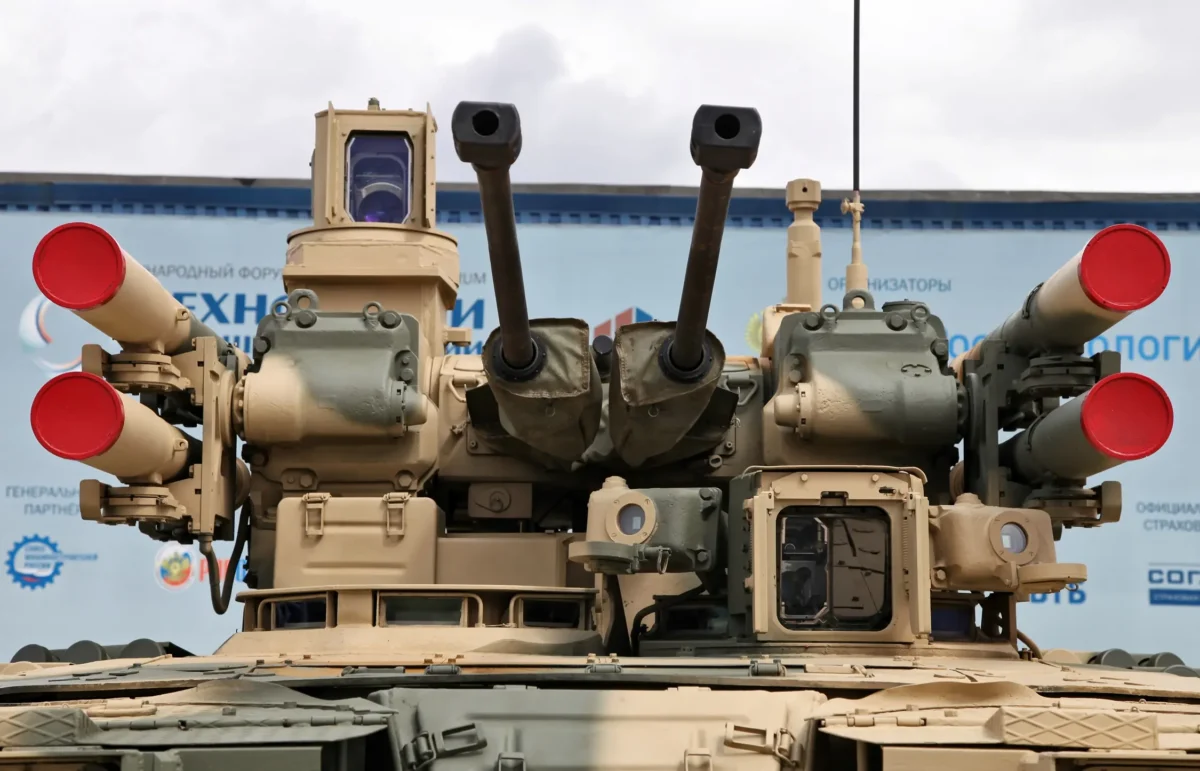
Where the Terminator looks and feels different is its weapons fit. It’s probably easier to think of the Terminator as carrying a toolbox of weapons rather than one giant gun. There are rapid cannons for dealing with nearby fighters, grenade launchers for short-range danger, ordinary machine guns for general use, and anti-tank rockets for heavier targets.
The setup is meant to be flexible: in theory, it lets a crew handle a sniper, an incoming drone, or a light armored vehicle quickly, instead of having to use a tank’s main cannon every time. The vehicle also carries modern sights and fire-control gear so a gunner can track several threats quickly. Exact weapon types and loadouts vary by model and export customer, so descriptions you read may differ slightly.
In doctrine, the BMPT is meant to be a tank’s close companion: it watches the flanks, covers blind spots, and handles the kinds of threats that a main gun and its crew would be awkward or wasteful to engage with. Think of it as a “point man” for heavy armor in towns or broken ground; a specialist that protects tanks from infantry with anti-tank weapons, engineers, or massed rocket fire.
In practice, Russia has used BMPTs in areas where they expected lots of close fighting or needed extra protection for tank columns. That said, opinions differ: some commanders value them and buy more, while critics say they add logistic and tactical complexity and that existing tanks and infantry teams can sometimes fill the same role. It might be fair to say the Terminator’s role changes with the battlefield. In dense urban fights it can be handy, but in open ground it sometimes struggles to justify its spot.
So, if someone asked, “What is the BMPT Terminator?” The easiest way to picture it is as a kind of helper or bodyguard for tanks. It was developed in Russia to cover them in places where tanks don’t do so well, like crowded cities, uneven ground, or areas full of ambush points.
Underneath all that gear, it runs on the old T-72 tank frame, so it’s got the same kind of heavy armor and tracks. But the setup on top isn’t like a regular tank. There’s no single giant cannon, instead, the crew has several smaller weapons to choose from: quick-firing guns, grenade launchers, and a few guided missiles tucked along the sides. The idea is to deal with anything that gets too close, so the tanks can survive longer
Read also: Russian T-72 Tank: The Soviet-Era MBT That Refuses to Retire
News about a possible drone hit on a BMPT Terminator spread fast, and not all of it was clear. Early in October 2025, a few posts began circulating online claiming that Ukrainian drones had struck Russian armored columns somewhere near Donetsk.
One short video showed smoke rising over the area, and a dark shape that people quickly labeled as a Terminator. The clip was blurry and shot from far away, but that didn’t stop the debate. Within hours, it was being shared with captions saying Russia’s high-profile support vehicle had finally been taken out.
Eyewitnesses on the ground told slightly different versions of what happened; a few Ukrainian operators claimed they’d been tracking the vehicle for several minutes before striking it. They said it was moving with a small tank column when the drone finally hit.
Russian channels, meanwhile, gave a more cautious version, acknowledging that a BMPT-72 might have been “damaged,” but not destroyed. Some even argued that the explosion shown online came from a nearby vehicle, not the Terminator itself. This conflicting storytelling isn’t unusual in modern warfare, where information moves faster than verification.
No one seems entirely sure what shape the vehicle ended up in. The videos clearly show some kind of hit, but analysts who looked at them said the Terminator might’ve held up better than expected. Its base, the old T-72, is built to take a beating, and the layered armor could’ve soaked up much of the blast.
Russian reports even claimed the crew survived, and the vehicle was later pulled back for repairs. Still, without a clear photo or close-up footage, everything stays in the maybe zone. What’s clear, though, is that the hit (real or exaggerated) has dragged the Terminator back into the spotlight, with new questions about how well it stands up to drones.
Read also: Russia Deploys New BMPT Terminator Tank Support Vehicles in 2025
When people talk about whether the BMPT Terminator can really survive modern drone warfare, opinions tend to split.
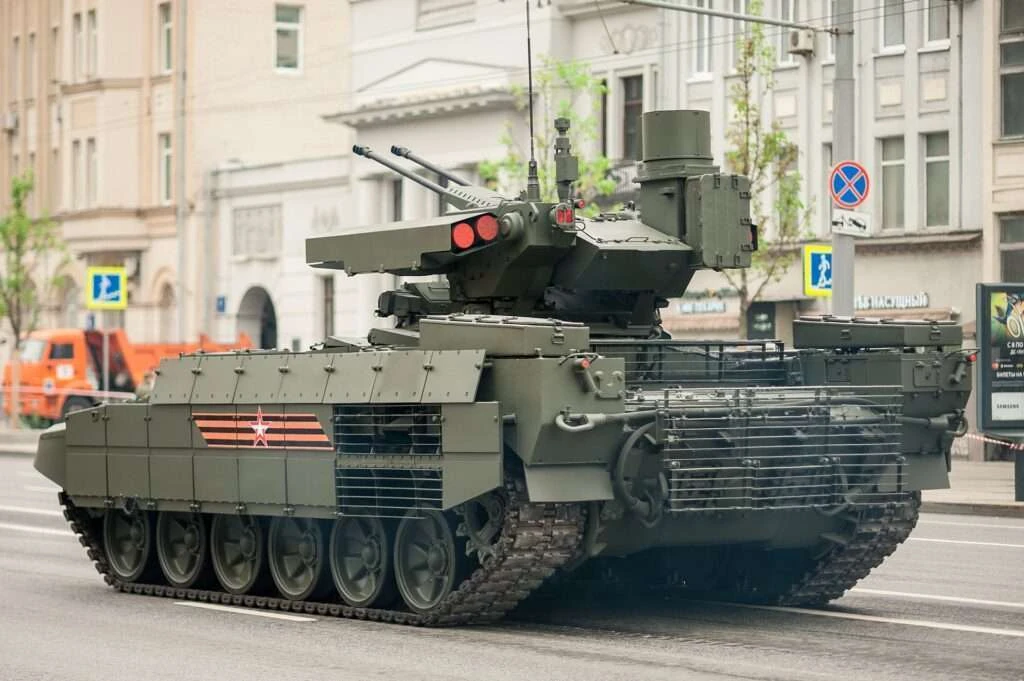
On paper, the vehicle’s armor looks impressive; it’s built on a T-72 tank chassis, which already gives it strong base protection. Over that, Russian engineers have added Relikt explosive reactive armor (ERA) on the front and sides, slat or cage armor at the rear, and thick side skirts to guard against shaped charges and fragments.
These layers are meant to handle hits from RPGs and light anti-tank weapons. In theory, that gives the Terminator a fighting chance against smaller drone-launched munitions. But modern drones often attack from above, and that’s where things get tricky; the top armor of most tanks and combat vehicles is still their weakest point. Even with extra cage armor over the roof, a well-aimed or repeated strike from a loitering drone can do real damage.
Experts who’ve followed the BMPT’s battlefield performance describe it as tough but not invincible. One Russian source quoted a crew member saying, “The uninhabited turret provides serious advantages. The Terminator can withstand many hits and still remain in service.” That suggests its design helps limit the damage from hits, especially since the crew sits deep in the armored hull.
Some analysts have pointed out that the newer Terminators look a bit tougher on top; extra roof armor and some gear have been added to jam drones. That probably comes straight from lessons learned in Ukraine, where cheap FPV drones have become daily threats.
Even so, those same analysts warn that no armor is magic. Out in the open, or without troops nearby to spot threats early, the Terminator could still be an easy mark.
When compared to other armored vehicles, the BMPT occupies an interesting middle ground. Against full main battle tanks like the T-90, it’s slightly less armored, especially in the front arc, where tanks have thick composite protection.
But compared to infantry fighting vehicles (IFVs) or armored personnel carriers (APCs), the Terminator is far better protected. Those lighter vehicles simply can’t handle a direct drone or missile hit the way a BMPT might.
Because it trades a big 125 mm cannon for multiple smaller weapons, designers could use that space and weight for extra armor and protection systems. So, it’s fair to say that Terminator is meant to handle the kind of ambush attacks. It might handle those situations better than most vehicles, though it can’t shrug them off entirely.
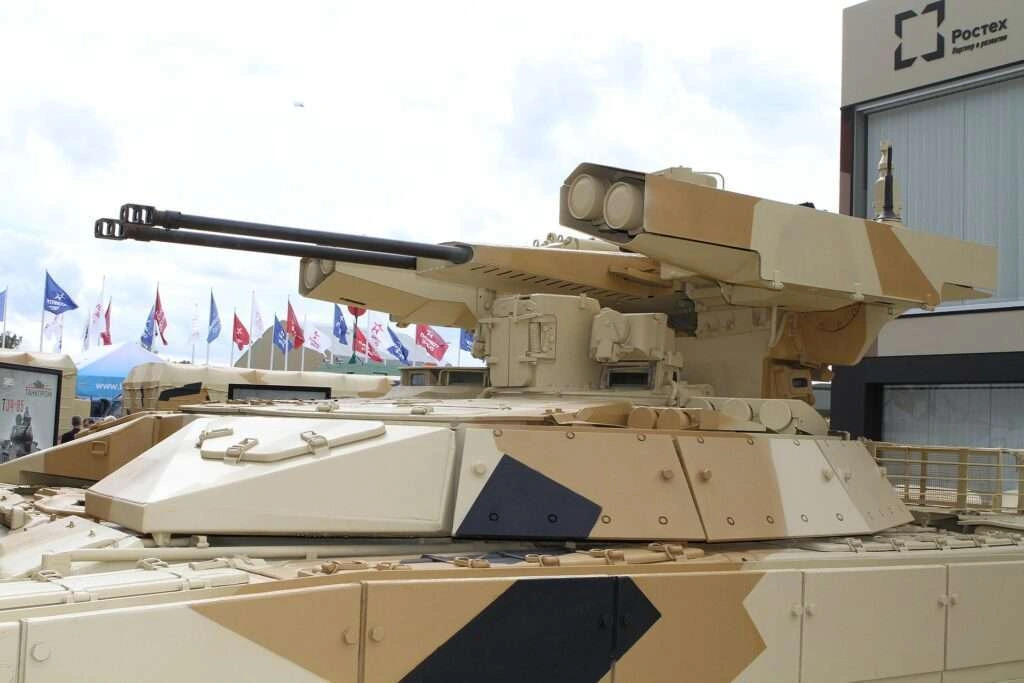
How well the Terminator holds up really comes down to use. It’s built solid, maybe tougher than most, but the battlefield’s changed. Drones don’t play by old rules; they hit from above, from the sides, sometimes all at once. So while it’s fair to say the Terminator can survive a lot, it’s just as fair to say it can still be brought down.
In the age of social media, the story of the BMPT Terminator has taken on a life of its own and not always a factual one. Every few months, new clips surface online claiming to show a “Terminator destroyed by drones” or “Russia’s invincible vehicle in flames.” These videos spread quickly, often without context or verification.
Some of them do show armored vehicles being hit, but on closer inspection, many experts point out they’re not actually BMPTs at all. It’s just T-72 tanks or BMPs filmed from awkward angles.
In several viral clips, the so-called Terminator’s distinctive twin autocannons are missing or blurred by smoke, making misidentification easy. The problem is that once a dramatic headline circulates “Drone wipes out Russia’s Terminator” it’s rarely corrected, even when the original claim is proven false.
Part of this confusion comes from how information travels during war. Most of the so-called “evidence” comes from drone feeds; shaky videos that get cut, reposted, and passed off as something new (which is part of the information war right now).
Ukraine wants the world to see Russian armor breaking down, and Russia wants to show its machines can take the hit. The Terminator ends up caught in that story. And the truth may sit somewhere in between.
When researchers and independent analysts check the details, they often realize things don’t line up. The same explosion might show up in three videos, filmed from different drones, and everyone assumes they’re new. Other times, old clips get recycled with new captions.
One viral video claimed a BMPT-72 was destroyed near Avdiivka this year, turns out it was the same video from 2023. It’s not always someone trying to mislead; sometimes it’s just how fast stories get copied and twisted online. Either way, it leaves everyone guessing what’s actually real.
So when the latest “Terminator destroyed” headline hits your feed, a bit of skepticism goes a long way. The BMPT’s reputation, whether for resilience or failure, is being shaped as much by viral videos and emotional storytelling as by verified battlefield data.
Until clearer evidence emerges, the fairest conclusion might be that the Terminator’s survival stories and its supposed destructions both tell us more about the fog of information war than about the vehicle itself.
It’s fair to say that it’s getting tougher for heavy armor to stay alive out there. The Terminator’s a good reminder of that. Ten years ago, thick plating and big guns were enough to make a difference.
Not anymore. These days, a small drone, something that costs a few thousand bucks, can take out a machine worth millions that took years to build. That’s a tough reality for any army to swallow.
The Terminator was meant to cover tanks, to keep them safe from infantry or ambushes. But war changed faster than the design did. Nowadays , the danger doesn’t always come from the front now; it comes from above, quiet and fast.

The Terminator shows both the potential and the limits of old-school armor in this new environment. It’s heavily protected and can take more punishment than most fighting vehicles, but even it struggles against persistent drone attacks. Some experts think that’s where the next big design shift will happen.
Adding more armor doesn’t seem to be the answer anymore. What’s coming next looks to focus more on technology; creating systems that jam or knock down drones before they hit (e.g., electronic warfare systems, active defenses, or anti-drone sensors). There’s even talk of tanks carrying their own mini drones, almost like guards that fly ahead and warn them what’s coming.
Maybe the big lesson from the BMPT’s story is that survival isn’t really about being the heaviest thing on the field anymore. Staying alive depends more on how smart the systems are and how alert the people inside stay. Vehicles like it will still have a place, sure, but they’ll probably look and fight nothing like the ones we know today.