Follow Us:
Follow Us:

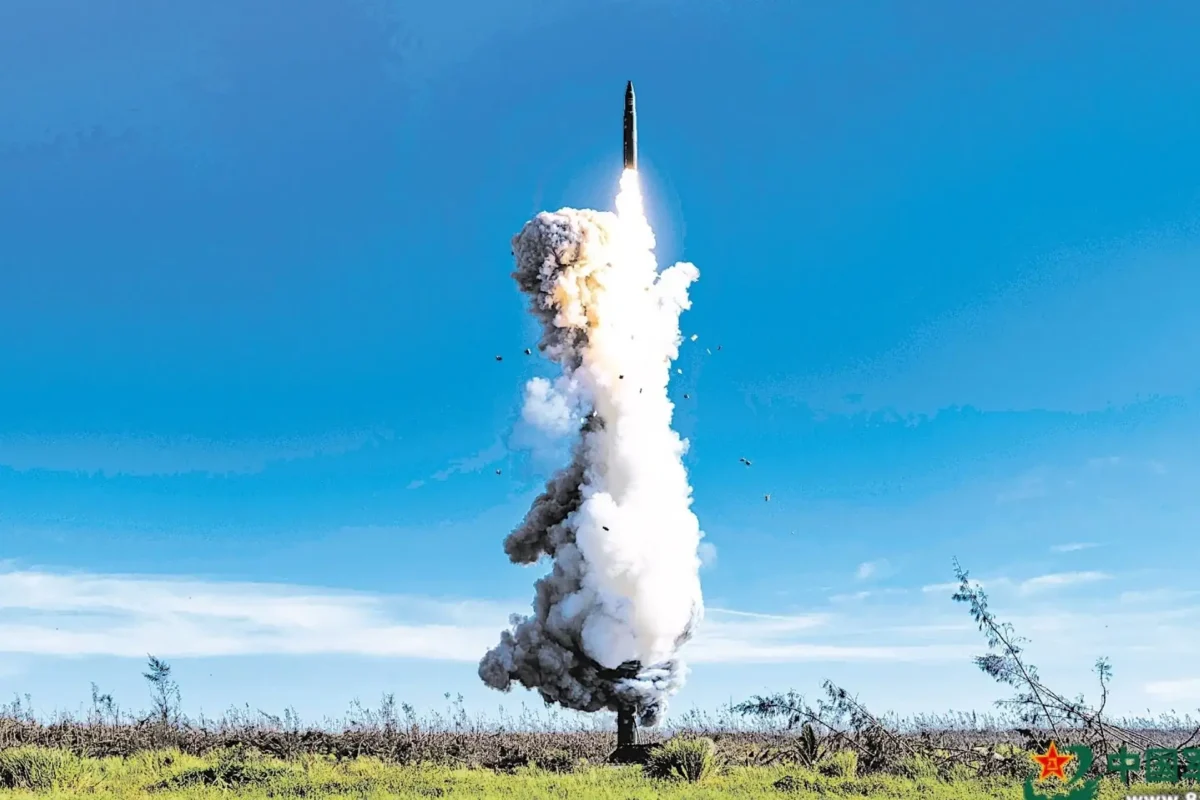
People have been talking a lot about China’s missile program lately — especially after that mysterious test in September 2025. It wasn’t clear what kind of missile it was, and opinions went in all directions. But it did remind everyone of the DF-41 missile.
It’s hard to talk about China’s missile program without mentioning the DF-41, or Dongfeng-41. From what’s known, it is fast, mobile, and able to carry several nuclear warheads. But the truth is, nobody outside China knows the full story.
What’s interesting is how much China’s overall strategy now seems to lean on systems like this. At the 2025 parade, for instance, the country showed off new land, sea, and air nuclear platforms.
Missiles that looked like the DF-41 were a highlight and got people wondering just how far China’s deterrent had come. It leaves people wondering how much of the DF-41 missile’s reputation is fact, how far can it go, how fast, how accurate, and how credible is the threat?
Few things show how far China’s missile technology has come better than its top intercontinental systems. Among them, the DF-41 missile stands out or at least, that’s how it’s often described. It’s believed to carry multiple nuclear warheads and travel incredible distances. But as with most things involving China’s strategic weapons, there’s still a lot we don’t know for sure.
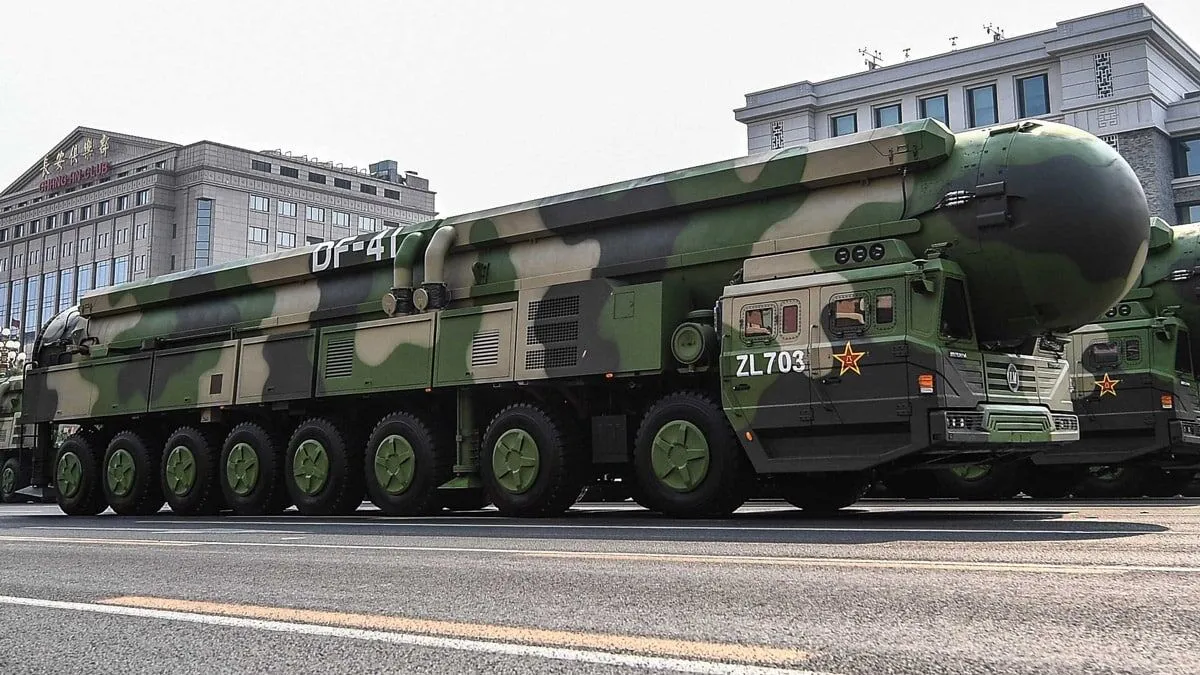
People often focus on the DF-41’s ability to carry several warheads; some say as many as ten. Whether that’s true or not, what seems clearer is how mobile the system is. Instead of being locked in underground silos, it rides on huge road vehicles that can move around and hide more easily. That’s a major advantage for any country thinking about how to keep its nuclear forces safe.
The DF-41 missile has a long backstory. China likely began working on it in the late 1980s or early 1990s to modernize its nuclear forces. Older missiles like the DF-4 and DF-5 used liquid fuel and took time to prepare. The new design aimed to be more mobile and ready to launch faster, giving it a better chance of surviving if things ever turned serious.
When you compare it to earlier models like the DF-31, the differences start to show. The DF-31 was China’s first solid-fuel ICBM that could be launched from a mobile platform, but its range was shorter, around 11,000 kilometers at most.
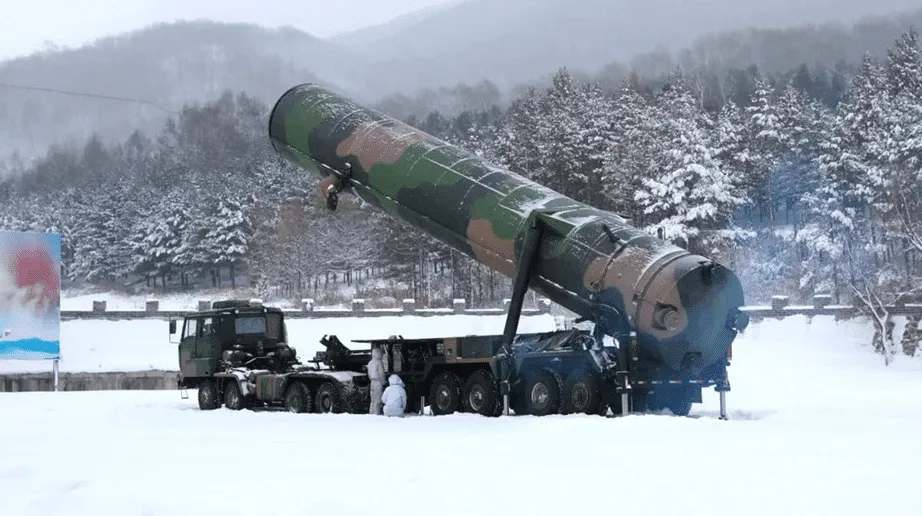
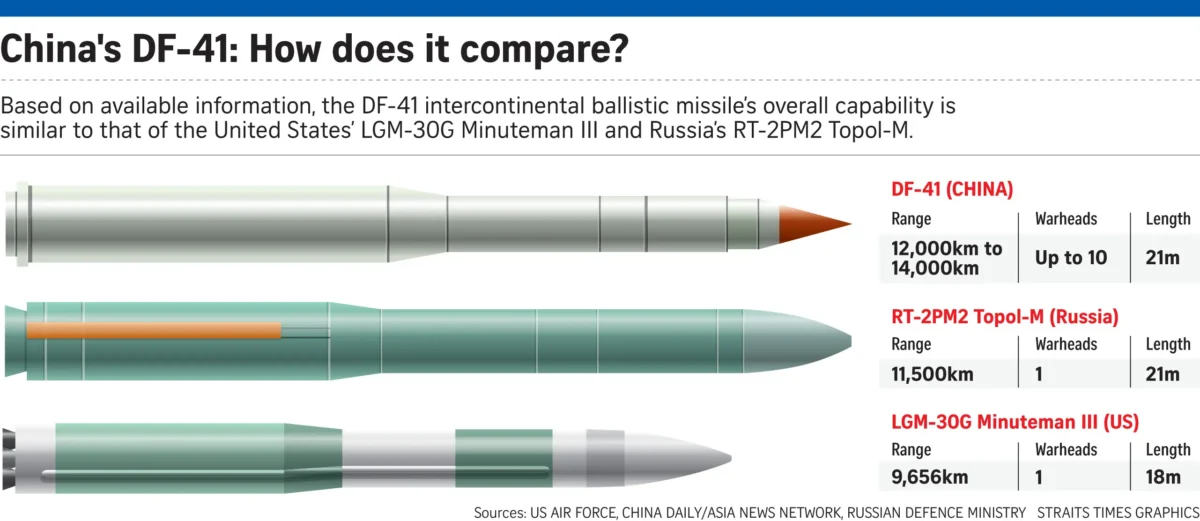
The DF-41 missile, if reports are accurate, may reach up to 15,000 kilometers. That’s far enough to hit almost anywhere in the world. Some defense sources even suggest better speed and accuracy, but those numbers are mostly estimates. So while the DF-41 looks impressive, it’s more of a continuation than a complete leap.
| Feature | Typical estimate / public reporting | Notes |
| Developer / Operator | People’s Liberation Army Rocket Force (PLARF) / China | Official Chinese details are limited. |
| Propulsion | Solid-fuel rocket stages | Solid propellant allows quicker launch and easier mobility than old liquid rockets. |
| Length | ~20–22 m (estimated) | Some public sources give different figures; hard to confirm from imagery alone. |
| Diameter | ~2–2.2 m (estimated) | Ballpark from transporter and silo images. |
| Launch weight | ~80–100+ tonnes (estimated) | Varies by configuration and is reported by some analysts. |
| Range (operational) | ~12,000–15,000 km (commonly cited) | May be shorter or longer depending on payload/MIRV load; these numbers are widely quoted. |
| Top speed | Re-entry vehicle hypersonic speeds, roughly Mach 15–25 (order of magnitude) | ICBM re-entry speeds are extremely high; exact figures vary by trajectory and stage. |
| Payload / warheads | MIRVs, often reported as up to ~3–10 warheads (estimates vary) | Public estimates range a lot; many analysts suggest multiple warheads but exact count is uncertain. |
| Re-entry vehicles | Multiple independently targetable reentry vehicles (MIRVs) | MIRVs increase strike flexibility and complicate missile defenses. |
| Guidance / accuracy | Inertial navigation possibly augmented by satellite and celestial updates; CEP likely tens to a few hundred meters (est) | China may have improved guidance, but open-source CEP estimates vary. |
| Launch platforms | Road-mobile transporter-erector-launcher (TEL); silo-capable; possible rail-mobile variants reported | Road mobility is emphasized in many assessments; silo variants increase readiness. |
| Deployment status | Entering service / limited deployment (public reporting varies) | Some units reportedly fielded; public confirmation is partial. |
What does this translate to …
• It’s an ICBM built for reach. The DF-41 missile is meant to go very far; long enough to strike distant continents if needed. When people say “12,000–15,000 km,” that means it could, in principle, reach targets practically anywhere on Earth from many launch points in China. That’s why it’s grouped with other long-range strategic weapons.
• It’s fast or ridiculously fast, but that’s normal for ICBMs. Saying “Mach 15–25” sounds dramatic, and it is. But that’s roughly the speed range re-entry vehicles hit when they come back through the atmosphere after an ICBM flight. Those speeds are what make intercepting them so hard; small timing or tracking errors can matter a lot.
• MIRVs change the math. If the DF-41 carries multiple independently targetable reentry vehicles, one missile can threaten several targets. That complicates missile defense and raises the stakes in a nuclear standoff. How many warheads it actually carries in service is debated, so it’s safer to say “multiple” rather than lock in a single number.
• Mobility = survivability. Road-mobile launchers (and possible rail or silo options) mean the missile force can hide, move, and disperse. That makes it harder for an adversary to find and destroy all of China’s ICBMs in a first strike, which is exactly the point for a deterrent force.
• Accuracy is better than old rockets, but exact figures are fuzzy. Modern guidance systems probably make the DF-41 more accurate than older Chinese ICBMs, but public estimates of CEP (how close it hits to the aim point) vary. Whether it’s “tens of meters” or “a few hundred meters” depends on the payload, flight profile, and what upgrades China has actually fielded.
What people actually mean by “accuracy”
When analysts talk about accuracy they usually mean CEP or circular error probable. It is the radius of a circle that contains 50% of the impacts.
So a 100-meter CEP doesn’t mean every shot lands inside 100 m, it means half do. That matters a lot when you’re thinking about whether a warhead needs megatons to destroy a hardened target, or if a smaller yield will do.
A lot of reputable open sources that track missiles suggest the DF-41’s CEP is on the order of ~100 meters (give or take). That’s become a common benchmark in public reporting, not a hard number from Beijing, but an estimate based on demonstrated guidance technology, imagery of reentry vehicles, and comparisons with earlier Chinese missiles.
Put differently, the DF-41 is widely thought to be in the “tens to low hundreds of metres CEP” band rather than being measured in kilometres.
Most modern intercontinental ballistic missiles use several layers of guidance, and the DF-41 seems to follow that pattern. Most analysts expect the DF-41 to lean heavily on an inertial navigation system; the usual mix of gyros and accelerometers.
INS is handy because it runs by itself and isn’t vulnerable to jamming, so it handles the boost and midcourse phases well. It’s not perfect, though, inertial systems tend to drift over time, so without updates small errors build up across long flights. That’s why most countries pair INS with other navigation aids.
In China’s case, the BeiDou satellite navigation system probably fills that role. BeiDou reached global coverage only a few years ago, and integrating it into strategic weapons would make sense. When INS is supported by satellite updates from BeiDou, the missile can correct for drift and maintain a much tighter flight path.
If the DF-41 or its reentry vehicles can receive position fixes before reentry, or if targeting data is updated just before launch, that could significantly reduce its CEP. This combination of INS and BeiDou is believed to be one of the main reasons analysts think the DF-41 is more accurate than older Chinese missiles.
There’s also talk about an additional, older technique; stellar or celestial navigation. This involves using sensors that “look” at known stars to double-check the missile’s position while in space. It’s not new; both U.S. and Soviet missiles used similar systems during the Cold War, but it remains a clever backup in case satellite signals are jammed or unavailable.
Some open-source assessments mention that China may still use this method for redundancy, which would make sense given the growing risk of satellite interference in wartime.
Of course, there are still a few reasons to be cautious when talking about DF-41 accuracy. For one, satellite signals can be jammed or spoofed. Even with BeiDou in the mix, it’s possible that a high-tech adversary could interfere with those signals.
That’s why China and everyone else still relies heavily on inertial and celestial navigation. They don’t depend on outside signals, which keeps the missile accurate even in a contested environment.
Another issue is that accuracy can vary depending on the missile’s configuration. If the DF-41 carries multiple warheads (MIRVs) or flies on a less-than-optimal trajectory, its CEP could get worse.
A heavier payload or unusual flight path makes precision harder to maintain. So when someone quotes a single “accuracy number” for the DF-41, it’s better to treat it as a range or an estimate rather than a fixed figure.
There’s also the difference between test performance and real-world conditions. Missiles tested under controlled conditions; perfect weather, pre-programmed paths, and careful preparation; often perform better than they would in combat, where stress, uncertainty, and quick reaction times come into play.
The truth is, most of the public numbers about the DF-41’s accuracy come from outside analysts, not official Chinese data. So while it’s fair to say it’s very accurate for an ICBM, we should also admit that much of that confidence comes from inference rather than confirmed testing results.
The Minuteman III’s CEP is commonly reported in open sources at roughly ~100–200 meters, with modern upgrades pushing it toward the lower end of that range (often cited as ~120 m after upgrades). It’s a very mature system with decades of iterative guidance improvements; the U.S. also benefits from a long history of GNSS integration and rigorous verification.
Read also: How Powerful Is the Minuteman III Missile?
So, in public assessments, the DF-41 and upgraded Minuteman III are often placed in roughly comparable CEP bands, though the margin could go either way by variant and mission profile.
Public technical writeups on the Sarmat focus more on range, payload, and flight paths than on a precise CEP. The Sarmat is described as a heavy, long-range ICBM able to carry many warheads; open estimates suggest modern Russian ICBMs aim for CEPs in the low hundreds of metres as well, though the exact number for Sarmat in operational service is not universally agreed in public sources.
Some analyses treat Sarmat as roughly comparable in accuracy to the DF-41 or Minuteman when modern guidance is assumed. But again, precise, confirmed CEP numbers are scarce for Sarmat in open literature.
Read also: RS-28 Sarmat “Satan 2”: Russia’s Most Feared ICBM Today
So, the public picture suggests all three sit in the same ballpark of “roughly low-hundreds-of-metres CEP,” subject to variation by payload, updates, and GNSS availability. But why do CEP differences matter?
If CEP is tight (say, tens of metres), a warhead with modest yield could destroy hardened military targets (command bunkers, missile silos). If CEP is looser (hundreds of metres), you need bigger yields to guarantee destruction of hardened targets; otherwise the missile is more useful for counter-value (cities, broad area targets). That’s why small changes in CEP can matter strategically.
MIRVs and accuracy interact. MIRVs let one missile threaten many targets, but splitting mass among multiple RVs can reduce the velocity or maneuvering a single RV can have, and that can slightly influence individual RV accuracy; tradeoffs exist.
What really makes the DF-41 stand out is how it supports China’s nuclear deterrent. The logic behind it isn’t new; if you have missiles that can move, hide, and strike multiple places, it makes any potential enemy think twice before launching first. No one could be sure they’d destroy everything in one go. That uncertainty is what keeps deterrence working, and the DF-41 seems to fit that logic quite well.
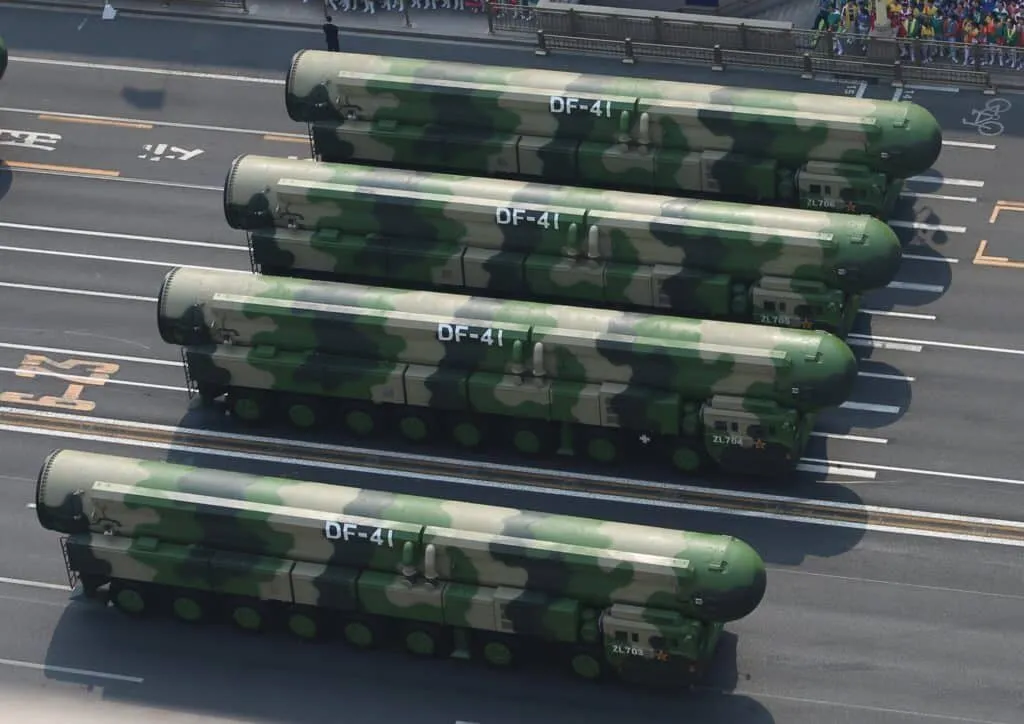
Part of why it strengthens deterrence is mobility. Road-mobile (and reportedly rail-mobile) launchers let missiles move, hide, and disperse across large areas. If you can’t reliably locate and destroy an opponent’s missiles on the ground, then the threat of a second strike becomes more credible.
Read also: China Debuts New DF-61 ICBM, Expands Nuclear Triad at Parade
In practice, that means the DF-41’s mobility increases the costs and uncertainty for any country thinking about a pre-emptive strike. Open reporting and imagery analyses have highlighted China’s push toward more mobile systems and camouflage practices that complicate targeting.
“Survivability” is the other big piece. Survivability isn’t just about being hard to find, it’s also about having diverse ways to deliver nuclear weapons. Beijing has been working on a more balanced triad (land, sea, air), and the DF-41 is a key land leg that’s both long-ranged and MIRV-capable, which amplifies its punch.
By increasing the number of dispersed, mobile ICBMs alongside growing sea-based forces, China makes a post-strike retaliation more believable, and that’s exactly what second-strike capability means. Many defense studies and recent force-structure assessments point to these trends as deliberate moves to raise China’s assured retaliation posture.
So what? The DF-41 missile probably makes China’s nuclear forces stronger and harder to target. But since many details are still secret, it’s safer to say it’s a big step forward, not a total game-changer just yet.