Follow Us:
Follow Us:

It looked like a spaceship. It flew like a ghost. And for years, it didn’t officially exist.
That was the F-117 Nighthawk—America’s first operational stealth aircraft and a revolutionary leap in air warfare.
Built in absolute secrecy by Lockheed’s Skunk Works in the late 1970s, the F-117 stealth fighter shattered the mold of traditional aircraft design. Forget curves and sleek wings—this jet was all sharp angles and radar-deflecting panels. Its mission was simple but bold: penetrate enemy airspace undetected and destroy high-value targets with pinpoint accuracy.
While labeled a “fighter,” the F-117 Nighthawk was no dogfighter. It carried no guns, relied on stealth over speed, and struck silently under the cover of darkness. That’s why it earned the nickname “Nighthawk” and was often mistaken for a stealth bomber.
The world first learned of the F-117 in 1988, but it had already been flying for years. Its first flight took place on June 18, 1981, and by 1983, it was operational. During the Gulf War in 1991, the aircraft proved its worth—flying over 1,200 sorties without a single loss.
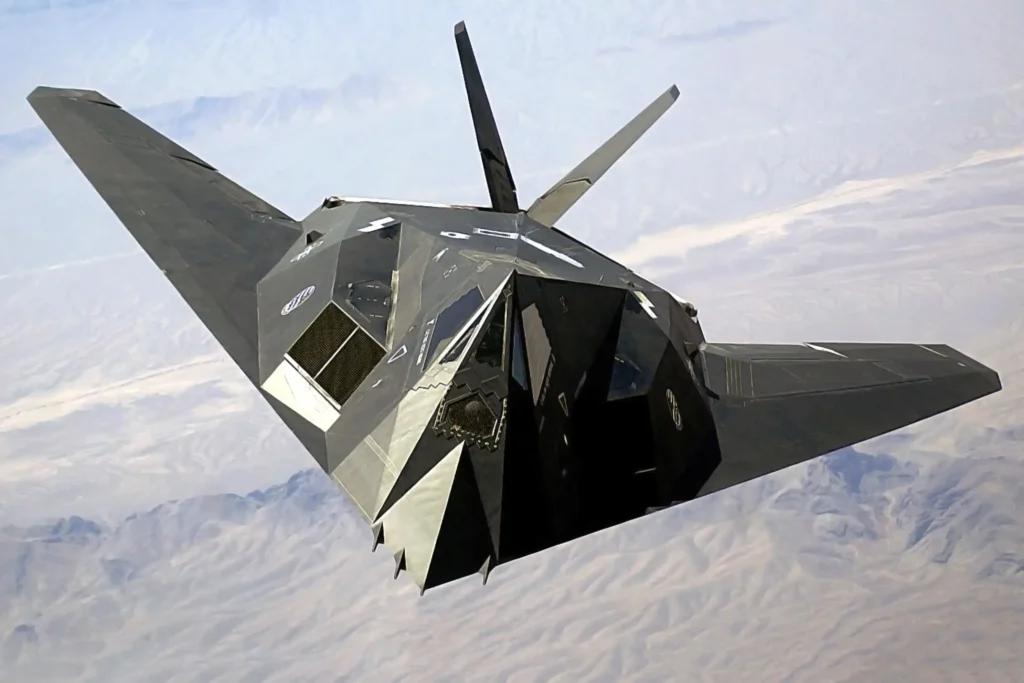
Under its black skin, the F-117 engine setup included two non-afterburning turbofans, making it subsonic but stealthy. It wasn’t fast—its top speed maxed out around Mach 0.9—but radar couldn’t see it coming.
The F-117 Nighthawk cockpit was strictly single-seat and packed with avionics designed for nighttime missions. It carried laser-guided bombs inside an internal bay to reduce its radar profile.
At a time when fighter jets focused on agility and speed, the Lockheed F-117 Nighthawk redefined what it meant to dominate the skies.
The story of the F-117 Nighthawk begins in the shadows of the Cold War. By the early 1970s, the U.S. Air Force realized that advanced Soviet radar systems posed a growing threat to American aircraft. Traditional methods like electronic jamming were no longer enough. What they needed wasn’t just better defense—it was near invisibility.
That idea set the foundation for stealth technology.
Lockheed’s secretive Skunk Works division took on the challenge. Under the leadership of Ben Rich, engineers developed a prototype known as Have Blue. It wasn’t pretty—it looked like a set of folded paper—but it worked. Have Blue proved that it was possible to bounce radar signals away from the source using a faceted design.
By 1978, the Air Force greenlit full-scale development of the stealth fighter. This project, shrouded in secrecy and funded through classified channels, eventually became the Lockheed F-117 Nighthawk.
The aircraft’s first flight took place on June 18, 1981, at Groom Lake, better known as Area 51. Just two years later, in 1983, the F-117 achieved Initial Operational Capability (IOC). At that point, it was officially flying combat-ready missions—though the public didn’t know.
Its existence wasn’t acknowledged until 1988, when the Pentagon released a grainy photo and minimal details. By then, the F-117 was already years into classified operations.
Over time, the F-117 stealth fighter transitioned from black-budget legend to battlefield weapon. In 1989, it flew combat missions during Operation Just Cause in Panama. But it was the 1991 Gulf War that cemented its legacy.
Even as other aircraft were dodging radar and missiles, the F-117 Nighthawk slipped through Iraqi air defenses with impunity. It flew over 1,200 sorties, dropped more than 2,000 tons of precision munitions, and returned with zero combat losses.
What made this success even more extraordinary was that the F-117 used no radar jammers and had no defensive weapons. Its protection came solely from stealth.
The aircraft’s unique shape, radar-absorbent materials, and precision targeting changed the way wars were fought. It wasn’t just a plane—it was a blueprint for future air superiority.
The F-117 Nighthawk wasn’t just visually unique—it was a marvel of stealth engineering. Every design choice, from its unusual airframe to its internal weapons bay, served one purpose: to avoid detection.
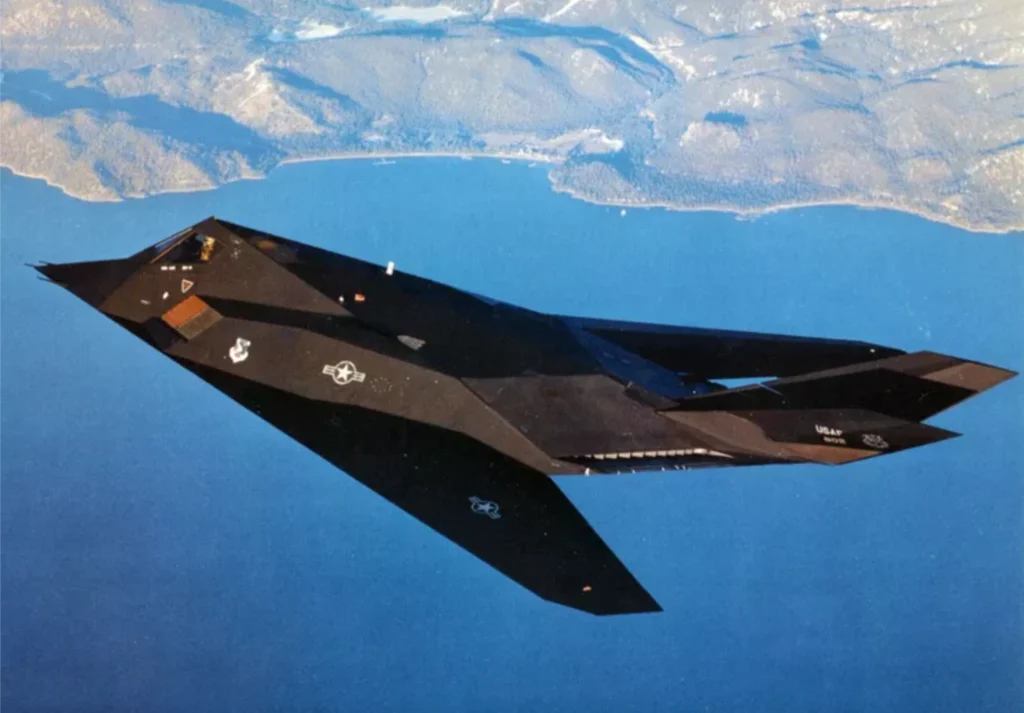
At first glance, the aircraft looks like a flying diamond. Its sharp edges and flat surfaces were a radical departure from the smooth curves of typical fighter jets. This wasn’t just for aesthetics. The faceted shape was critical for deflecting radar waves away from enemy sensors. The design was based on early computer modeling of radar reflection—a breakthrough at the time.
The F-117 stealth fighter measured about 65 feet (20 meters) in length, with a wingspan of 43 feet (13 meters). Its height stood at 12.5 feet. It weighed approximately 52,500 pounds (23,800 kg) when fully loaded.
Under the hood, the F-117 engine configuration featured two General Electric F404-GE-F1D2 turbofans. Unlike the afterburning engines found on most fighters, these were non-afterburning to reduce heat and infrared visibility. While this limited performance, it enhanced stealth.
Top performance numbers included a maximum speed just under Mach 1—about 617 mph (993 km/h). So the F-117 Nighthawk’s top speed wasn’t anything extraordinary. In fact, it was subsonic by design. High speed wasn’t necessary when the enemy couldn’t detect you.
The aircraft had a range of roughly 1,070 miles (1,720 km) without refueling and could reach altitudes of around 43,000 feet (13,100 meters). These figures made it ideal for penetrating hostile airspace and returning home without needing extensive support.
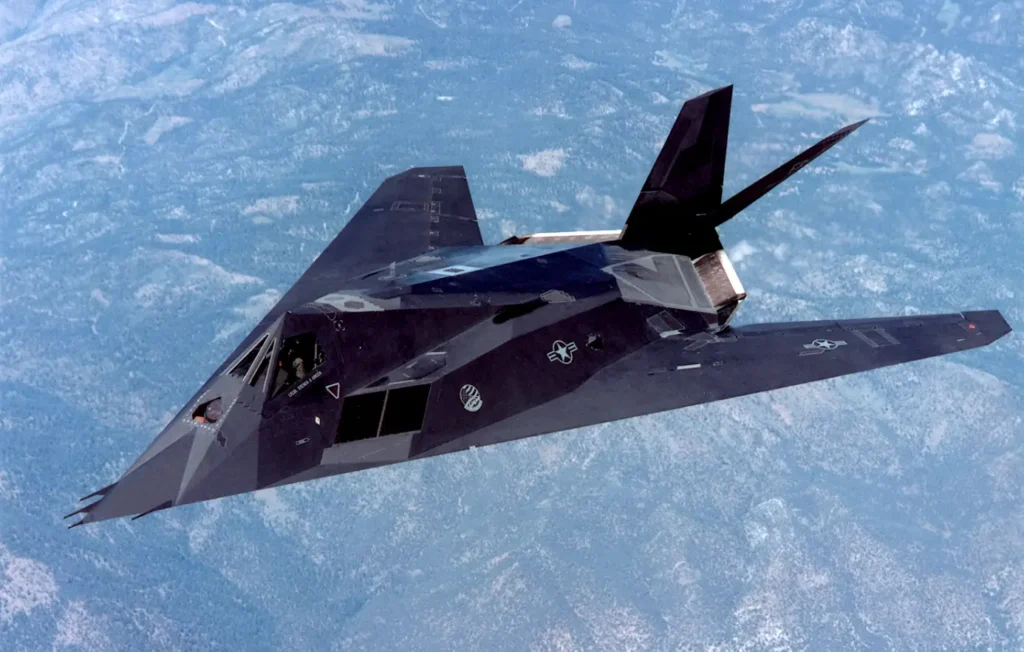
Inside the F-117 Nighthawk cockpit, the layout was relatively basic. It was a one-seat configuration with early-generation fly-by-wire controls and multi-function displays suited for nighttime operations. The F-117 stealth fighter cockpit was optimized for simplicity, allowing pilots to focus on their mission objectives without being overwhelmed by controls.
Armament was stored in an internal weapons bay to maintain a low radar profile. The F-117 Nighthawk armament typically included two laser-guided bombs, such as the GBU-10 Paveway II or the more precise GBU-27 Paveway III. These were ideal for striking hardened targets like bunkers, bridges, or command centers.
Despite its outdated avionics by modern standards, the F-117’s design remains legendary. In terms of innovation per pound, the Lockheed F-117 Nighthawk might still be one of the most efficient airframes ever built.
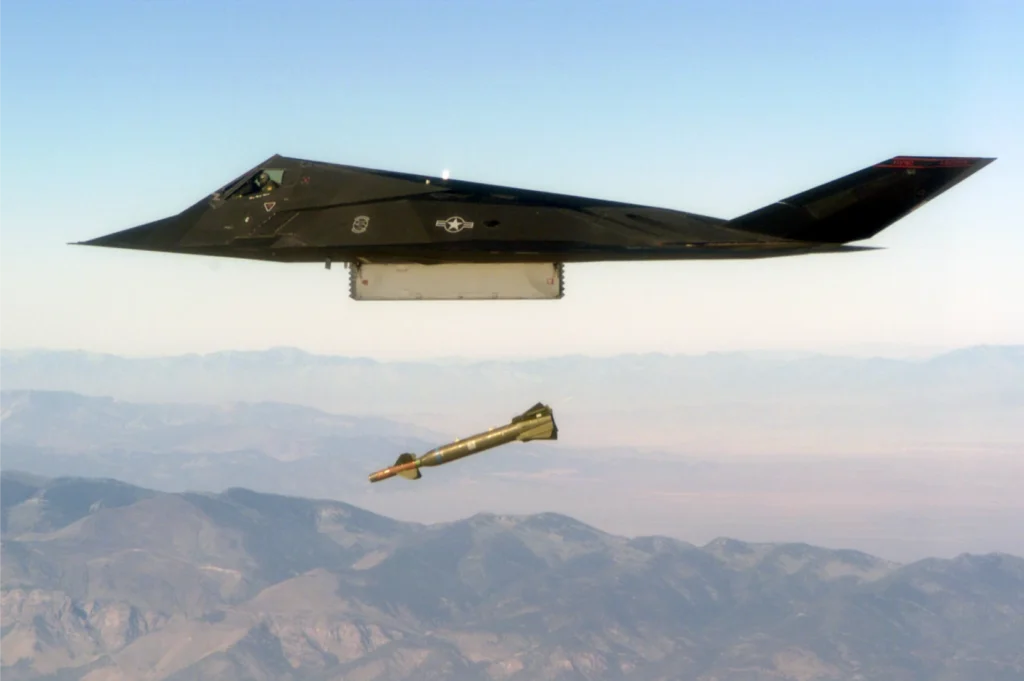
The magic behind the F-117 Nighthawk wasn’t in its speed, agility, or firepower. It was in something much harder to see—literally. The true weapon of this aircraft was its stealth. The ability to fly deep into enemy territory undetected changed the rules of air combat forever.
But how did it work?
The F-117 stealth fighter achieved invisibility through a revolutionary blend of design, materials, and tactics. Its strange, angular body wasn’t just for show—it was meticulously engineered to deflect radar waves in every direction except back to the radar source. This reduced its radar cross-section to the size of a bird—virtually invisible to traditional radar systems.

At a time when most jets were sleek and aerodynamic, the Lockheed F-117 Nighthawk looked like a broken prism. Its surface was covered in flat panels arranged at precise angles. This design was based on a concept called faceting, which was crucial for scattering radar energy.
To enhance this effect, the aircraft was coated with radar-absorbent material (RAM). These coatings further reduced its visibility on radar screens by soaking up signals instead of bouncing them back. While RAM wasn’t new, the Nighthawk’s coating was among the most advanced of its time.
Read also: How Do Stealth Aircraft Work? Stealth Tech Breakdown
The aircraft’s engine configuration also played a role in its stealth profile. The two General Electric F404 turbofans were buried deep in the fuselage, with flat exhaust nozzles that reduced heat emissions and infrared visibility. This design helped minimize detection from heat-seeking missiles and IR sensors—critical for surviving in hostile airspace.
Stealth wasn’t just about radar. It also required limiting visible, acoustic, and electronic signatures. The F-117 engine produced minimal smoke and left a small heat trail. Its narrow profile, matte black paint, and nighttime-only missions made it hard to spot with the naked eye, even from the ground.
The cockpit, internal weapons bay, and antenna placements were all built with stealth in mind. Even the F-117 Nighthawk cockpit canopy used special coatings to reduce radar reflection from the pilot’s helmet.
In short, every inch of the Nighthawk screamed low-observable technology. It was the first aircraft built not to fight radar—but to disappear from it.
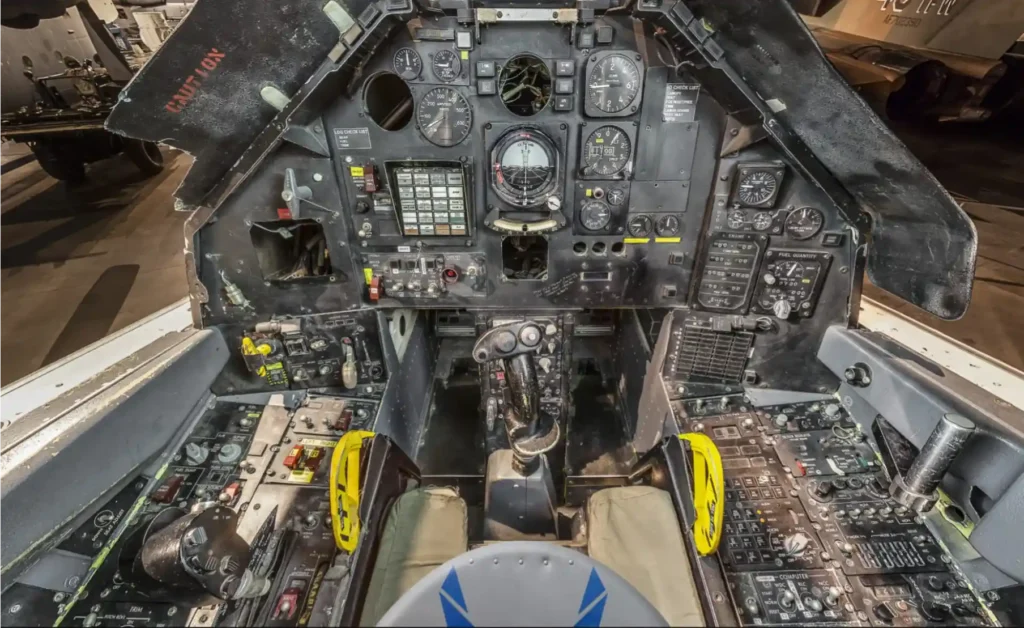
The F-117 Nighthawk may have been born in secrecy, but it earned its legacy in combat. Unlike many experimental aircraft that never see the battlefield, the Nighthawk became a frontline weapon in some of the most pivotal U.S. military operations of the late 20th century.
Its first combat mission came during Operation Just Cause in Panama, December 1989. In that conflict, the F-117 was used to drop precision bombs near Panamanian Defense Force barracks to shock and disorient enemy forces without causing mass casualties. The mission proved its surgical accuracy and ability to operate under heavy cover of darkness.
But it was the Gulf War in 1991 where the F-117 made history.
Nicknamed the “Black Jet,” it flew nearly 1,300 sorties over Iraq, striking heavily defended targets that other aircraft couldn’t reach. It hit communication centers, government buildings, air defense systems, and bunkers deep in Baghdad—all without being detected or shot down. While it represented less than 3% of coalition air assets, the F-117 Nighthawk was tasked with hitting over 40% of the high-value targets in the first days of the war.
The aircraft carried GBU-10 and GBU-27 laser-guided bombs, stored in its internal bay to maintain stealth. The F-117 Nighthawk armament wasn’t diverse, but it was precise. The use of two 2,000-pound bombs allowed it to cripple key infrastructure with minimal collateral damage.
Its ability to strike without warning became a psychological weapon. Iraqi air defenses struggled to respond. They fired thousands of missiles but never landed a hit—until 1999.
During the Kosovo War, on March 27, 1999, a Serbian missile battery managed to shoot down an F-117 using a Soviet-built SA-3 system. The incident marked the first and only known F-117 Nighthawk shot down in combat. The pilot ejected safely and was rescued, but the wreckage was partially recovered by adversaries, sparking concerns over stealth technology compromise.
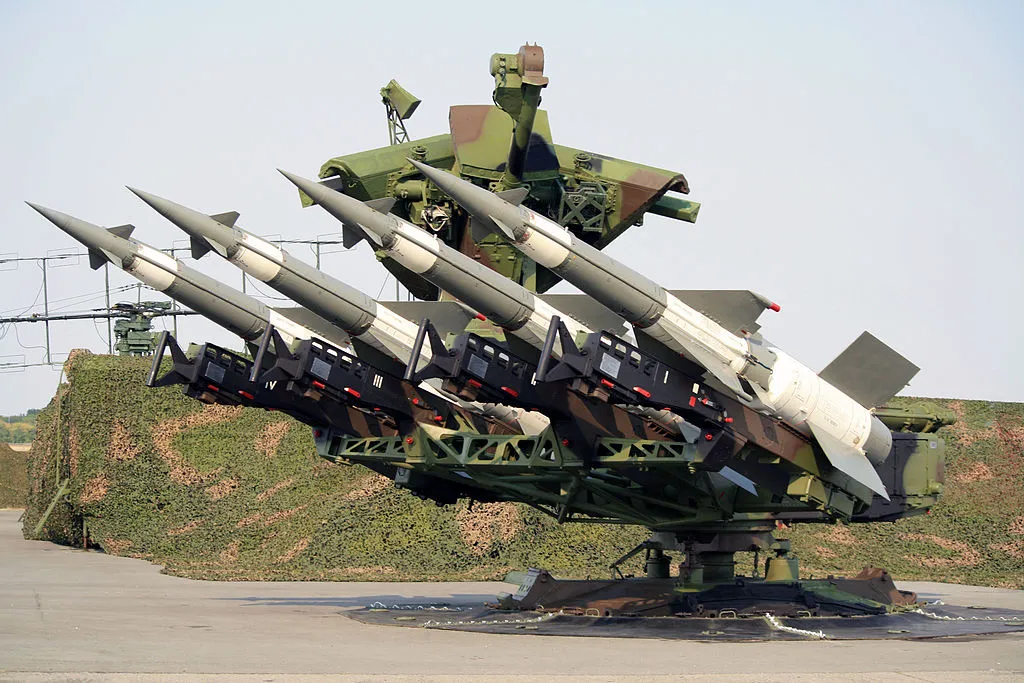
Despite that loss, the Nighthawk’s combat record remained unmatched. It was later used in Operation Iraqi Freedom in the early 2000s, targeting air defenses and command centers.
By 2008, the F-117 was officially retired. But even after its withdrawal, sightings of flying Nighthawks continued—fueling speculation about their secretive post-retirement role or limited use as stealth trainers.
From Panama to Baghdad, the F-117 stealth bomber proved that invisibility could win wars.
For years, the F-117 Nighthawk was thought to be invincible. Designed to slip through enemy radar and strike without warning, it had flown hundreds of missions without taking a single hit. But that aura of invulnerability was shattered in 1999, during the NATO bombing campaign in Yugoslavia.
On March 27, 1999, an F-117 was shot down by the Serbian military. It remains the only F-117 Nighthawk shot down in combat.
The pilot, Lt. Col. Dale Zelko, had taken off from Aviano Air Base in Italy and was flying a bombing mission over Belgrade during Operation Allied Force. Unknown to him, a Yugoslavian air defense unit had been tracking the general flight paths of NATO aircraft, including stealth jets. That night, they used a vintage Soviet-made SA-3 surface-to-air missile system, modified for better tracking and timed to catch the Nighthawk during a known window of vulnerability—when it opened its bomb bay doors.
The missile struck the F-117, causing critical damage. Zelko ejected safely and was recovered hours later in a successful search-and-rescue operation. But the loss of the aircraft was a significant moment—it showed that stealth didn’t mean “invisible,” only “harder to detect.”
The wreckage of the F-117 was recovered by the Serbians, and parts were reportedly shared with foreign governments, including Russia and China. This raised concerns that sensitive stealth technologies may have been compromised, though the U.S. never confirmed any serious breach.
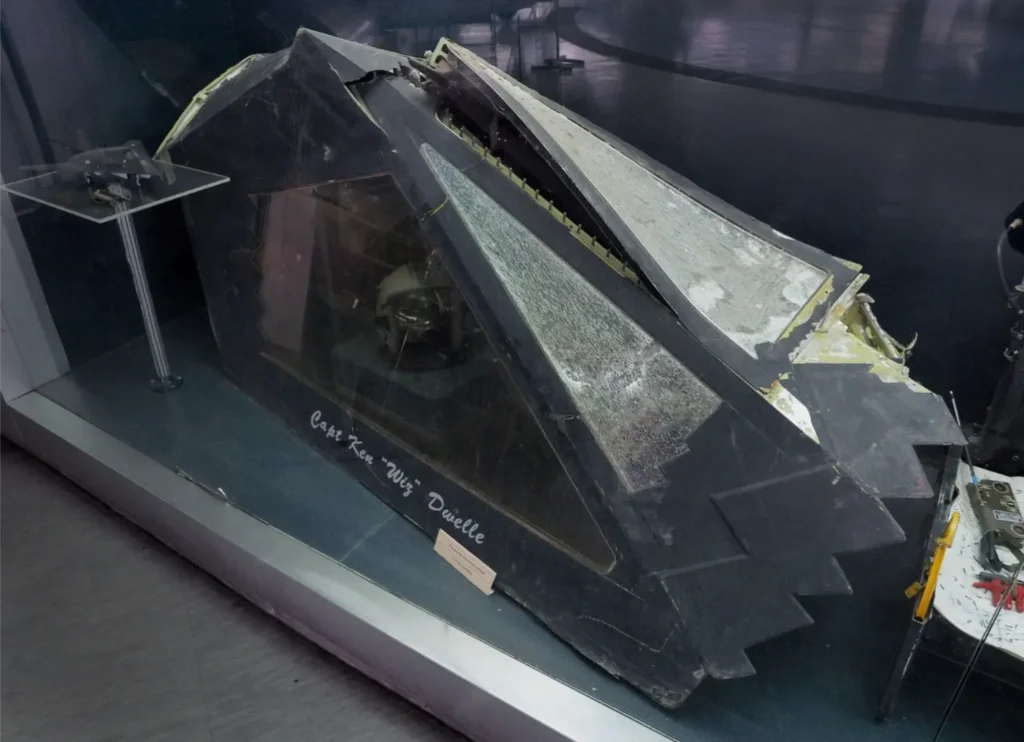
The incident sparked debate in military circles. Some questioned whether the F-117 stealth fighter was becoming outdated, especially as radar and missile systems evolved. It also highlighted the importance of operational tactics—stealth alone couldn’t guarantee survivability.
Despite this setback, the F-117 continued to fly missions for several more years, including operations in Iraq and Afghanistan. But the 1999 shootdown remains the most famous—and humbling—moment in the jet’s otherwise remarkable combat record.
It was a reminder that no aircraft, no matter how advanced, is truly untouchable.
By the time the F-117 Nighthawk retired in 2008, it had already reshaped modern air warfare. But its influence didn’t end when it was taken out of active service—it simply moved into the background, much like the jet itself had always done.
The U.S. Air Force began phasing out the Nighthawk in favor of the more advanced F-22 Raptor, a true multirole stealth fighter. This marked the arrival of the F-117 replacement, an aircraft capable of both air-to-air combat and precision ground strikes—roles the F-117 couldn’t perform simultaneously. The F-22 was faster, more maneuverable, and integrated stealth into a broader range of missions. Though not a direct successor in function, it inherited the stealth mantle.
Despite retirement, the F-117 didn’t vanish entirely. Several aircraft were placed into a state known as Type 1000 storage at the Tonopah Test Range, meaning they could be recalled to flight status if needed. In fact, sightings of flying Nighthawks have continued over the years, with photos and videos emerging as recently as the 2020s.
These appearances suggest that some F-117s have been used for training exercises, possibly serving as stealth targets for radar testing or simulating enemy aircraft. Others believe the aircraft plays a role in secret programs or stealth-related experimentation. Whatever the reason, its continued activity fuels speculation and adds to its legend.
The F-117 Nighthawk price at the time of procurement was around $111 million per unit in 1990s dollars—an enormous figure for a subsonic, single-role platform. However, that investment laid the groundwork for an entire generation of stealth aircraft. The technology developed for the Nighthawk directly contributed to platforms like the B-2 Spirit, F-22 Raptor, and F-35 Lightning II.
Today, you can find the F-117 stealth fighter in museums across the U.S. Notable examples include the National Museum of the U.S. Air Force in Dayton, Hill Aerospace Museum in Utah, and the Ronald Reagan Presidential Library in California. These static displays help preserve the history of a jet that was once too secret to even acknowledge.
The Lockheed F-117 Nighthawk was never built to last forever—but its legacy will. It was the first aircraft to make invisibility real, and it showed the world that the future of air power wasn’t just about speed or firepower—it was about staying unseen.