Follow Us:
Follow Us:

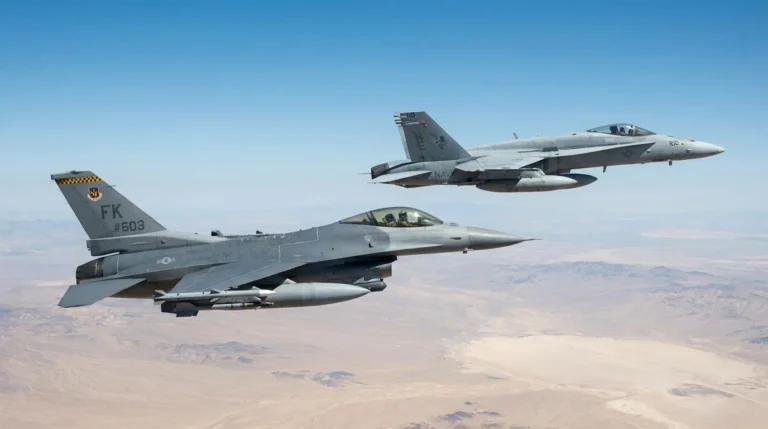
To the casual observer, the F-18 Hornet vs Super Hornet may seem like two versions of the same aircraft—just a minor upgrade, a name tweak, perhaps a few added capabilities.
But that assumption couldn’t be further from the truth. While they share a designation, these two jets differ so significantly in design, size, performance, and mission roles that some aviation analysts argue the Super Hornet should’ve had an entirely new name.
With the U.S. Navy now planning for a post-Super Hornet future, amid rising tensions in the Indo-Pacific and the looming arrival of sixth-generation platforms, the differences between these aircraft are not just historical trivia. They matter. Especially as countries like Australia continue operating both airframes and debates resurface about the Super Hornet’s survivability in high-end conflict zones like the South China Sea.
So how did a jet that began life as a lightweight multirole fighter evolve into a much larger, more complex platform? And is the F/A-18E/F Super Hornet truly a “better Hornet,” or a fundamentally different beast?
The story of the F/A-18 Hornet begins in the uncertainty of the 1970s, a time when the U.S. military was still digesting the hard lessons of the Vietnam War.
The Navy, in particular, was rethinking its approach to air combat. Older carrier-based aircraft like the A-7 Corsair II and F-4 Phantom II were powerful but increasingly outdated. They were either too specialized or too maintenance-heavy to meet the shifting demands of modern warfare.
The Department of Defense wanted something new, something flexible, affordable, and adaptable. Out of that need emerged the Lightweight Fighter program, which eventually led to the development of two aircraft: the Air Force’s F-16 Fighting Falcon, and for the Navy, what would become the F/A-18 Hornet.

Based on Northrop’s YF-17 prototype, the F/A-18 was shaped to do what few jets had done before: combine the roles of fighter and attack aircraft into one multirole platform.
Hence the dual “F/A” designation—Fighter/Attack. It wasn’t just about saving money (though cost-efficiency was a key factor); it was about giving carrier air wings more flexibility without requiring an entirely separate fleet of aircraft.
By the early 1980s, the F/A-18C/D Hornet was entering operational service, quickly becoming a staple of U.S. Navy and Marine Corps aviation. Its twin engines offered reliability and power. Its agility made it a formidable opponent in dogfights.
And perhaps most importantly, it was built for life at sea, rugged enough to handle the punishing routine of carrier takeoffs and landings. Over the next two decades, the F/A-18 Hornet proved itself in a wide range of missions, from the Gulf War to Kosovo, and later in Afghanistan and Iraq.
In terms of specs, the F-18 Hornet top speed reached about Mach 1.8, powered by two General Electric F404 engines. It could carry a wide mix of air-to-air and air-to-ground weapons, making it well-suited for both interception and strike missions.
While not particularly large, its f-18 hornet payload capacity, around 13,700 pounds, was enough to fulfill most carrier-based tasks without requiring heavier bombers.
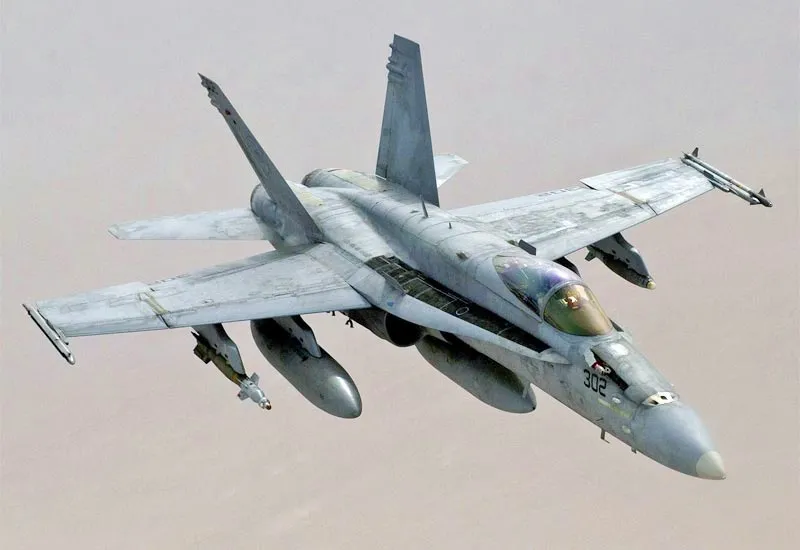
Today, the F-18 Hornet was retired from carrier operations in 2019. However, it remains active in several allied air forces, including Australia, Canada, and Switzerland, which continue to rely on its combat-proven track record and operational flexibility.
By the early 1990s, it was becoming increasingly clear that the original F/A-18 Hornet—as capable as it was—might not be enough for the challenges ahead.
The Cold War had ended, but new kinds of threats were emerging: longer-range missions, low-observable radar threats, and rising costs in operating legacy aircraft like the F-14 Tomcat. The Navy needed something bigger, more flexible, and more survivable—but without the massive price tag of developing a brand-new jet from scratch.
That’s where the F/A-18E/F Super Hornet entered the picture.
At a glance, the Super Hornet looks similar to the Legacy Hornet. It shares the same basic aerodynamic shape and carrier-based DNA. But under the skin, it’s a substantially redesigned aircraft.
First flying in 1995 and entering service with the U.S. Navy by 1999, the F/A-18E (single-seat) and F/A-18F (two-seat) models were essentially a clean-sheet redesign that still preserved the Hornet’s multirole philosophy.
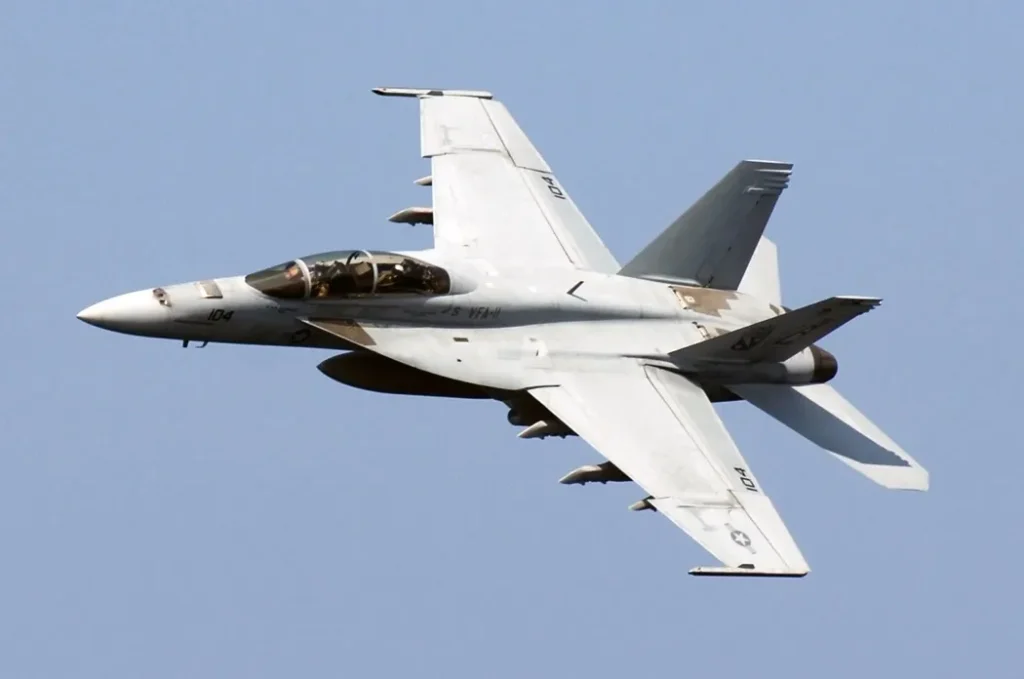
The differences in design are, frankly, hard to overstate. The Super Hornet’s airframe is approximately 20% larger, with an increased wingspan, a stretched fuselage, and additional hardpoints. That extra size translated into significantly more internal fuel, improving the range by around 35–40% compared to the original Hornet.
What’s more, the F-18 Super Hornet’s payload capacity jumped to nearly 17,750 pounds, allowing the aircraft to carry a broader and more lethal mix of weapons, including precision-guided munitions, long-range standoff missiles, and electronic warfare pods.
This payload flexibility helped the Super Hornet grow into roles that the original Hornet wasn’t designed for, including the vital role of tanker support (via the “Buddy Pod” refueling system) and electronic warfare (with the EA-18G Growler variant).
It’s also worth noting that the Super Hornet’s engines—two General Electric F414s—offered around 35% more thrust than the legacy F404s, giving the jet the power it needed to carry heavier payloads without sacrificing agility.

Still, some might argue that the Super Hornet trades a bit of the original Hornet’s nimbleness for endurance and versatility. It’s not quite as sleek in a dogfight, but it’s far more capable in longer, complex missions that demand more fuel, more weapons, and more resilience.
In many ways, the F-18 Super Hornet represents the U.S. Navy’s shift in mindset, from Cold War-era air dominance to post–Cold War adaptability. While it retains the carrier-friendly features of the original, twin engines, rugged landing gear, folding wings, its larger frame and enhanced capabilities have allowed it to become the Navy’s primary strike fighter for nearly two decades.
One of the most immediate differences lies in physical dimensions. The Super Hornet is about 20% larger than the original F-18 Hornet in nearly every measurable way. It stretches over 60 feet in length, compared to roughly 56 feet for the legacy Hornet. Its wingspan is also wider, 44.9 feet versus the Hornet’s 40.4 feet, and its empty weight comes in several thousand pounds heavier.
This increase in size enables the Super Hornet to carry more fuel internally, contributing to its greater range and endurance. It also provides extra room for upgraded avionics, weapons bays, and cooling systems.
Still, it’s worth noting that this larger footprint can create logistical challenges on crowded carrier decks, especially when maneuvering or parking aircraft. However, both aircraft retain foldable wings, a critical design feature that helps optimize space efficiency aboard aircraft carriers.

While both jets are equipped with advanced combat systems for their respective eras, the Super Hornet’s avionics suite is a generational leap forward. It features more powerful radar, such as the AN/APG-79 AESA (Active Electronically Scanned Array) radar in later variants, which provides superior target tracking, electronic warfare resistance, and simultaneous air-to-air and air-to-ground engagement capabilities.
The cockpit layout also reflects modern trends: glass displays, touchscreen interfaces (in Block III variants), and digital data fusion, making it easier for pilots to manage complex missions with less workload. In contrast, the F/A-18C/D Hornet—while advanced for the 1980s—relied more heavily on analog gauges and less integrated systems.
In practical terms, this means the Super Hornet can process and deliver more real-time information to pilots, which might give it a key advantage in modern high-threat environments.
In terms of raw speed, the difference is relatively modest. The F-18 Hornet’s top speed clocks in around Mach 1.8, while the Super Hornet is slightly slower at Mach 1.6, likely due to its larger size and added weight. However, that speed difference is arguably less important today than other performance metrics.
Where the Super Hornet does pull ahead is in combat radius and range. Thanks to additional internal fuel and more efficient F414 engines, the Super Hornet has a combat radius of approximately 722 nautical miles, compared to around 500 nautical miles for the legacy Hornet. That extra range may prove vital in future Indo-Pacific operations, where distance and endurance are increasingly important.
That said, the legacy Hornet was often considered more agile, especially in close-in air-to-air engagements. Its smaller frame and lighter weight may have given it a slight edge in maneuverability, particularly in dogfighting scenarios, though this is somewhat subjective and mission-dependent.
When it comes to combat punch, the F-18 Super Hornet has a clear upper hand. With 11 hardpoints and a max payload capacity of around 17,750 pounds, it can carry more weapons—and more diverse ones—than the original Hornet, which had 9 hardpoints and a payload limit of about 13,700 pounds.
The Super Hornet’s weapon compatibility includes everything from AIM-120 AMRAAMs and JDAMs to anti-ship missiles and electronic warfare pods. Plus, it’s been adapted to launch newer standoff weapons, such as the AGM-158C LRASM, which the older Hornet cannot integrate without major modifications.
Both jets retain the iconic 20mm M61 Vulcan cannon, but in terms of sheer versatility and future-proofing, the Super Hornet’s expanded payload options make it more adaptable to evolving mission sets.

Both aircraft are carrier-optimized, but the Super Hornet was specifically designed to improve on the Hornet’s already successful naval compatibility. It features a redesigned tailhook, beefed-up landing gear, and wider-spaced main wheels for better carrier handling and safer arrested landings. These might seem like small tweaks, but they contribute to the Super Hornet’s improved landing stability, especially during rough sea states or nighttime operations.
The foldable wings, strengthened airframe, and corrosion-resistant materials continue to make both aircraft well-suited for maritime environments, though the Super Hornet’s newer design materials may offer longer-lasting durability.

While the F-18 Hornet was known for its relatively low maintenance burden and high sortie rate, it’s becoming increasingly costly and difficult to maintain as parts become scarce and airframes age. In fact, one of the driving factors behind its U.S. Navy retirement was precisely this growing logistical challenge.
The F-18 Super Hornet, on the other hand, benefits from newer parts availability, digital maintenance tracking, and ongoing upgrades, especially the Block III configuration, which includes structural life extension and advanced networking capabilities.
But even so, some analysts argue that the Super Hornet’s lifecycle cost is rising due to increased complexity and the evolving nature of high-tech warfare.
In terms of raw numbers, the f-18 hornet cost per unit was reportedly around $29 million, while the f-18 super hornet cost is closer to $65–70 million, depending on configuration and upgrades. But that higher sticker price reflects not just inflation, but expanded mission capability, longer range, and modernized systems.
That really depends on how we define “better.” If we’re talking about raw capability, the F/A-18E/F Super Hornet is clearly more advanced, it offers greater range, higher payload, more modern avionics, and better adaptability to evolving mission requirements. But if the mission doesn’t require all of that? Then the original F/A-18C/D Hornet might still be the more practical choice in some contexts.
The legacy Hornet, for example, is arguably better suited for lighter roles, such as air policing, close air support, or shorter-range strike missions, especially in regions where airspace is relatively permissive and logistics favor simpler, more agile platforms. It’s smaller, more maneuverable in certain scenarios, and generally cheaper to operate though that cost advantage has been shrinking as maintenance becomes more difficult over time.
In contrast, the Super Hornet is designed for multirole operations in more complex environments. Its extended range and payload make it better suited for longer-range strike missions, carrier-based power projection, and networked air warfare, especially when paired with advanced standoff munitions and datalink capabilities.
For example, its role as an aerial tanker or its ability to integrate seamlessly with the EA-18G Growler gives it strategic utility that the legacy Hornet simply can’t match.
From a fleet strategy perspective, this shift is reflected in how the U.S. Navy transitioned away from the older Hornets entirely by the late 2010s.
The Super Hornet became the backbone of carrier air wings for a reason: it offered a more future-proof platform, especially with the Block III upgrade extending its service life and adding advanced features like low observability and enhanced situational awareness.
However, for allied operators with smaller air forces or more modest mission sets—like Finland (before its shift to the F-35) or Switzerland, the legacy Hornet arguably made more sense at the time. It was reliable, relatively affordable, and capable of fulfilling a range of peacetime and wartime roles without overextending defense budgets.
Bottom Line?
If the priority is cost-effective, short-to-mid-range operations, the legacy F/A-18 Hornet may still be good enough in some cases. But for navies or air forces needing a more capable multirole platform with extended strike range and modern survivability, the F/A-18 Super Hornet is likely the better fit.
Still, which one is “better” depends less on raw specs—and more on the mission, geography, budget, and strategic priorities of the operator.