Follow Us:
Follow Us:


Defense Feeds – New US M1117 Guardians have given Kosovo a significant boost to its defense capability after the United States delivered 50 of the armored vehicles to the Kosovo Security Force (KSF).
Prime Minister Albin Kurti announced on August 17 that Kosovo had received new M1117 Guardians, a purchase considered among the largest additions to the country’s ground combat capabilities.
The transfer, carried out under the U.S. Excess Defense Articles Program, underscores Washington’s long-term commitment to helping Kosovo modernize its armed forces and strengthen national defense against emerging regional security challenges.
Military analysts emphasize that these new US M1117 Guardians are more than just an upgrade in hardware.
Their delivery also sends a strong strategic signal at a time when Kosovo continues to face tensions with Serbia and growing geopolitical competition across the Western Balkans.
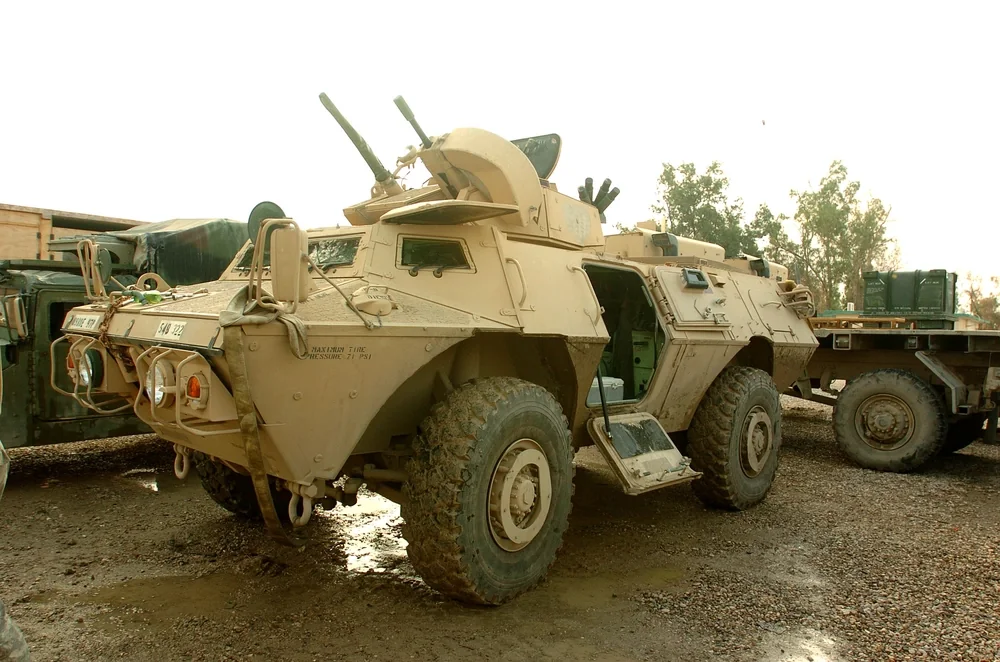
The M1117 Guardian, manufactured by Textron Marine & Land Systems, was originally developed for the U.S. Army Military Police Corps.
It has been extensively tested in combat during operations in Iraq and Afghanistan, where its combination of mobility, armor, and firepower proved invaluable in urban warfare and counter-insurgency environments.
Built with a robust all-welded steel hull reinforced with ceramic-composite applique panels, the M1117 offers protection against 12.7 mm armor-piercing rounds, artillery fragments, and the deadly threat of mines and improvised explosive devices (IEDs).
The vehicle also incorporates advanced survivability features such as blast-resistant seating and firing ports for crew protection.
Weighing roughly 13.4 tonnes, it is powered by a Cummins 6CTA8.3 turbocharged diesel engine that produces 260 horsepower, paired with an Allison MD3560 automatic transmission.
The vehicle reaches 101 km/h and sustains an operational range of 725 km, influenced by terrain type.
Run-flat tires and a central tire inflation system ensure mobility even under hostile fire, while four-wheel independent suspension allows the vehicle to handle Kosovo’s rugged landscapes, including mountainous zones and rural roads with limited infrastructure.
Its turret system is one of its defining features, equipped with a .50 caliber M2HB heavy machine gun, a 40 mm Mk 19 automatic grenade launcher, and a co-axially mounted M240H 7.62 mm machine gun.
Additional configurations include smoke grenade launchers and options for thermal imaging, GPS, and laser targeting systems.
The vehicle operates with a crew of three and can carry up to three additional soldiers, giving it both offensive punch and troop transport capabilities.
Within armed forces, the Guardian is valued for its versatility and reliability.Its missions range from convoy escort, border patrol, reconnaissance, and VIP transport to supporting stabilization operations in urban hotspots.
For the KSF, it represents a critical enhancement of mobility and firepower, bridging the gap between existing light vehicles and heavier armored platforms.
The delivery of these armored vehicles is taking place against a backdrop of persistent friction with Serbia, particularly in northern Kosovo where Serb-majority municipalities continue to question Pristina’s authority.
Despite progress under the EU-brokered Ohrid Agreement in 2023, implementation has largely stalled, while sporadic violence underscores the fragile security environment.
One of the clearest reminders of this volatility came in September 2023, when armed Serbian paramilitary groups carried out a deadly attack in the village of Banjska.
Since then, Belgrade’s troop movements near the border and political standoffs in international forums have added pressure on Kosovo to strengthen its deterrence posture.
Beyond the Serbia-Kosovo dynamic, the Western Balkans remain a theater of strategic competition, with regional and global powers vying for influence.
Disinformation campaigns, foreign-backed destabilization measures, and political interference continue to challenge the region’s move toward Euro-Atlantic integration.
Kosovo’s leadership has responded by prioritizing a modern, NATO-interoperable armed force—a goal that these capabilities directly support.
Recent years have seen the KSF acquire UH-60M Black Hawk helicopters, FGM-148 Javelin missiles, and advanced communications systems as part of a decade-long modernization strategy aimed at transforming the force into a full territorial defense structure by 2028.
The addition of the Guardians fits into this roadmap, complementing air mobility, anti-armor firepower, and logistical support capacities.
Furthermore, in March 2025 Kosovo joined a trilateral defense cooperation pact with Albania and Croatia, strengthening interoperability and signaling regional solidarity in security affairs.
The U.S. supply of these M1117s is seen as reinforcing that alignment while elevating Kosovo’s operational readiness for both defensive and peacekeeping roles.
As the 50 M1117 Guardians are deployed within active battalions, Kosovo gains a tool that is both practical and symbolic.
On a tactical level, these vehicles offer commanders greater flexibility in responding quickly to crises across difficult terrain or in urban flashpoints.
They represent a significant increase in survivability and lethality for Kosovo’s troops, helping to safeguard national borders and deter hostile acts.
From a broader perspective, the delivery highlights Kosovo’s deepening alignment with the United States. For a young state still consolidating its sovereignty, visible U.S. defense support offers not only hardware but also credibility on the international stage.
In the coming years, the KSF will integrate the Guardians into joint exercises with U.S. and NATO partners, ensuring technical proficiency and doctrinal alignment.
Their modular design also leaves room for adaptation, whether as command-and-control units, medical evacuation platforms, or specialized communication hubs.
For Kosovo, this acquisition is about much more than armored vehicles—it is about consolidating sovereignty, deterring aggression, and signaling a commitment to stability in a region where unresolved disputes and foreign interference remain persistent threats.