Follow Us:
Follow Us:

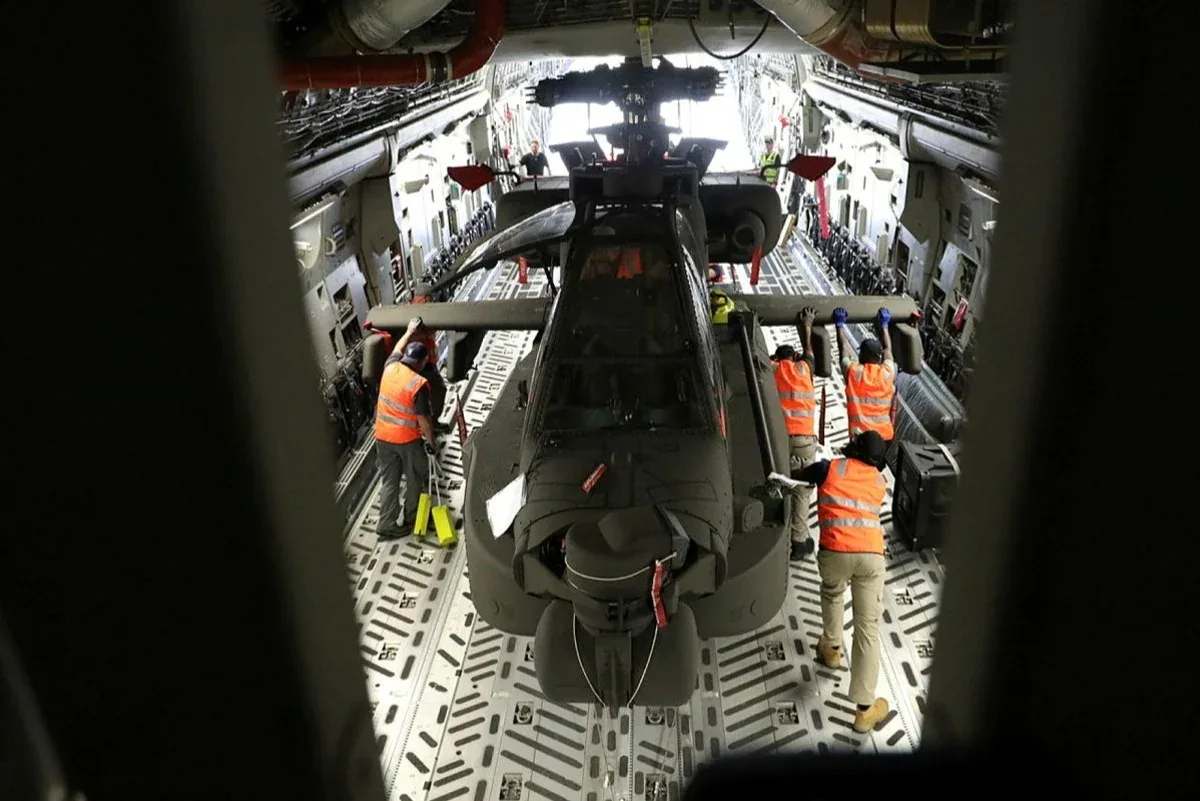
Defense Feeds, Canberra — Australia AH-64E Apache delivery expands Army attack capability as the Australian Army receives two additional AH-64E Apache Guardian helicopters under its ongoing aviation modernization program. The arrival marks another major step in replacing the Army’s aging Tiger attack helicopter fleet with one of the world’s most advanced combat rotorcraft platforms.
The AH-64E Apache Guardian is widely regarded as one of the most capable attack helicopters currently in service. Equipped with advanced targeting systems, improved networking capability and upgraded survivability features, the aircraft is designed to operate in complex battlefield environments while supporting both conventional and expeditionary missions.
Australia’s Apache acquisition program reflects broader efforts to strengthen military readiness and improve interoperability with allied forces, particularly the United States. As regional security challenges continue evolving in the Indo-Pacific, modern combat aviation capability is becoming increasingly important for deterrence and rapid response operations.
The AH-64E Apache Guardian introduces major improvements over previous attack helicopter generations. Equipped with advanced sensors, radar systems and precision-guided weapons, the aircraft is capable of engaging both ground and aerial threats in day or night operations.
One of the Apache’s key advantages is its ability to operate in highly contested environments while maintaining strong battlefield awareness. Modern avionics and data-sharing systems allow the aircraft to coordinate effectively with ground forces, drones and other air assets during operations.
The AH-64E also features improved engine performance and enhanced survivability systems compared to earlier variants. These upgrades increase operational reliability while allowing the helicopter to perform more effectively in demanding environments.
In addition to anti-armor and close air support missions, the Apache can support reconnaissance, escort and maritime security operations. This flexibility makes it a valuable asset across a wide range of military scenarios.
The helicopter’s ability to integrate with unmanned systems is another major capability enhancement. Modern Apache variants can coordinate with drones to extend surveillance reach and improve targeting efficiency during combat missions.
The arrival of additional Apache helicopters forms part of Australia’s broader defense modernization strategy focused on replacing older platforms with more advanced and interoperable systems. The AH-64E is set to gradually replace the Army’s Airbus Tiger helicopters over the coming years.
Australia selected the Apache because of its proven operational record and extensive use by allied militaries. Operating a widely used platform also improves logistics, training and interoperability during joint operations with partner nations.
The transition to the AH-64E requires extensive pilot training, infrastructure preparation and maintenance support. Integrating a new attack helicopter fleet is a complex process involving both operational and technical adaptation across the Army aviation branch.
The Apache acquisition also supports broader regional defense planning. Modern attack helicopters provide rapid-response capability during high-intensity operations while supporting land maneuver and force protection missions.
In addition, enhanced combat aviation capability strengthens Australia’s ability to contribute to coalition operations and regional security initiatives. Interoperability with allied systems is becoming increasingly important in modern military planning.
Australia’s investment in advanced combat aviation reflects the changing security dynamics of the Indo-Pacific region. Expanding military modernization across the region, combined with growing strategic competition, has increased emphasis on readiness and operational flexibility.
Attack helicopters remain important despite the rise of drones and precision-guided missiles. Their ability to provide mobile firepower, close air support and rapid response capability continues to make them highly relevant in modern warfare.
The Apache’s advanced networking and targeting systems are especially valuable in future battlefield environments expected to rely heavily on real-time data sharing and integrated operations. Modern combat increasingly depends on coordination between air, land and autonomous systems.
The arrival of additional helicopters also demonstrates Australia’s continued focus on strengthening defense cooperation with the United States. Shared platforms and compatible systems simplify joint training and multinational operations across the Indo-Pacific region.
At the same time, maintaining advanced aviation capability requires significant long-term investment in maintenance, logistics and personnel training. Ensuring operational readiness over the life of the fleet will remain a major priority for the Australian Army.
Looking ahead, the AH-64E Apache is expected to become a central component of Australia’s future land combat capability. As regional security challenges continue evolving, advanced attack helicopters will remain important for deterrence, force projection and battlefield support operations.
The delivery of two more Apache helicopters highlights Australia’s ongoing effort to modernize its armed forces with proven and technologically advanced systems. In an increasingly contested strategic environment, maintaining capable and interoperable combat aviation assets is becoming more critical than ever.