Follow Us:
Follow Us:


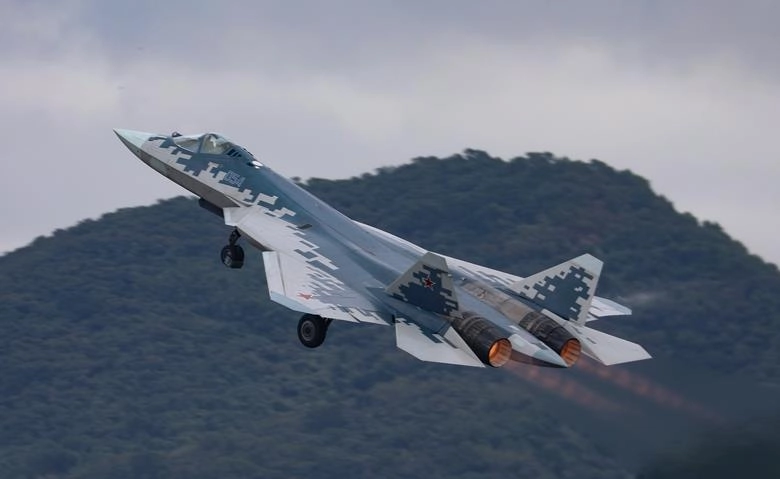
Defense Feeds – Russia’s Su-57 Debuts Anti-Radar Missiles configuration in newly released footage that showcases the stealth fighter carrying two Kh‑58UShK missiles inside its forward weapons bay.
The display highlights the aircraft’s progress in low‑observable design and its growing focus on internal weapons integration for improved radar evasion during strike missions.
The video also emphasizes Russia’s intent to demonstrate the Su‑57’s advanced capabilities before upcoming global defense exhibitions, aiming to attract international buyers and reinforce its position as the centerpiece of Moscow’s next‑generation airpower modernization strategy despite production and supply challenges.
The United Aircraft Corporation (UAC), part of the Rostec conglomerate, released a promotional video on November 9 displaying the Su‑57 carrying two Kh‑58UShK anti‑radiation missiles inside its forward weapons bay.
The aircraft, identified as test unit T‑50‑9 with the tail number 509, is seen performing maneuvers with the bay doors open, marking the first confirmed demonstration of the jet carrying such missiles internally during flight.
The Kh‑58UShK is designed to destroy enemy radar installations from long ranges, playing a vital role in Suppression of Enemy Air Defense (SEAD) operations.
Internal integration of these missiles suggests that the Su‑57 aims to minimize radar detection while striking air defense targets.
Russian engineers reportedly developed bespoke internal ejectors for the deep tandem bays to accommodate these large munitions.
The video also shows two short-range R‑74 air‑to‑air missiles mounted externally, providing a glimpse of how the jet balances stealth with operational flexibility.
Observers suggest that this type of load configuration showcases how the Felon can shift between mission types, maintaining stealth in offensive operations while retaining defensive missiles when radar suppression is secondary.
The footage’s release coincides with preparations for Dubai Airshow 2025, where Moscow seeks to attract international buyers for the Su‑57 and other platforms under the United Aircraft Corporation portfolio.
The promotion follows reports of leaked internal Rostec files shared by hacker collective “Black Mirror,” which allegedly referenced ongoing negotiations with Iran, Algeria, and Ethiopia for potential Su‑57 exports.
Although the authenticity of these documents has not been verified, they reflect Russia’s continued push to market the Felon abroad despite sanctions, limited production capacity, and persistent dependence on foreign suppliers for advanced components. With Western restrictions constraining access to precision manufacturing equipment, the Kremlin has reportedly relied on covert supply routes through intermediary states to maintain production.
Industry insiders suggest that demonstrating internal anti‑radar missile loadouts ahead of the airshow is a strategic move to strengthen the jet’s appeal to prospective clients, highlighting features comparable to the American F‑35’s internal armament design.
While the Su‑57 is promoted as Russia’s first fifth‑generation fighter, Western analysts remain skeptical about whether it fully meets that classification.
Critics often cite weaker radar signature reduction compared to U.S. and allied stealth fighters, as well as the jet’s inconsistent production pace since entering limited service.
Engine upgrades and improved avionics have been promised under upcoming modernization programs, but exact timelines remain vague.
According to independent assessments, the airframe’s internal weapon system does show notable advancements in low‑observable integration, aligning it conceptually with other stealth aircraft.
However, its current propulsion system and radar cross-section measurements reportedly fall short of fifth‑generation benchmarks set by the F‑35 Lightning II and F‑22 Raptor.
Meanwhile, prior leaks by cyber groups InformNapalm and Fenix revealed through classified files from OKBM that both the Su‑57 and the under‑development PAK DA stealth bomber depend on imported CNC machinery and subsystems.
These disclosures emphasize the technological hurdles Russia faces in sustaining next‑generation aircraft manufacturing under stringent global sanctions.
Even with these limitations, Russia still promotes the Su‑57 as the cornerstone of its modern aerospace forces, integrating advanced sensors, electronic warfare suites, and internally mounted weapons.
As the Dubai Airshow approaches, Moscow’s renewed marketing effort suggests it hopes to prove that the Felon still holds export potential, even as doubts linger about whether it truly ranks among the world’s elite stealth fighters.