Follow Us:

Follow Us:


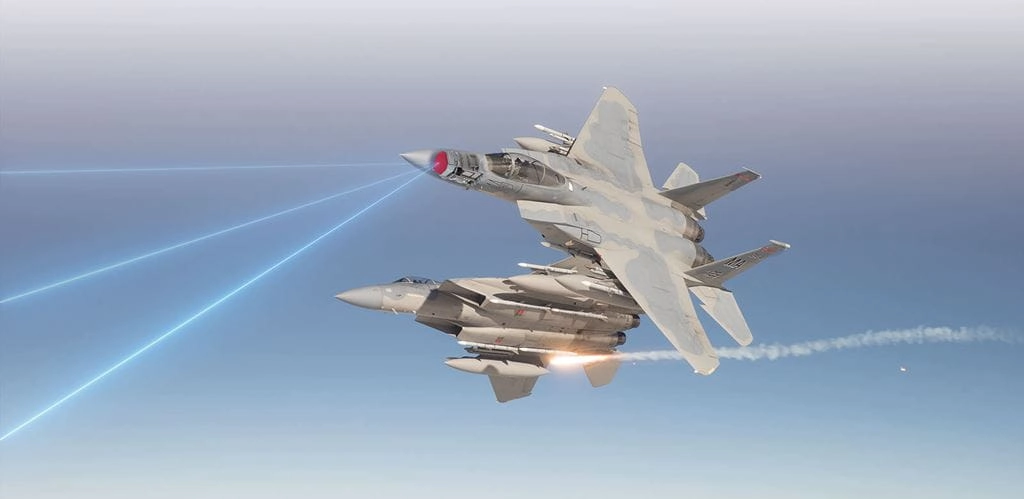
Defense Feeds – RTX GaN Radar APG-82(V)X has been introduced by Raytheon, marking the latest upgrade to the combat-proven APG-82 system.
The new radar, enhanced with gallium nitride (GaN) technology, promises extended detection ranges, quicker target acquisition, and improved flexibility across air-to-air, air-to-ground and electronic warfare missions.
Designated as the APG-82(V)X, the system provides what RTX describes as a critical “first-look, first-shoot advantage” that strengthens survivability against emerging aerial and missile threats.
The major advancement in the APG-82(V)X lies in the integration of GaN-based semiconductors, which have become increasingly vital in modern radar design.
Compared to conventional gallium arsenide components, GaN delivers higher power handling and improved efficiency, enabling longer detection ranges without placing additional strain on an aircraft’s power systems.
This improvement is critical for modern fighters that operate in electronically contested environments, where reaction time can determine mission outcomes.
According to RTX, the adoption of GaN not only boosts performance but also simplifies radar integration by reducing thermal loads.
This allows operators to achieve greater surveillance coverage and resilience against jamming threats in both offensive and defensive missions.
By applying these advantages to the APG-82(V)X, the radar effectively transforms from a traditional targeting sensor into a multi-mission asset for electronic attack and battlespace awareness.
Industry analysts have noted that GaN has already proven its utility in U.S. missile defense radars and surface-based systems.
Bringing the same technology to airborne fighters ensures future survivability in environments with advanced adversary fighters and long-range surface-to-air missiles.
The APG-82(V)X positions itself at the intersection of combat affordability and technological superiority.
One of the defining traits of the new radar is its open systems architecture. Unlike older variants locked into specific hardware, the APG-82(V)X is designed for flexibility, meaning it can evolve in concert with changing mission requirements.
RTX emphasizes that the radar can be seamlessly updated with new software-driven capabilities, ensuring long-term relevance without the need for costly overhauls. The modular design also simplifies integration across platforms.
Originally developed for U.S. Air Force F-15E Strike Eagles and later upgraded F-15EX Eagle II aircraft, the new radar variant is expected to interface effectively with other fighter fleets and potentially foreign customer platforms.
With many allied nations fielding upgraded F-15s and exploring modernization options, the system could become an attractive global solution for air forces seeking a radar edge.
Beyond just upgrading sensors, open architecture allows warfighters to synchronize radar data more easily with other assets.
In high-intensity conflict scenarios, this means pilots using the APG-82(V)X can pass gathered electromagnetic intelligence to allied fighters, command nodes, and ground forces in real time.
Integrating it into a networked battlespace creates an operational advantage stretching far beyond the performance of a single aircraft.
The unveiling of the APG-82(V)X comes at a time when airpower strategy is being shaped by great power competition.
Adversary nations continue to refine stealth fighters, advanced interceptors, and long-range anti-air defenses that challenge U.S. dominance in contested airspace.
A radar capable of spotting threats sooner and countering electronic jamming more effectively enhances survivability.
For the F-15E and F-15EX community, the new system ensures these platforms will remain formidable for decades.
Often referred to as the “missile truck” for the U.S. Air Force, the Eagle II stands to benefit significantly from a radar capable of supporting larger missile loads and longer standoff ranges.
The APG-82(V)X will give pilots confidence to engage hostile aircraft before adversaries detect them while also reinforcing ground strike missions under more complex threat environments.
RTX has also highlighted the radar’s role in advancing multi-domain operations. With its expanded electronic warfare modes, the APG-82(V)X is not just a detection tool but an electronic attack platform that can disrupt enemy communications and targeting networks.
In doctrine terms, combining radar sensing with offense broadens the definition of air dominance to include spectrum dominance—a factor increasingly critical to modern combat.
Foreign partners could also see significant interest in the radar upgrade, aligning with a global push to strengthen deterrence in the Indo-Pacific and European theaters.
Given the system’s adaptability, allied forces operating legacy fighters or considering F-15EX purchases will likely evaluate adding the APG-82(V)X to their modernization roadmaps.
For nations facing rising aerial threats, the ability to plug into a radar solution that ensures interoperability with U.S. assets becomes a decisive procurement factor.