Follow Us:
Follow Us:


Defense Feeds – New SNC T-45 Goshawk replacement jet, the Freedom Trainer, was officially introduced by Sierra Nevada Corporation (SNC) on August 21, 2025, at the prestigious Tailhook Symposium in Reno, Nevada.
This brand-new aircraft is designed specifically for the US Navy’s next-generation training program.
The debut marked SNC’s formal entry into the Undergraduate Jet Training System (UJTS) competition, a high-stakes program aimed at replacing the Navy’s decades-old T-45 Goshawk fleet, with procurement expected to exceed 200 aircraft by the end of the decade.
The Navy is expected to make its first contract award in 2027, with initial deliveries targeted before 2030.
With so much riding on this decision, SNC’s Freedom Trainer positions itself as a disruptive newcomer against established defense industry giants like Boeing, Lockheed Martin, Leonardo, and Textron.
Unlike its rivals that are adapting existing airframes, the Freedom Trainer stands out as the only clean-sheet aircraft in the contest.
Designed from the ground up with naval training in mind, the jet is purpose-built to meet the Navy’s demanding mission requirements.
While the Navy recently removed the requirement for carrier touchdown training from its solicitation, SNC emphasized that its aircraft retains the ability to perform carrier touch-and-go operations and Field Carrier Landing Practice (FCLP)—critical maneuvers that prepare naval aviators for one of the most difficult tasks in aviation: landing on an aircraft carrier deck.
By offering this capability, SNC hopes to address a long-standing readiness gap while preserving the service life of frontline fighters like the F/A-18 and F-35. Durability and ruggedness are at the heart of the design.
The Freedom is built with a 16,000-hour airframe life and trailing-link landing gear engineered to withstand repeated hard deck landings.
Put simply, its design leans heavily on survivability and endurance, positioning it as a long-term solution for naval flight training.
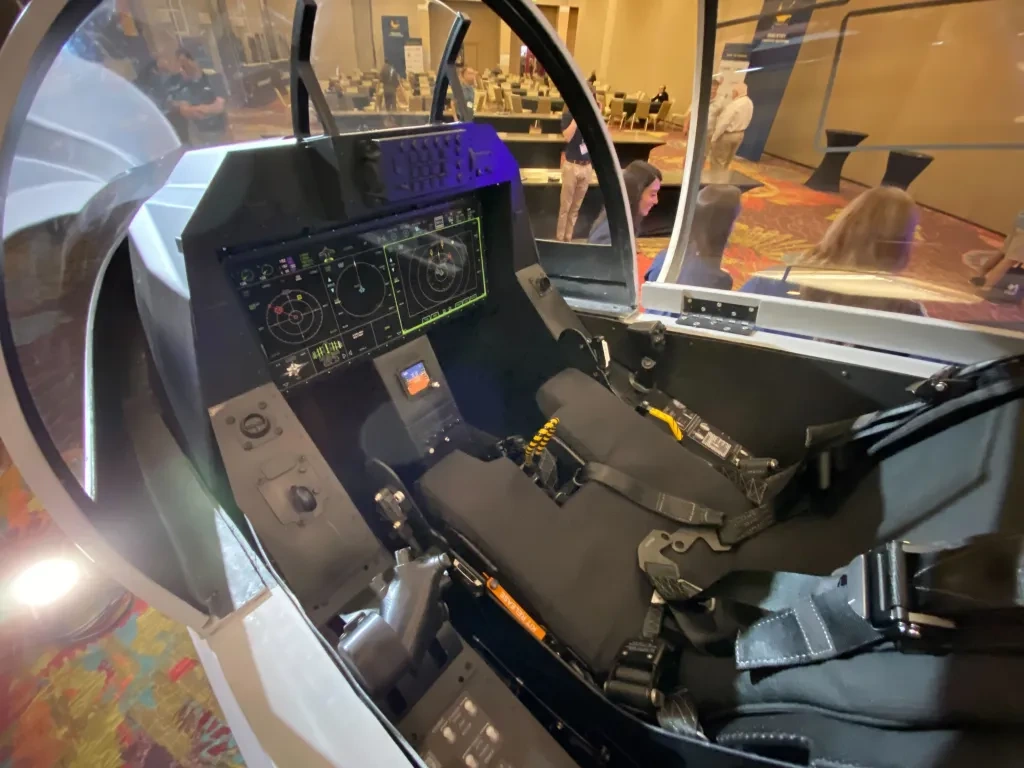
SNC has stressed that the Freedom Trainer is not only highly capable but also economical.
The jet is powered by twin Williams FJ44-4M engines, a choice that the company claims will reduce engine-related costs by more than 40 percent compared with the Navy’s current trainers, and by as much as 50 percent compared to competing land-based designs.
At approximately $4,500 per flight hour, the Freedom’s operating costs are nearly half that of trainers running the General Electric F404 or Honeywell F124 engines.
Beyond raw savings, the aircraft also boasts longer sortie durations—up to 40 percent more training time per mission—helping stretch every dollar invested in the program.
The new trainer takes a modular open-system architecture approach, meaning the Navy won’t be locked into proprietary upgrades controlled by a single contractor.
Instead, NAVAIR will maintain data rights and have the flexibility to integrate third-party technologies across the jet’s projected decades-long service life.
Perhaps most forward-looking is the Freedom’s partnership with Red 6, incorporating the Airborne Tactical Augmented Reality System (ATARS).
This cutting-edge technology projects simulated enemy aircraft, missiles, and scenarios into the pilot’s headset during live flight, offering near-real battle conditions without the cost of flying actual adversary aircraft.
With successful demonstrations already conducted with the US Air Force and the UK’s Royal Air Force, ATARS pushes the Freedom beyond a mere trainer to the heart of a combat-ready ecosystem.
The UJTS contract is shaping up to be one of the most consequential programs for naval aviation in years.
Financial estimates put the effort in the multi-billion-dollar range, with a baseline requirement of at least 145 aircraft and an eventual fleet of over 200. Although the Navy has yet to lock in funding, senior leaders such as Vice Adm.
Daniel Cheever have underscored the importance of providing student pilots with aircraft featuring advanced avionics, realistic simulation capabilities, and digital training integration.
For SNC, the Freedom Trainer’s journey has been unusual. The project began years ago as a joint effort with Turkey’s TUSAŞ Aerospace for the Air Force’s T-X program.
That partnership dissolved when the Turkish firm shifted focus to its indigenous Hürjet, leaving SNC to shelve its design.
Now revived and redesigned around Navy needs, the Freedom emerges as a more mature and uniquely naval-centric offering.
Should SNC secure this contract, it would mark a major shift in the defense industrial landscape, breaking the dominance of prime contractors that traditionally command such large procurements.
Beyond its impact on the US Navy, adoption of the Freedom could influence allied navies in Europe and Asia, many of which are also confronting aging trainer fleets and spiraling operating costs.
For Washington, the decision will go beyond simply selecting a trainer jet. It will reflect broader defense strategies emphasizing affordability, resilience, and innovation—values that SNC is betting heavily on.
By offering the Navy a purpose-built aircraft integrated with augmented reality and cost-saving technologies, the company is positioning itself not just as a bidder, but as a potential transformative force in naval pilot training.