Follow Us:

Follow Us:


Defense Feeds – KAI Unveils G6500-Based Electronic Warfare Jet as Korea Aerospace Industries (KAI) officially presented the design of its next-generation electronic warfare aircraft, a platform set to play a pivotal role in South Korea’s defense modernization.
The 1.77 trillion won program, overseen by the Defense Acquisition Program Administration (DAPA), highlights Seoul’s ambition to advance homegrown electronic warfare capabilities.
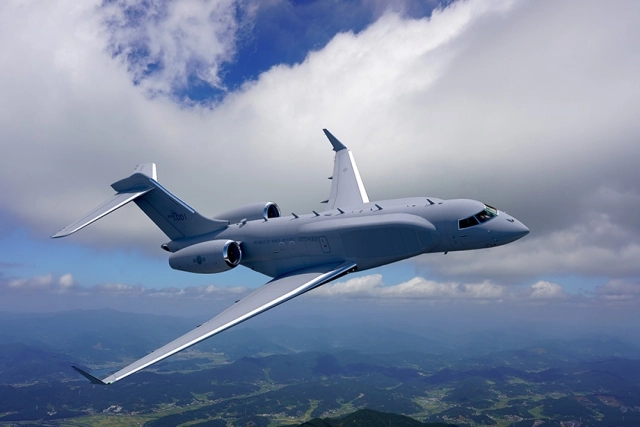
KAI’s aircraft will serve as a long-range electronic warfare asset, aiming to disrupt and neutralize enemy defenses by jamming radar networks and cutting off hostile communication systems.
According to the company, this capability will be critical in safeguarding South Korea’s air operations in future high-intensity conflicts, where controlling the electromagnetic spectrum could be as decisive as air superiority itself.
The concept builds upon a commercial airframe but has been tailored specifically for military roles.
At the core of the development is the Bombardier G6500, a business jet selected for its endurance, range, and ability to host specialized mission equipment.
KAI has reconfigured the fuselage design to accommodate advanced sensors, power-distribution systems, and cooling units for the high-powered electronic warfare payloads.
Unlike basic conversions, KAI highlighted that the integration process ensures the aircraft maintains stability in terms of center of gravity, while supporting the required energy output for on-board electronic suites.
This precise engineering is intended to protect flight performance despite the heavy mission systems onboard.
KAI has teamed up with Hanwha Systems, a leader in defense electronics, to supply mission-critical hardware including jamming, detection, and airborne defense support equipment.
Together, the companies have devised a side-mounted equipment configuration that embeds the electronic warfare technology into both flanks of the fuselage.
This placement not only reduces aerodynamic penalties but also maximizes the effectiveness of antennas and radar-absorbing systems.
Another important aspect is weight reduction: by employing miniaturized subsystems, the overall aircraft design avoids unnecessary strain on performance, ensuring that the jet can achieve long operational sorties without compromising its mission payload.
KAI officials noted that the design bears similarities to the U.S. Air Force EA-37B Compass Call, widely regarded as one of the most advanced electronic warfare aircraft in the world.
While South Korea’s version will be developed independently, the inspiration demonstrates Seoul’s intent to stand alongside leading aerospace powers in this specialized domain.
Beyond the technical achievements, the company emphasized that the program marks a symbolic milestone. For decades, South Korea relied extensively on U.S. systems for high-end electronic support missions.
By pursuing a domestic solution, Seoul is declaring its ambition not only to sustain national self-reliance but also to contribute indigenous technologies to future allied operations.
This program has become one of South Korea’s most consequential defense competitions of recent years.
KAI and Hanwha Systems, with their G6500-based proposal, are competing against a rival team consisting of Korean Air and LIG Nex1, who have put forward their own plans for an indigenous electronic warfare aircraft.
DAPA is expected to select the prime contractor by next month, a decision that could shape South Korea’s electronic warfare roadmap for the next two decades.
The winner will be tasked with translating this initial design into a fully operational military platform, with delivery schedules and integration into the Republic of Korea Air Force likely to be announced after contract award.
Analysts argue that the chosen aircraft could serve not only domestic defense needs but also position South Korea as a potential exporter of modern electronic warfare systems.
Many regional air forces in Asia are beginning to seek aircraft that can counter advanced radar and missile threats, meaning Seoul’s investment could open future export opportunities, especially in markets seeking alternatives to U.S. and European suppliers.
The expanding reliance on electronic warfare (EW) has redefined the battlefield. Modern conflicts emphasize the suppression of enemy air defenses (SEAD) and electronic attack as foundational requirements for successful air campaigns.
South Korea’s decision to launch this program reflects lessons not only from its security environment but also from global conflicts where control of the electromagnetic spectrum has shaped outcomes.
Experts also underline that once the aircraft enters operational service, it will complement future stealth fighters and surveillance platforms, giving the Republic of Korea Armed Forces a layered advantage.
Together with indigenous assets like the KF-21 Boramae fighter jet, the new EW aircraft is expected to create a robust integrated system capable of disrupting adversary operations and ensuring decision-making superiority.
As DAPA prepares to make its final announcement, both industrial teams remain in intensive competition.
For KAI, the unveiling of its detailed design signals confidence and strategic commitment to becoming South Korea’s prime developer of electronic warfare aircraft.