Follow Us:
Follow Us:


Defense Feeds, Warton — Eurofighter Typhoon counter-drone rockets achieved a major milestone when BAE Systems successfully test-fired laser-guided APKWS munitions from a Royal Air Force jet.
The trial marked a significant step toward integrating advanced precision weapons on NATO’s most sophisticated multi-role fighter platform. BAE conducted the test at its flight development center in Warton, Lancashire, with the Typhoon striking a ground-based target at a UK military testing range.
The development signals a critical evolution in air combat capability as RAF and allied nations face escalating drone threats. This integration represents what BAE Systems termed a “game-changing capability and cost-effective solution” that substantially enhances the Typhoon’s weapons portfolio.
The company’s managing director noted that affordable interception options are urgently needed across RAF and international Typhoon operators.
Current air-to-air missiles on Typhoon platforms carry prohibitive per-unit costs that strain military budgets during sustained operations against drone threats.
The AIM-120 Advanced Medium-Range Air-to-Air Missile costs approximately $1 million per round, while AIM-9X Sidewinders run around $450,000 each. Typhoon’s native short-range missiles—IRIS-T and ASRAAM—command similarly expensive price points that restrict engagement frequency.
By contrast, Eurofighter Typhoon counter-drone rockets offer dramatic cost reductions for comparable effectiveness. The APKWS II guidance kit costs between $15,000 and $20,000 per unit, while 70mm rocket motors range from $1,000 to $2,000
This cost advantage, approximately 25 to 40 times cheaper than traditional air-to-air missiles, fundamentally changes counter-drone economics for RAF operations. A single weapons pylon carrying seven APKWS rockets replaces what would otherwise hold just one air-to-air missile.
Magazine depth improvements multiply the tactical advantages of this integration. Standard APKWS pods hold seven rockets, while an RAF Typhoon equipped with two pods carries fourteen counter-drone weapons while maintaining six additional air-to-air missiles for conventional threats. This configuration vastly increases sustained engagement capability against coordinated drone swarms compared to missile-only loadouts.
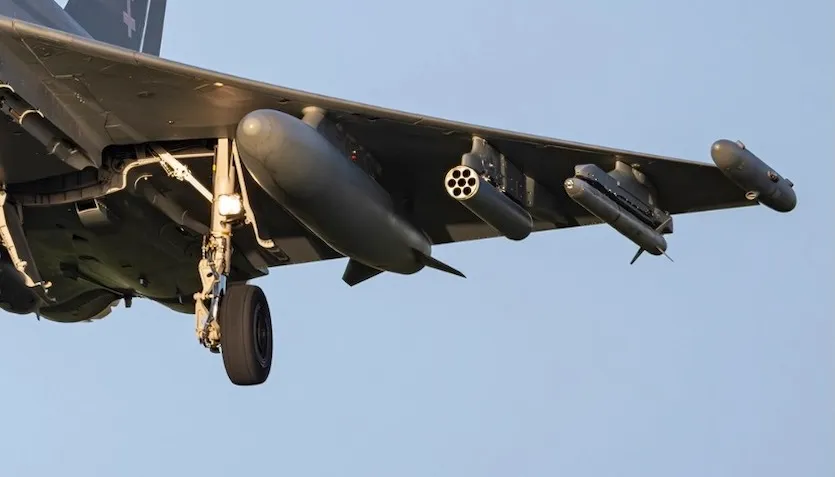
US military experience with APKWS across multiple platforms provides operational validation that drove RAF enthusiasm for Typhoon integration.
The US Air Force has rapidly cleared F-15E Strike Eagles, F-16C Vipers, and A-10 Warthogs to employ laser-guided rockets in the air-to-air role. USAF Lieutenant General Derek France, head of Air Forces Central, described these weapons as “our primary weapon against a drone,” citing multiple successful shoot-downs against Iranian threats.
The scale of US inventory deployment underscores combat effectiveness. F-15E Strike Eagles can carry up to 42 APKWS rockets across six pods on just two weapons stations while still maintaining eight additional air-to-air missiles. This unprecedented magazine depth transforms air operations against drone threats, enabling multiple engagements per sortie that would exhaust conventional air-to-air loadouts in moments.
Ukraine has similarly adopted APKWS on its F-16 fleet to counter relentless one-way attack munitions threatening the nation.
The proven success across diverse aircraft types and operational theaters convinced BAE Systems and RAF leadership that Eurofighter Typhoon counter-drone rockets would deliver equivalent advantages.
The Middle East conflict, where Iran launched hundreds of drones in recent campaigns, illustrated the acute operational need for affordable counter-measures.
RAF Typhoon operations in the Middle East already demonstrate the fighter’s existing counter-drone potential against Iranian threats. Joint RAF-Qatari units, along with Saudi Arabian, Omani, and Kuwaiti Typhoon operators, have successfully engaged hostile drones using conventional air-to-air weapons. Adding APKWS capability would dramatically improve their defensive posture while reducing engagement costs.
BAE Systems indicated that discussions with Germany, Italy, and Spain, fellow Eurofighter partner nations responsible for aircraft development and sustainment, are underway regarding APKWS integration.
Eurofighter CEO Jorge Tamarit Degenhardt previously confirmed that counter-drone missions represent growing importance for international Typhoon customers facing evolving threat environments. The successful trial provides engineering data supporting broader platform integration decisions.
European air arms increasingly recognize laser-guided counter-drone systems as the optimal balance between effectiveness and affordability. Belgium and other nations are independently testing locally-produced laser-guided rockets on fighter fleets, validating the global shift toward precision-guided counter-drone weapons.
As one-way attack munitions proliferate globally, from Ukraine to the Middle East, affordable interception systems like APKWS represent essential capability for maintaining air superiority.
The Eurofighter Typhoon counter-drone rockets trial demonstrates that advanced NATO fighters are adapting rapidly to emerging threats through cost-effective integration of proven technologies. This tactical evolution reflects the fundamental change in modern air warfare, where affordable drone swarms challenge expensive fighter inventories.
Laser-guided rockets offer the optimal compromise: precision engagement capability at fraction-of-cost compared to traditional air-to-air missiles, enabling sustained operations against multiple threat types.