Follow Us:

Follow Us:


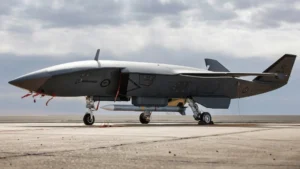
Defense Feeds – Elroy Air Cargo Drone achieved a breakthrough demonstration when the Chaparral successfully moved from vertical takeoff to wingborne forward flight during testing.
This milestone sets a new benchmark in hybrid-electric drone technology and could transform the future of military logistics, humanitarian relief, and commercial deliveries by improving efficiency, reducing fuel consumption, and extending operational range.
The Chaparral aircraft, a hybrid-electric VTOL developed by Elroy Air, proved in its latest trials that it can vertically lift off, transition into efficient wing-supported flight, sustain rapid forward cruising, and finished the journey by landing vertically with accuracy.
According to company officials, the aircraft reached speeds of nearly 70 miles per hour (about 113 kilometers per hour) during testing.
This shift from rotor-driven hover to wingborne lift is an engineering milestone. Unlike conventional drones that rely entirely on propellers for lift, the Chaparral’s wings create aerodynamic lift once in motion, allowing it to fly more like a fixed-wing airplane.
This approach reduces the overall power needed for cruising, conserving battery and fuel resources, while increasing the drone’s endurance capabilities.
For military planners, disaster relief agencies, and private-sector supply chains, this technology represents a significant leap forward.
By combining vertical lift with efficient horizontal flight, such hybrid platforms can bypass traditional infrastructure needs such as runways, which opens up new potential for delivering supplies to remote or contested areas.
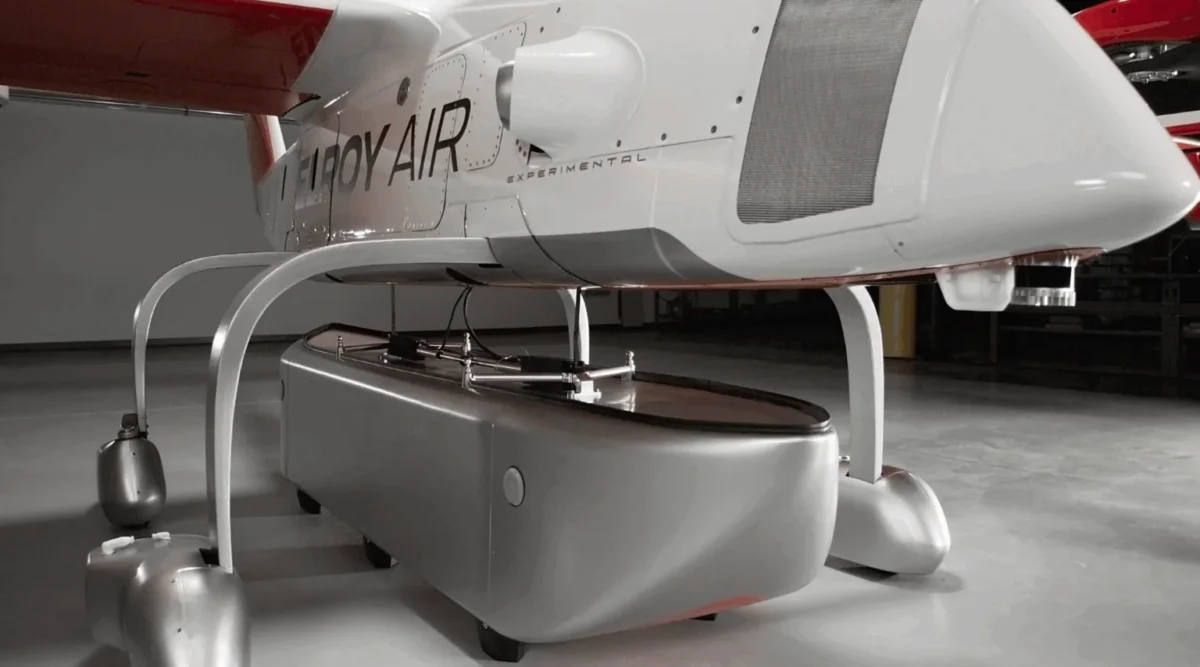
The Chaparral cargo drone is designed to operate with autonomy in complex environments where traditional manned airlift may be too costly or too risky.
Its ability to transition to wingborne flight is especially relevant for defense logistics, where energy efficiency and range are critical.
Reduced power consumption means longer flight endurance, enabling the aircraft to deliver cargo over greater distances without frequent stops or battery swaps.
For armed forces, this could change how supplies are transported across dispersed theaters of operation.
Instead of relying on vulnerable ground convoys or exposing manned aircraft to hostile environments, the Chaparral provides a safer, scalable alternative.
In regions affected by war or natural catastrophes where infrastructure is compromised, the drone is able to lift off from confined sites, transition into wing-supported cruising, and touch down precisely at pre-marked locations.
Beyond defense, commercial cargo operations stand to benefit as well. Distribution networks have long struggled with the “last mile” problem, where roads, weather, or terrain make delivery challenging.
Hybrid aircraft such as Chaparral could dramatically ease these challenges. By leveraging a VTOL system paired with a fixed-wing cruise mode, it strikes a balance between helicopter accessibility and airplane efficiency—an attractive solution for logistics firms and emergency response teams alike.
Elroy Air has been positioning the Chaparral as the next step in unmanned aerial cargo systems.
Unlike small drones limited to deliveries of a few kilograms, the Chaparral is designed to carry larger payloads, offering an autonomous middle ground between manned cargo planes and smaller consumer-style drones.
Its hybrid-electric propulsion system provides flexibility, blending electric motors with a fuel-based generator, extending operational endurance while avoiding the limitations of purely battery-powered designs.
By proving the transition from vertical lift to wingborne flight, the company has removed one of the most challenging barriers for hybrid VTOL development.
The achievement signals growing readiness for scaling the aircraft into routine operations.
Industry analysts note that this kind of aircraft could play a critical role in the modernization of military supply chains as the Pentagon and allied forces actively seek more resilient logistics solutions in an era of near-peer competition.
At the same time, private-sector adoption could emerge rapidly, driven by global e-commerce expansion and rising demand for faster, more flexible delivery.
The recent success of the Chaparral tests highlights a growing shift in aviation, where advanced robotics and automation are driving cargo transport toward unmanned systems that operate with less reliance on permanent infrastructure.
From humanitarian operations in rugged terrain to island supply routes in the Pacific, the implications are wide-reaching.