Follow Us:
Follow Us:


Defense Feeds – The AeroVironment JUMP 20 Drone marks a major advance as South Korea steps up its unmanned aerial systems (UAS) capabilities through a new collaboration between Korean Air and U.S. defense firm AeroVironment.
The two companies have signed an agreement to co-develop and produce advanced tactical drones tailored for South Korea’s military requirements.
This partnership represents a key milestone in Seoul’s strategy to enhance domestic expertise in drone warfare and reduce reliance on imported systems.
Under the memorandum of understanding, Korean Air will act as AeroVironment’s main local partner, initially focusing on adapting the AeroVironment JUMP 20 Drone, a vertical takeoff and landing (VTOL) platform known for its endurance and flexibility.
The aircraft will be customized for South Korea’s diverse operational environments, combining AeroVironment’s proven unmanned technologies with Korean Air’s robust aerospace manufacturing capabilities.
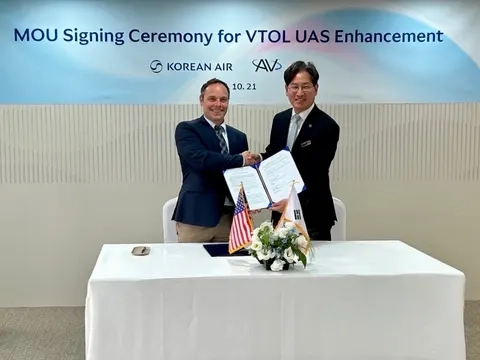
According to AeroVironment’s Asia-Pacific business director Larry Satterfield, the agreement underscores the company’s dedication to expanding international cooperation and delivering versatile defense solutions with regional partners.
He emphasized that the JUMP 20’s adaptability and endurance make it an ideal platform to anchor future UAS development programs within South Korea’s military modernization framework.
The partnership also aligns with Seoul’s ongoing effort to strengthen its defense industry ecosystem.
By building drones domestically and transferring part of the technological processes to Korean Air and other local suppliers, the nation aims to reduce dependence on foreign-made UAV systems.
This effort complements South Korea’s shifting defense posture that prioritizes self-reliant production, next-generation technology, and integration of artificial intelligence in combat operations.
In recent years, the Korean Ministry of National Defense has encouraged domestic firms to form global joint ventures to speed up innovation in reconnaissance and surveillance technologies.
Experts say the AeroVironment-Korean Air agreement will accelerate this initiative, establishing South Korea as a potential hub for next-generation unmanned aircraft manufacturing across East Asia.
At the heart of the partnership is AeroVironment’s JUMP 20, a medium-sized, runway-independent drone first introduced for tactical reconnaissance missions.
Unlike fixed-wing systems that require catapult launches or long runways, the JUMP 20 employs a vertical takeoff and landing configuration, allowing rapid deployment even in confined areas.
The aircraft measures about 3 meters in length with a 6-meter wingspan. It carries payloads weighing up to 14 kilograms and has a maximum takeoff weight of roughly 96 kilograms.
Its modular design enables operators to equip a variety of sensors, electro-optical payloads, and communication systems suited for intelligence gathering and border surveillance.
Powered by a 190cc electronic fuel injection engine using standard gasoline, the drone cruises at speeds near 93 kilometers per hour and operates at altitudes up to 17,000 feet.
The drone’s key strength lies in its endurance, as it can stay aloft for more than 13 hours while sustaining communication with operators across distances reaching 185 kilometers.
Such parameters give South Korea’s military forces enhanced observation capacity during extended missions across mountains, coastal zones, or urban battlefields.
AeroVironment’s JUMP 20 has already proven itself with several NATO countries, including Denmark and Italy, strengthening its credibility as a reliable VTOL platform.
Integrating this drone into South Korea’s arsenal is expected to improve real-time battlefield intelligence and strengthen interoperability with allied forces during coalition operations.
Defense analysts view the move as part of South Korea’s broader plan to transition toward fully networked, semi-autonomous warfare capabilities.
The government’s investment in indigenous UAV production, added to its defense technology cooperation with U.S. and European partners, signals a national push to redefine airpower in the coming decade.
As global militaries race to modernize with AI-driven drones, South Korea’s decision to partner with AeroVironment represents a strategic step to secure technological parity and operational flexibility.
The collaboration not only enhances Seoul’s surveillance and reconnaissance reach but also ensures that its growing defense ecosystem remains competitive in a rapidly changing geopolitical landscape.