Follow Us:
Follow Us:

A fighter jet screaming across the sky at twice the speed of sound tends to make people ask the same question: Which one is the best?
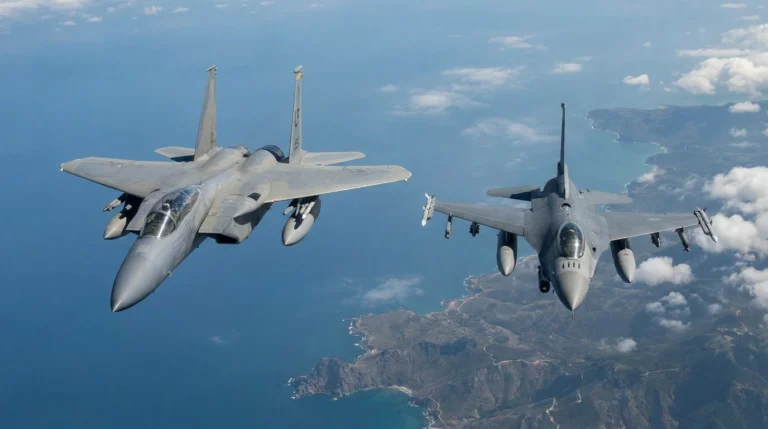
When the conversation turns to F-16 vs F-18, that question becomes even more interesting because these two aircraft have spent decades proving themselves in combat, training exercises, and real-world military operations around the globe.
At first glance, the comparison seems straightforward. Both are American-made multirole fighters. Both can engage enemy aircraft, strike ground targets, and carry advanced weapons. Both have earned reputations as some of the most successful fighter aircraft ever built. Yet beneath the surface, they were designed with very different priorities in mind.
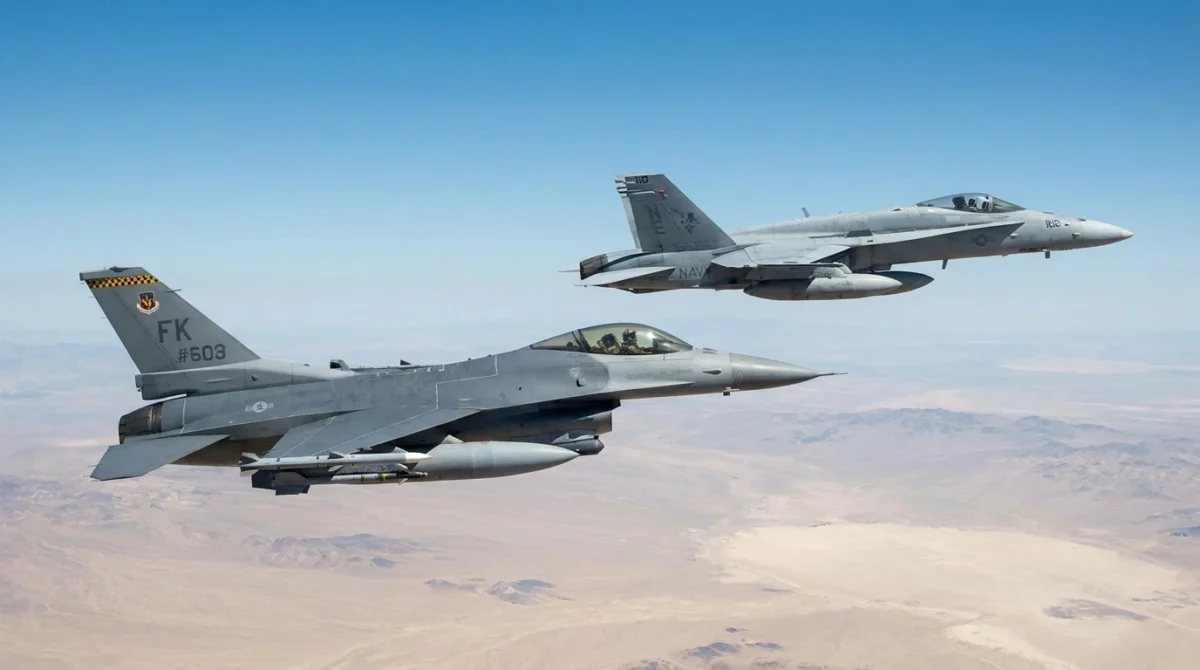
The F-16 Fighting Falcon was created as a lightweight, highly maneuverable fighter that could deliver impressive performance without the enormous cost associated with larger aircraft.
The F/A-18 Hornet, and later the Super Hornet, evolved into a naval workhorse capable of launching from aircraft carriers, surviving harsh maritime environments, and performing a wide variety of missions.
That distinction matters. A jet operating from a runway in the desert faces different challenges than one landing on a moving ship in rough seas at night.
The numbers alone don’t tell the whole story. Speed, range, payload, maneuverability, combat radius, maintenance requirements, and survivability all influence how these aircraft perform in the real world.
In some situations, the F-16 holds a clear advantage. In others, the F-18 is the more practical and capable platform.
This comprehensive F-16 vs F-18 comparison explores exactly where each aircraft excels, where it falls short, and why both remain among the most respected fighter jets ever built.
The story of F-16 vs F-18 isn’t really about two fighter jets competing against each other. It’s about two different branches of the U.S. military facing two very different challenges during the Cold War, and coming up with two remarkably successful solutions.
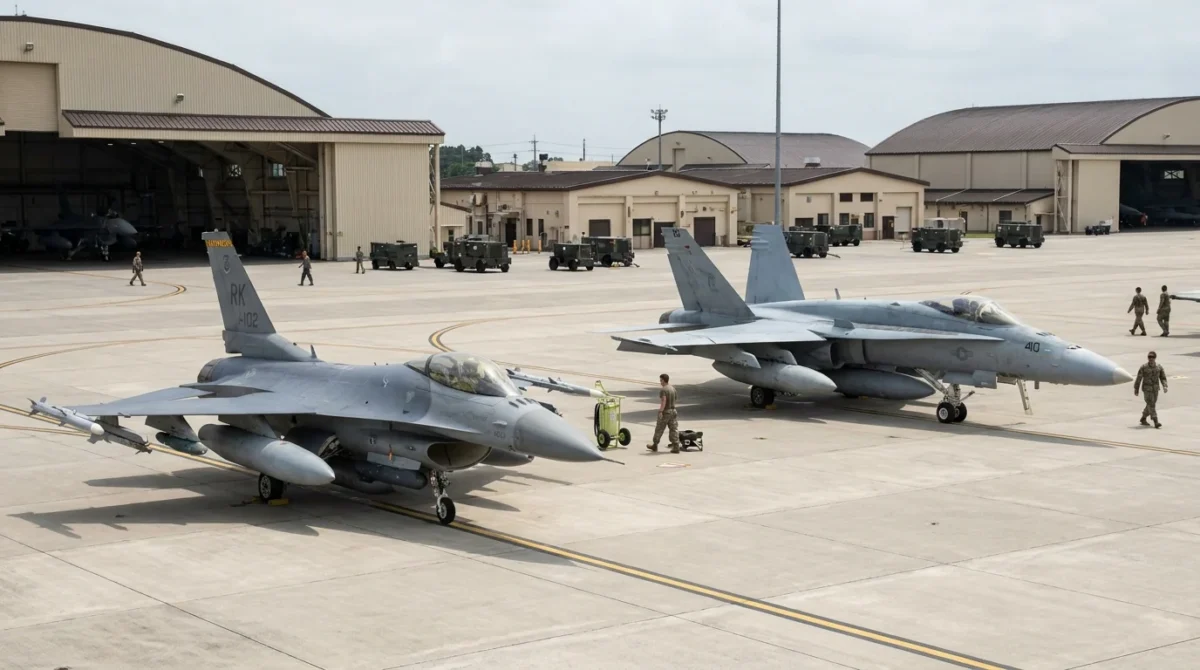
The F-16 Fighting Falcon traces its roots to the early 1970s, when the U.S. Air Force wanted a lightweight fighter that could outmaneuver Soviet aircraft while remaining affordable to build and operate. Engineers focused on speed, agility, and simplicity.
The result was a single-engine jet with a revolutionary fly-by-wire flight control system and a bubble canopy that gave pilots exceptional visibility. First entering service in 1978, the F-16 quickly evolved from a pure air-to-air fighter into one of the world’s most versatile multirole aircraft.
The F/A-18 had a different journey.
The U.S. Navy needed a replacement for several aging carrier-based aircraft and wanted a single platform capable of both fighter and attack missions, the “F/A” in its name literally stands for Fighter/Attack. Introduced in the early 1980s, the Hornet was designed to survive the brutal demands of carrier operations, from catapult launches to hard deck landings.
As military technology advanced, both aircraft adapted instead of fading away. The F-16 received upgraded radars, precision-guided weapons, and advanced avionics, while the Hornet family expanded into the larger and more capable Super Hornet.
Perhaps the most surprising part of the F-16 vs F-18 comparison is their longevity. More than four decades after their introduction, both aircraft remain in active service and continue to receive upgrades. That’s a rare achievement in military aviation and a testament to how well their original designs anticipated the future of modern air combat.
Specs don’t always predict the outcome of an air battle, but they’re a good place to start. In the F-16 vs F-18 matchup, performance figures reveal two aircraft with distinct strengths rather than a clear-cut champion.
| Performance | F-16 Fighting Falcon | F/A-18 Hornet |
| Top Speed | Mach 2.0+ | Mach 1.8 |
| Engines | 1 | 2 |
| Service Ceiling | 50,000+ ft | 50,000 ft |
| Combat Radius | ~340–500 miles* | ~390–450 miles* |
| Maximum G-Load | +9G | +7.5G |
The F-16 grabs attention with its speed. Capable of exceeding Mach 2, it was designed to intercept threats quickly and maintain energy during aerial combat. Its lightweight airframe and powerful engine produce an impressive thrust-to-weight ratio, allowing rapid acceleration and strong climb performance.
The F-18 approaches the problem differently. While it gives up a little top-end speed, it was engineered for stability and control across a broad flight envelope. That’s particularly important during carrier operations, where precision matters far more than outright velocity.
The Hornet also performs exceptionally well at high angles of attack, maintaining control in situations where many aircraft would struggle.
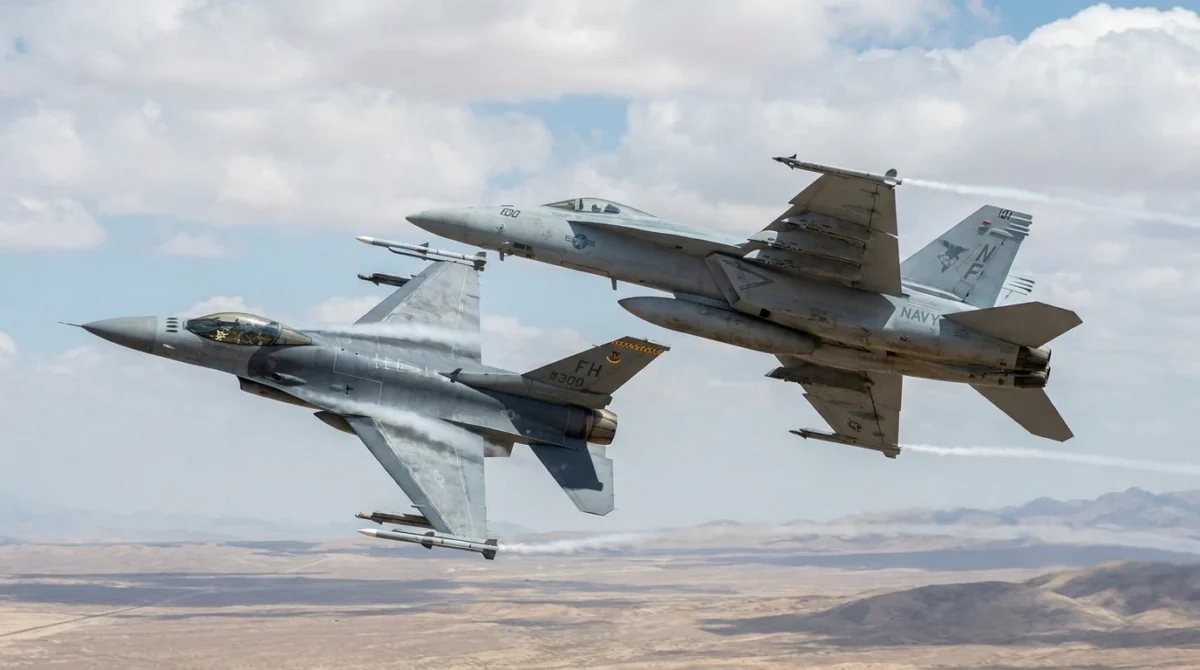
Range is another interesting point in the F-16 vs F-18 comparison. The Falcon generally benefits from greater fuel efficiency thanks to its single-engine design, making it well suited for long-distance missions.
The Hornet can extend its reach with external fuel tanks and aerial refueling, though this often comes with added weight.
Yet fighter pilots often say that a spec sheet doesn’t win battles. Radar systems, weapons, pilot training, and mission planning can outweigh a few hundred miles per hour or an extra few thousand feet of altitude.
The F-16 may edge ahead in raw performance, but the F-18 balances its numbers with versatility, making both aircraft formidable in very different ways.
Ask a room full of fighter pilots or aviation enthusiasts about the F-16 vs F-18 debate, and sooner or later someone will bring up dogfighting. It’s almost unavoidable. After all, there’s something timeless about two aircraft twisting through the sky, each trying to outmaneuver the other.
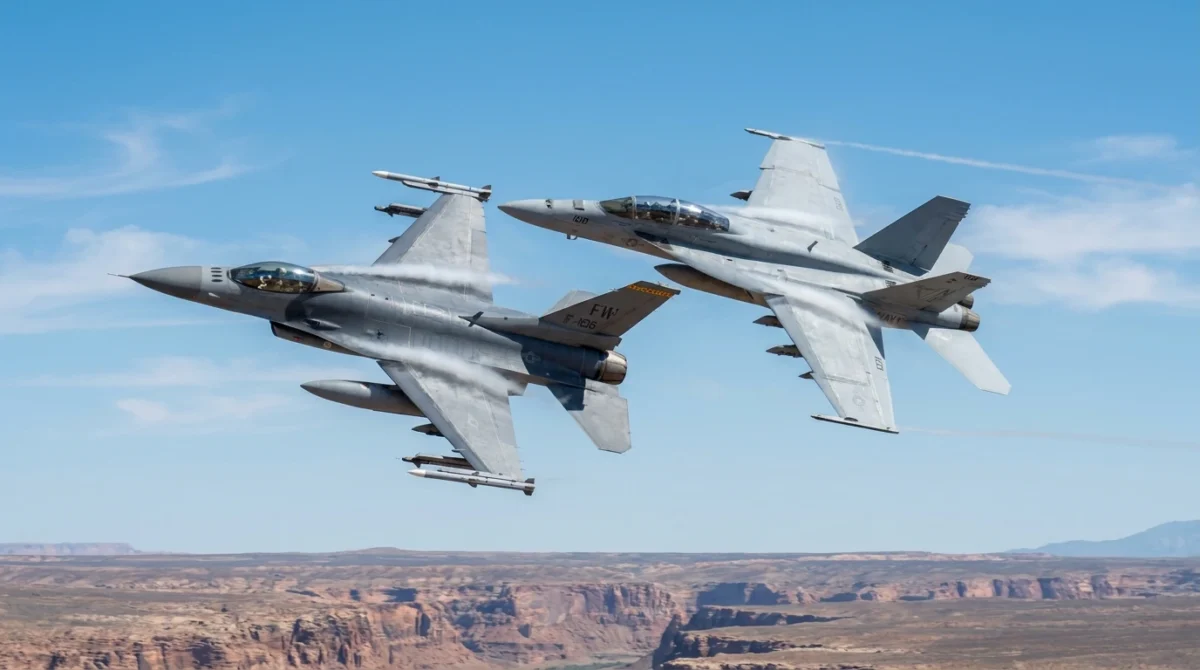
The F-16 was practically built for this kind of fight. Nicknamed the “Viper” by many pilots, its lightweight design and powerful engine give it exceptional acceleration and sustained turning performance.
The aircraft can pull up to 9G, allowing experienced pilots to maintain energy through aggressive maneuvers. Its bubble canopy also provides outstanding visibility, making it easier to track an opponent during close-range engagements.
The F-18 has a different trick up its sleeve. Thanks to its large leading-edge extensions and aerodynamic design, the Hornet excels at high angles of attack.
In plain English, it can point its nose at an enemy even when flying relatively slowly, a valuable advantage during tight turning battles. Pilots often describe the aircraft as forgiving and remarkably stable, qualities that inspire confidence in demanding situations.
| Dogfighting Feature | F-16 | F-18 |
| Sustained Turn Performance | Excellent | Very Good |
| High-Angle-of-Attack Control | Very Good | Excellent |
| Pilot Visibility | Outstanding | Very Good |
| Low-Speed Handling | Good | Excellent |
Here’s the catch: modern air combat rarely unfolds like scenes from an action movie. Advanced radar systems and beyond-visual-range missiles often allow pilots to engage targets long before they can see them.
Still, if the fight closes to visual range, the F-16 vs F-18 contest becomes incredibly competitive
The F-16 thrives on speed and energy management, while the F-18 shines in slow-speed agility and nose-pointing authority. Victory often comes down to pilot skill, tactics, and the situation rather than the aircraft alone, and that’s one reason this debate refuses to die.
A fighter jet can be fast, agile, and packed with cutting-edge technology, but without effective weapons, none of that means much. In the F-16 vs F-18 comparison, both aircraft are capable of delivering tremendous firepower, though they approach combat missions with slightly different strengths.
One reason both jets have remained relevant for decades is their flexibility. Neither aircraft is limited to a single role. They can engage enemy fighters, strike ground targets, destroy radar installations, support troops on the battlefield, and even conduct maritime attack missions when required.
For air-to-air combat, both platforms commonly carry advanced missile systems such as the AIM-120 AMRAAM for beyond-visual-range engagements and the AIM-9 Sidewinder for close-range encounters.
In practical terms, this means an F-16 and an F-18 can often carry very similar air combat weapons loads.
Where differences begin to emerge is payload capacity and mission focus.
| Weapons Capability | F-16 Fighting Falcon | F/A-18 Hornet |
| Air-to-Air Missiles | Excellent | Excellent |
| Precision-Guided Bombs | Excellent | Excellent |
| Anti-Ship Weapons | Good | Excellent |
| Multirole Flexibility | Very Good | Outstanding |
| Carrier Strike Capability | No | Yes |
The F-16’s lighter design allows it to deliver weapons efficiently while maintaining strong performance. The aircraft has participated in precision strike missions across multiple conflicts and has proven highly effective against both airborne and ground targets.
The F-18, however, was designed from the beginning as a true fighter-attack aircraft. Naval missions often require carrying a wide mix of weapons during a single sortie, and the Hornet excels in this role.
A pilot might launch from a carrier prepared to intercept enemy aircraft, attack ground targets, and support fleet operations during the same mission.
Ultimately, the F-16 vs F-18 firepower debate doesn’t produce a clear winner. Both jets can carry devastating weapons. The real difference lies in how those weapons are employed and the missions each aircraft was designed to perform.
If fighter jets were chess players, avionics would be their ability to think several moves ahead. In the modern F-16 vs F-18 debate, sophisticated electronics often matter more than raw speed because the aircraft that detects a threat first usually gains a significant tactical advantage.
Early versions of both fighters relied on conventional pulse-Doppler radar systems, but decades of upgrades have transformed them into highly capable combat platforms.
Modern F-16 variants and the latest F/A-18 models feature Active Electronically Scanned Array (AESA) radars, which can track multiple targets simultaneously while resisting electronic jamming more effectively than older systems.
The cockpit has changed just as dramatically. Gone are the days of pilots juggling dozens of separate gauges. Large multifunction displays, digital maps, and helmet-mounted cueing systems allow pilots to access critical information with a quick glance.
| Avionics Feature | F-16 Fighting Falcon | F/A-18 Hornet |
| AESA Radar Options | Yes | Yes |
| Helmet-Mounted Display | Yes | Yes |
| Precision Strike Systems | Excellent | Excellent |
| Electronic Warfare | Very Good | Excellent |
| Multi-Mission Integration | Excellent | Outstanding |
One area where the F-18 stands out is electronic warfare. Naval aviation often operates in highly contested environments, so the Hornet family was built with strong defensive systems that can detect, jam, and counter enemy radar threats. This gives pilots an added layer of protection during complex missions.
The F-16 counters with an impressive upgrade path. Many operators have continuously modernized their fleets, adding advanced targeting pods, datalinks, and improved mission computers that keep the aircraft competitive with newer designs.
Perhaps the most important trend in the F-16 vs F-18 comparison is that today’s battles aren’t fought by isolated aircraft. Both fighters can share information with allied forces, coordinate attacks, and build a common picture of the battlefield. In modern air combat, the smartest fighter, not just the fastest one, often has the edge.
When people compare the F-16 vs F-18, they often focus on speed or dogfighting. Military planners, however, usually start with a different question: Can we afford to buy and operate it for the next 30 years?
A fighter jet isn’t a one-time purchase, it’s a long-term investment that includes fuel, maintenance, pilot training, spare parts, and periodic upgrades.
The F-16 has earned a reputation as one of the most cost-effective modern fighters ever built. Depending on the variant and equipment package, a new F-16 Block 70/72 typically costs between $65 million and $85 million per aircraft. Operating costs are estimated at roughly $22,000–$27,000 per flight hour, although this varies by country and mission profile.
The F/A-18 family is more expensive. A new F/A-18E/F Super Hornet generally carries a procurement cost of around $70 million–$85 million per aircraft, while operating expenses are estimated at $30,000–$36,000 per flight hour. The higher figure reflects its twin-engine design and the demands of naval aviation.
| Cost Factor | F-16 Fighting Falcon | F/A-18 Super Hornet |
| Estimated Unit Cost | $65–85 million | $70–85 million |
| Flight Hour Cost | $22,000–27,000 | $30,000–36,000 |
| Engines | 1 | 2 |
| Fuel Consumption | Lower | Higher |
| Maintenance Burden | Moderate | Higher |
| Carrier Capability | No | Yes |
These numbers only tell part of the story.
The F-16’s affordability has helped it become one of the most widely exported fighter jets in history, with more than 3,000 aircraft still serving around the world. Its large user base also helps reduce maintenance and spare-parts costs.
The F-18 takes a different approach to value. Although operating costs are higher, a single aircraft can perform air superiority, ground attack, fleet defense, reconnaissance, and carrier strike missions. For navies, that versatility can offset the added expense by reducing the need for multiple specialized aircraft.
In the F-16 vs F-18 cost comparison, the Falcon is the more economical choice for air forces seeking high performance at a manageable price. The Hornet, meanwhile, justifies its higher operating budget by delivering capabilities that a conventional land-based fighter simply cannot match.
The simplest way to settle the F-16 vs F-18 debate is to stop asking which fighter is better and start asking, Better for what? Military aircraft are tools, and like any tool, their value depends on the job at hand.
If the mission calls for rapid response, long-range patrols, and cost-effective operations from established air bases, the F-16 has a strong case. Its high speed, efficient fuel consumption, and relatively low operating costs make it an attractive choice for air forces that need to cover large areas without stretching their budgets.
The F-18 shines in environments where flexibility is everything. Operating from aircraft carriers allows it to project power far from friendly territory, and its twin-engine design provides added confidence during long overwater missions.
The Hornet can switch between air combat and ground attack roles with remarkable ease, a feature that has made it indispensable for naval aviation.
| Mission Type | Better Choice | Why |
| Air Defense | F-16 | Speed and rapid response |
| Long-Range Patrol | F-16 | Greater efficiency and range |
| Carrier Operations | F-18 | Designed for naval aviation |
| Fleet Defense | F-18 | Protects naval task forces |
| Precision Ground Attack | Tie | Both excel with modern weapons |
| Close Air Support | Tie | Mission-dependent |
| Expeditionary Operations | F-18 | Flexible multirole capability |
| Budget-Conscious Air Force | F-16 | Lower operating costs |
There’s also a strategic angle that rarely gets enough attention. A country without aircraft carriers gains little from the F-18’s naval features, making the F-16 a logical investment.
On the other hand, a navy operating across the world’s oceans needs an aircraft specifically engineered for life at sea.
The F-16 vs F-18 comparison ultimately reveals two different philosophies of air power. The Falcon is a fast, efficient, and highly capable land-based fighter.
The Hornet is a rugged, adaptable aircraft built to handle the unpredictable demands of naval warfare. Neither dominates every category, but each excels in the environment it was designed to master.