Follow Us:
Follow Us:

Picture two fighter jets streaking across the sky. One is big, loud, and built to dominate the airspace around it. The other is lean, nimble, and can switch from dogfighting to dropping precision bombs before heading home for dinner. Which one would you want on your side?
That’s the question behind one of military aviation’s longest-running debates: F-15 vs F-16.
At first glance, comparing the F-15 Eagle and the F-16 Fighting Falcon seems straightforward. They were both born during the Cold War, both carry American engineering DNA, and both have earned legendary reputations in combat. But here’s the twist that often gets missed. They weren’t designed to replace each other.
In many ways, they’re like a heavyweight boxer and a world-class mixed martial artist, different builds, different strengths, and surprisingly complementary.
The F-15 arrived first, created with a simple mission: win air battles and don’t lose. The F-16 followed with a different philosophy.
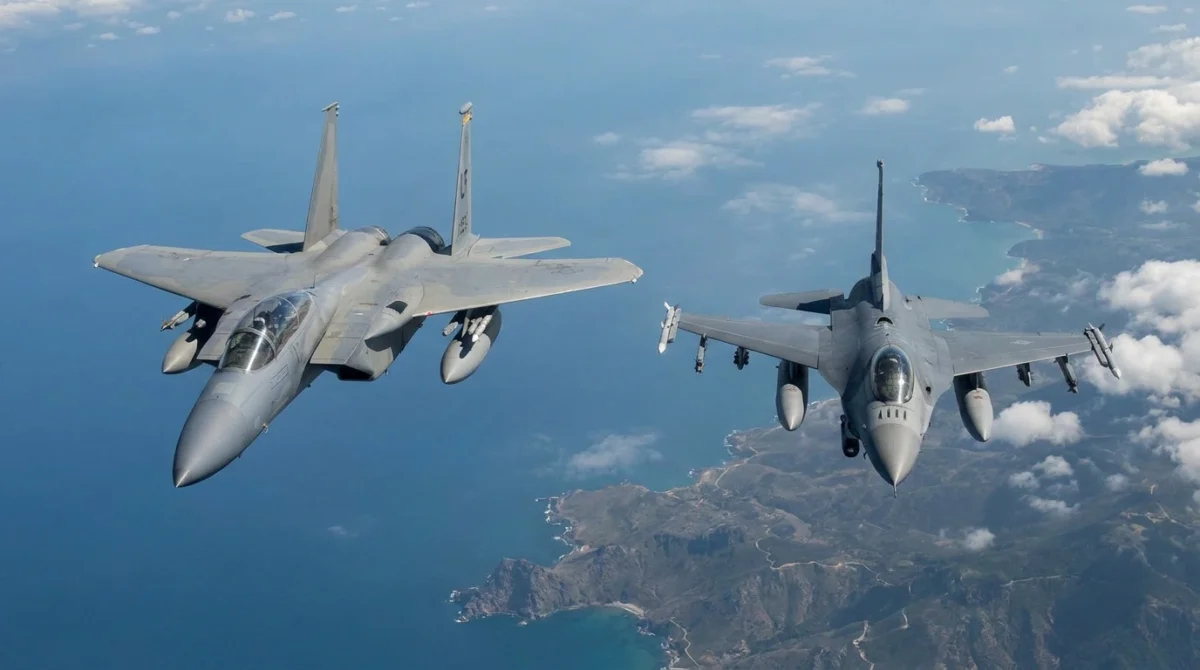
Military planners wanted a fighter that could do almost everything while costing less to buy and operate. Decades later, both aircraft are still flying, still being upgraded, and still attracting new customers around the world.
So, is the F-15 better than the F-16? The answer depends on what you’re asking. Speed? Payload? Dogfighting? Range? Operating cost? Modern technology? Each category tells a different story.
In this in-depth F-15 vs F-16 comparison, we’ll go beyond the usual spec sheet.
We’ll look at the engineering decisions that shaped these aircraft, the combat records that built their reputations, and the real-world missions where one clearly outshines the other.
By the end, you’ll understand not only which fighter performs better, but why the U.S. military has spent decades keeping both in the skies.
The story of F-15 vs F-16 really begins with a problem the U.S. Air Force faced in the late 1960s.
Military planners were watching the Soviet Union roll out faster, more capable aircraft, and they didn’t want to be caught playing catch-up. Their solution? Build not one revolutionary fighter, but two, each with a very different personality.
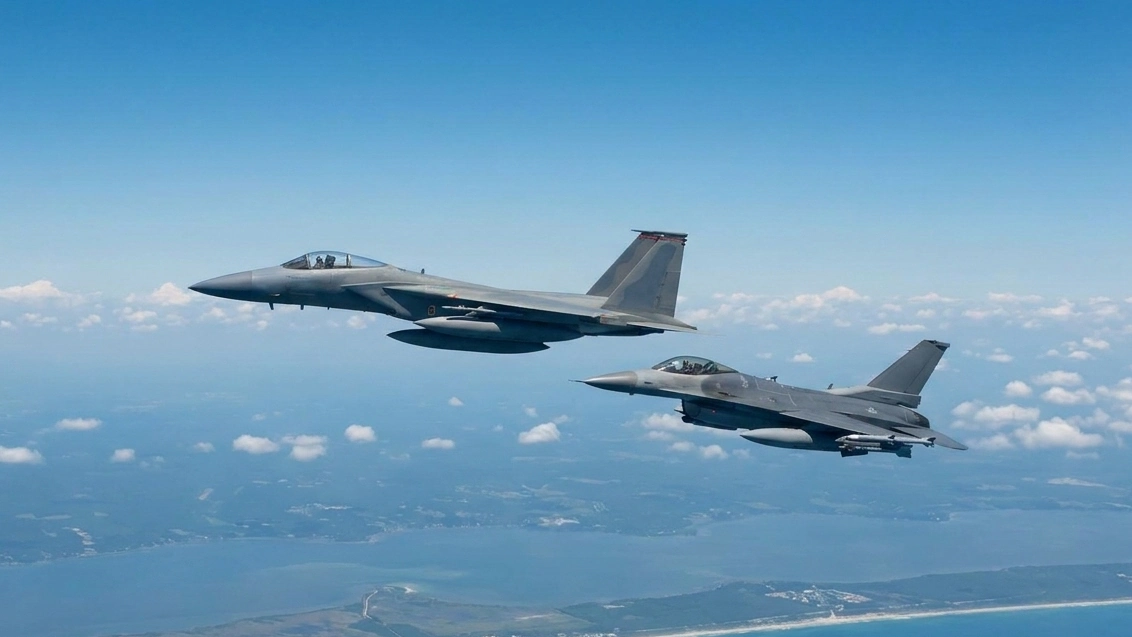
The F-15 Eagle came first. Engineers designed it with a straightforward mission: win air battles, period. After lessons learned in Vietnam, the Air Force wanted an aircraft that could climb quickly, fly above Mach 2.5, carry a large missile load, and engage enemy fighters long before they became a threat. Size and cost were secondary concerns. Performance was king.
Then something unexpected happened. A group of military thinkers argued that bigger wasn’t always better. They believed a lighter, cheaper fighter could outperform heavier aircraft in close combat while allowing the Air Force to buy them in much larger numbers. That idea became the F-16 Fighting Falcon.
In many ways, the F-16 was the rebel of the family. It introduced a fly-by-wire flight control system, a side-mounted control stick, and a reclined pilot seat designed to help withstand high G-forces. Some of these features looked unconventional at the time but later became common in modern fighter design.
Ironically, the two aircraft weren’t rivals at all. The Air Force developed a “high-low mix” strategy, with the F-15 serving as the high-end air superiority fighter and the F-16 providing an affordable multirole partner. It was a calculated gamble that paid off.
Decades later, both jets remain in active service, proving that sometimes the smartest answer isn’t choosing one aircraft over another, it’s building a team where each covers the other’s weaknesses.
You can learn a surprising amount about the F-15 vs F-16 rivalry without ever looking at their performance numbers. Just park them side by side on a runway. One looks like it could bench-press a tank. The other seems eager to sprint.
The F-15 Eagle is the larger aircraft by a comfortable margin. Stretching roughly 63 feet (19.4 m) in length with a wingspan of 42.8 feet (13 m), it’s powered by two turbofan engines.
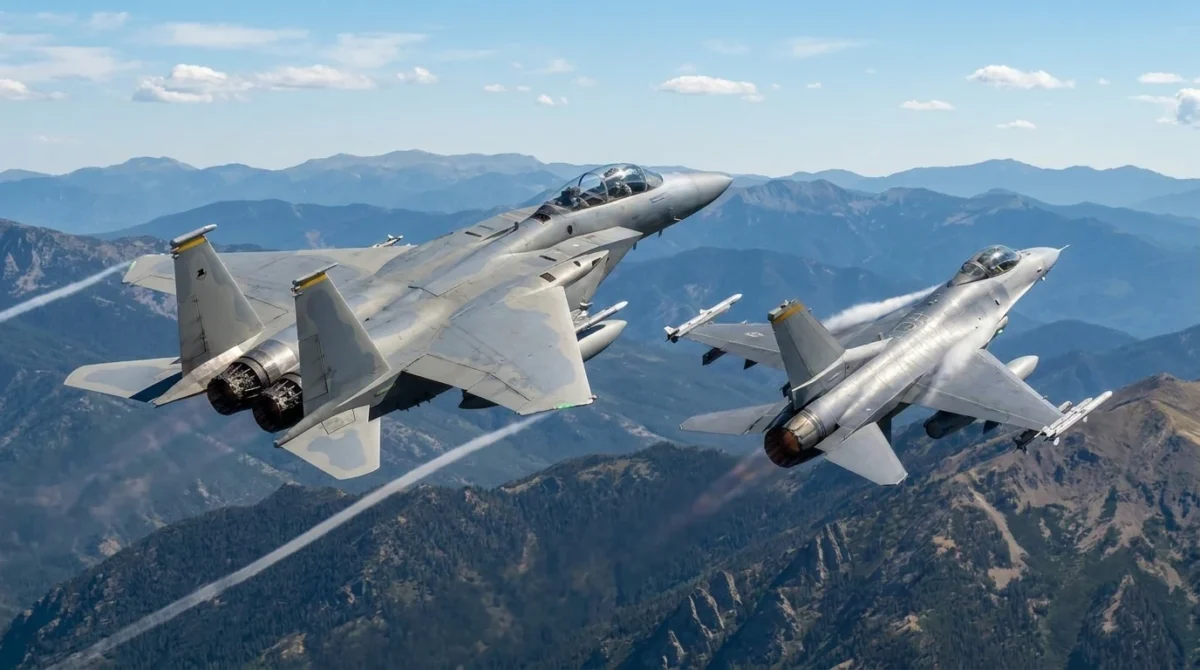
That twin-engine layout offers extra thrust and an added layer of safety during long-range missions over hostile territory. It also gives the F-15 the muscle to carry a substantial weapons load without sacrificing speed.
The F-16 Fighting Falcon took a different approach. At about 49.5 feet (15 m) long and equipped with a single engine, it was designed to stay light and responsive. Less weight means quicker acceleration, sharper turns, and lower operating costs. For many air forces, that’s a very attractive trade-off.
| Design Feature | F-15 Eagle | F-16 Fighting Falcon |
| Engine Configuration | Twin-engine | Single-engine |
| Length | 63 ft | 49.5 ft |
| Pilot Seating | Upright | 30° reclined |
| Flight Controls | Conventional with digital upgrades | Full fly-by-wire |
| Primary Design Goal | Air superiority | Lightweight multirole |
One of the F-16’s clever touches is its bubble canopy, which provides exceptional visibility. Combined with the side-stick controller and reclined seat, the pilot can maintain awareness during high-G maneuvers that would challenge many other aircraft.
The F-15 counters with a larger airframe that accommodates more fuel, larger radar systems, and greater internal growth for future upgrades.
Here’s the interesting bit: neither design is objectively superior.
The F-15 was engineered to project power across long distances and dominate the skies, while the F-16 was built to be an agile, adaptable workhorse.
Their shapes aren’t just engineering choices, they’re physical expressions of two completely different combat philosophies, and that’s what keeps the F-15 Eagle vs F-16 Fighting Falcon comparison so compelling.
This is where the F-15 vs F-16 debate gets serious.
Aviation fans love to compare top speeds, but fighter pilots will tell you that a jet’s true performance is a mix of speed, altitude, acceleration, range, and the ability to carry weapons while still fighting effectively. In other words, the fastest aircraft doesn’t always win.
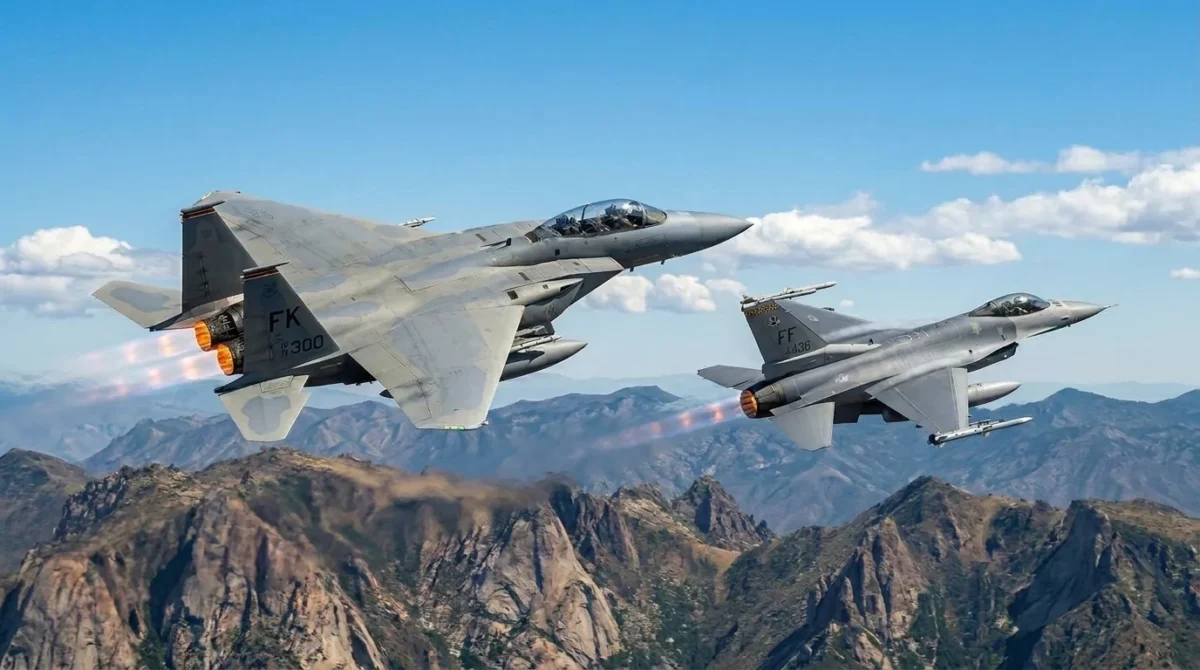
On paper, the F-15 Eagle has the advantage in outright power. Its twin engines generate over 50,000 pounds of combined thrust, pushing the aircraft beyond Mach 2.5 (around 1,875 mph or 3,018 km/h).
The F-15 can also climb rapidly to high altitudes and maintain energy during demanding combat maneuvers, a valuable trait in air-to-air engagements.
The F-16 Fighting Falcon isn’t slow by any measure. With a top speed of around Mach 2.0 (1,500 mph or 2,414 km/h), it remains one of the fastest multirole fighters ever built. Its lighter weight and excellent thrust-to-weight ratio allow it to accelerate quickly and respond rapidly to changing combat situations.
| Performance Category | F-15 Eagle | F-16 Fighting Falcon |
| Top Speed | Mach 2.5+ | Mach 2.0 |
| Engines | 2 | 1 |
| Combat Radius | ~1,200 miles | ~340–500 miles* |
| Service Ceiling | 65,000 ft | 50,000+ ft |
| Maximum Payload | ~23,000 lbs | ~17,000 lbs |
Range is another major difference.
The F-15 carries more internal fuel and can stay in the fight longer without relying heavily on aerial refueling. That makes it particularly useful for long-range patrols and air superiority missions. The F-16, meanwhile, trades some endurance for flexibility and lower operating costs.
Interestingly, the numbers don’t tell the whole story. The F-15 was built to overwhelm opponents with speed, altitude, and firepower.
The F-16 was designed to make the most of every pound of thrust and every gallon of fuel. If the mission calls for carrying a heavy missile load over long distances, the Eagle has the edge. If it demands quick reactions and efficient multirole performance, the Falcon proves why it has remained one of the world’s most successful fighter aircraft.
Ask ten fighter pilots about an F-15 vs F-16 dogfight, and you’ll probably get eleven different answers. That’s because air combat isn’t a video game where the aircraft with the highest stats automatically wins. Pilot skill, fuel load, altitude, weapons, and even the weather can tilt the odds.
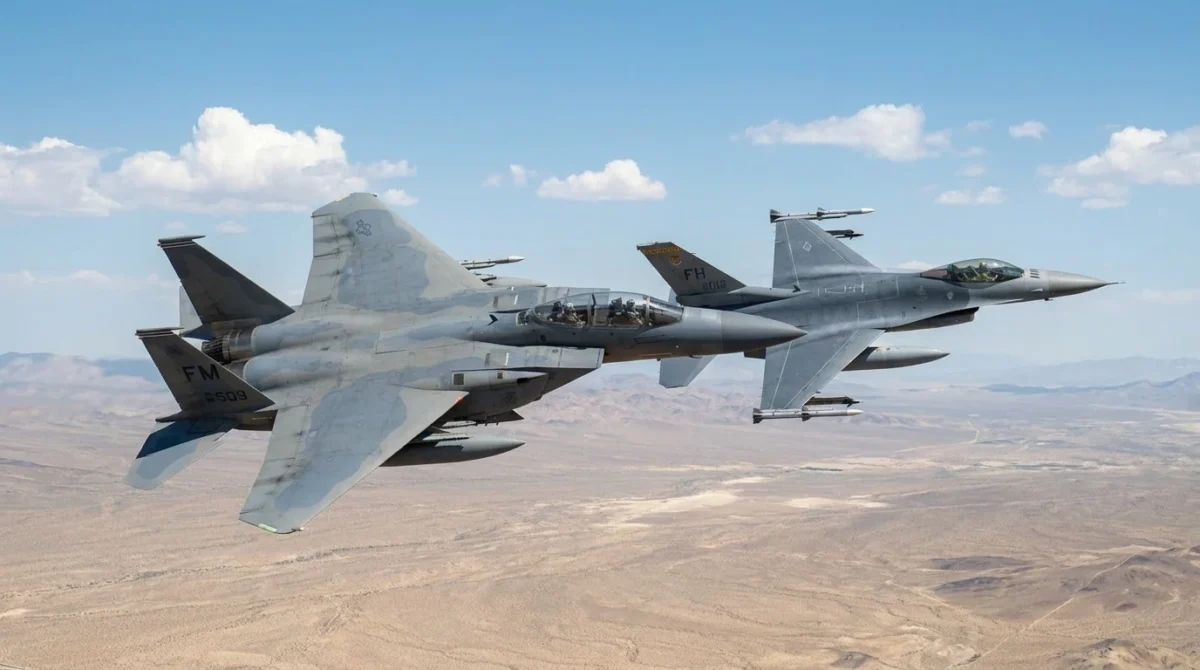
Still, the two jets have distinct personalities in a close-range fight.
The F-16 Fighting Falcon was practically built for maneuverability. Nicknamed the “Viper” by many pilots, its lightweight airframe, fly-by-wire controls, and relaxed aerodynamic stability allow it to change direction with remarkable precision.
The aircraft can sustain high-G turns and maintain control in situations that would push many older fighters to their limits. In a traditional turning fight, the F-16 is often considered one of the best fourth-generation fighters ever built.
The F-15 Eagle takes a different approach. Rather than trying to out-turn every opponent, it relies on raw engine power and energy management. Its twin engines let the aircraft climb aggressively, recover speed quickly, and fight in the vertical plane. Instead of circling endlessly, an F-15 pilot may convert speed into altitude and attack from a stronger position.
| Dogfight Factor | F-15 Eagle | F-16 Fighting Falcon |
| Tight Turning | Very Good | Excellent |
| Vertical Maneuvers | Excellent | Very Good |
| Energy Recovery | Excellent | Good |
| High-G Handling | Excellent | Excellent |
| Pilot Visibility | Good | Outstanding |
Here’s the twist that often gets missed in the F-15 Eagle vs F-16 debate: modern air combat rarely starts with a turning battle.
Advanced radar systems and beyond-visual-range missiles mean the first aircraft to detect and engage an opponent often has the advantage. In those scenarios, the F-15’s larger radar and missile capacity become significant strengths.
But if the fight closes to visual range? The agile F-16 can be a difficult opponent to shake. That’s why there’s no universal winner.
The Eagle likes to dictate the fight from a position of strength, while the Falcon excels at adapting when the battle gets messy, and air combat has a habit of getting messy.
There’s an old saying in military aviation: the fighter that spots its opponent first often doesn’t need to dogfight at all. That’s why the F-15 vs F-16 comparison isn’t just about speed or maneuverability. It’s also about what the pilot can see, track, and engage before the other side knows trouble is coming.
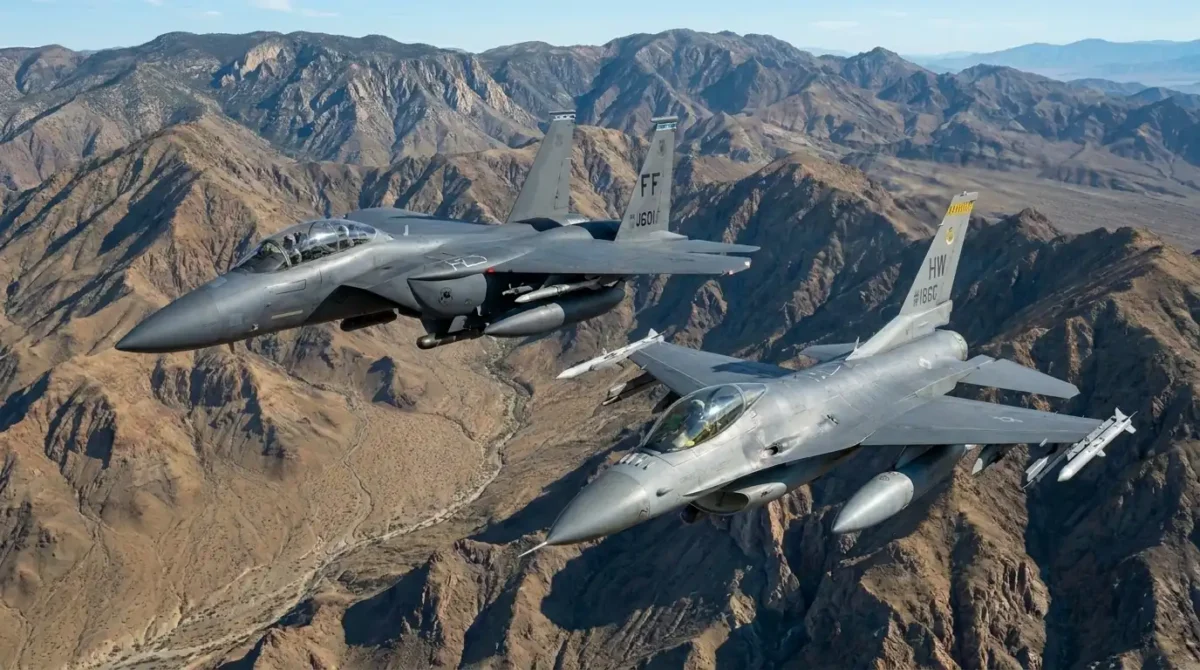
The F-15 Eagle was designed as an air-superiority fighter, so it naturally received a large and powerful radar system. Its bigger nose section allows for a larger radar antenna, giving the aircraft excellent detection and tracking capabilities.
Modern variants, especially the F-15EX, use Active Electronically Scanned Array (AESA) radar technology, which can monitor multiple airborne and ground targets simultaneously while resisting electronic jamming.
The F-16 Fighting Falcon started with a smaller radar because of its compact design, but decades of upgrades have narrowed the gap considerably.
The latest F-16V configuration features the AN/APG-83 AESA radar, dramatically improving target detection, tracking accuracy, and battlefield awareness. For many missions, it delivers capabilities that earlier generations of fighter pilots could only dream about.
| Avionics Feature | F-15 Eagle | F-16 Fighting Falcon |
| Radar Size | Larger | Smaller |
| Modern AESA Radar | Yes | Yes |
| Multi-Target Tracking | Excellent | Excellent |
| Electronic Warfare | Advanced | Advanced |
| Data Link Capability | Extensive | Extensive |
Radar alone doesn’t win battles, though. Modern fighter aircraft rely on a network of sensors, electronic warfare systems, infrared warning receivers, and secure data links that allow pilots to share information with other aircraft and command centers. In many ways, today’s fighters act as flying information hubs rather than isolated machines.
So, who wins the F-15 Eagle vs F-16 sensor battle?
The F-15 benefits from a larger airframe that can house more powerful systems and future upgrades. The F-16 counters with cutting-edge avionics packed into a smaller, more affordable platform.
In modern air warfare, both aircraft prove that seeing first, and understanding what you’re seeing, can matter more than simply flying faster.
A fighter jet can be fast, agile, and packed with cutting-edge electronics, but at some point, it still has to carry the tools needed to finish the job.
That’s where the F-15 vs F-16 comparison starts to separate into two very different philosophies: one aircraft was built to carry an arsenal, while the other was designed to carry exactly what the mission demands.
The F-15 Eagle is, frankly, a beast when it comes to payload. Depending on the variant, it can haul roughly 23,000 pounds (10,400 kg) of weapons and external stores.
Air-to-air missiles like the AIM-9 Sidewinder and AIM-120 AMRAAM fit naturally into its air superiority role, while strike versions such as the F-15E and F-15EX can carry precision-guided bombs, cruise missiles, and hypersonic weapons under development.
The F-16 Fighting Falcon may carry less, around 17,000 pounds (7,700 kg), but versatility is its calling card.
Over the years, it has integrated an impressive range of weapons, from air-to-air missiles and laser-guided bombs to anti-ship missiles and advanced stand-off munitions. Few fighter aircraft have adapted to new weapons as successfully as the F-16.
| Weapons Category | F-15 Eagle | F-16 Fighting Falcon |
| Maximum Payload | ~23,000 lbs | ~17,000 lbs |
| Air-to-Air Missiles | Excellent | Excellent |
| Precision Strike Weapons | Excellent | Excellent |
| Long-Range Strike | Superior | Very Good |
| Mission Flexibility | High | Extremely High |
An interesting detail often gets overlooked in the F-15 Eagle vs F-16 discussion. Carrying more weapons isn’t always an advantage.
A heavily loaded aircraft burns more fuel, creates more drag, and may sacrifice some agility. Military planners rarely load a fighter with every weapon it can physically carry. Instead, they tailor the loadout to a specific mission.
That’s where the two jets shine in different ways. The F-15 can arrive with an intimidating mix of missiles and bombs while still maintaining impressive performance.
The F-16 takes a more economical approach, carrying a balanced load that allows it to switch between air combat and ground attack with minimal compromise. In the end, the Eagle wins the payload contest, but the Falcon proves that flexibility can be just as powerful as sheer firepower.
By now, you’ve probably noticed a pattern in the F-15 vs F-16 debate. Every time one aircraft seems to pull ahead, the other counters with a strength of its own. That’s because asking, “Which fighter is better?” is a bit like asking whether a pickup truck is better than a sports car. The answer depends entirely on what you’re trying to do.
The F-15 Eagle thrives in missions where range, speed, and firepower are non-negotiable. Long-range air patrols, homeland defense, bomber escorts, and air superiority operations all play to its strengths. Its large radar, heavy missile load, and twin-engine reliability make it an excellent choice for controlling vast areas of airspace.
The F-16 Fighting Falcon, meanwhile, was built for versatility. Need a fighter to intercept hostile aircraft, strike ground targets, support troops, conduct reconnaissance, or patrol borders? The F-16 can do all of that, often with minimal changes between missions. For many countries, that flexibility translates into significant cost savings and operational efficiency.
| Mission Type | Better Choice | Why |
| Air Superiority | F-15 | Greater range and missile capacity |
| Long-Range Intercept | F-15 | Higher speed and endurance |
| Precision Ground Attack | F-16 | Proven multirole flexibility |
| Close Air Support | F-16 | Agile and adaptable |
| Homeland Defense | F-15 | Powerful radar and payload |
| Budget-Conscious Operations | F-16 | Lower operating costs |
There’s another factor worth considering: teamwork. Modern air forces rarely send a single type of aircraft into combat alone. An F-15 might establish control of the skies while F-16s carry out strike missions below.
Data links and networked warfare allow both platforms to share information, creating a force that’s more effective than either aircraft could be on its own.
So, who wins the F-15 Eagle vs F-16 Fighting Falcon contest? For pure air dominance and long-range power, the Eagle takes the crown. For flexibility, affordability, and day-to-day military utility, the Falcon is hard to beat.
The smartest air forces in the world figured this out decades ago, which is why many chose not to pick a winner at all, but to fly both.