Follow Us:
Follow Us:

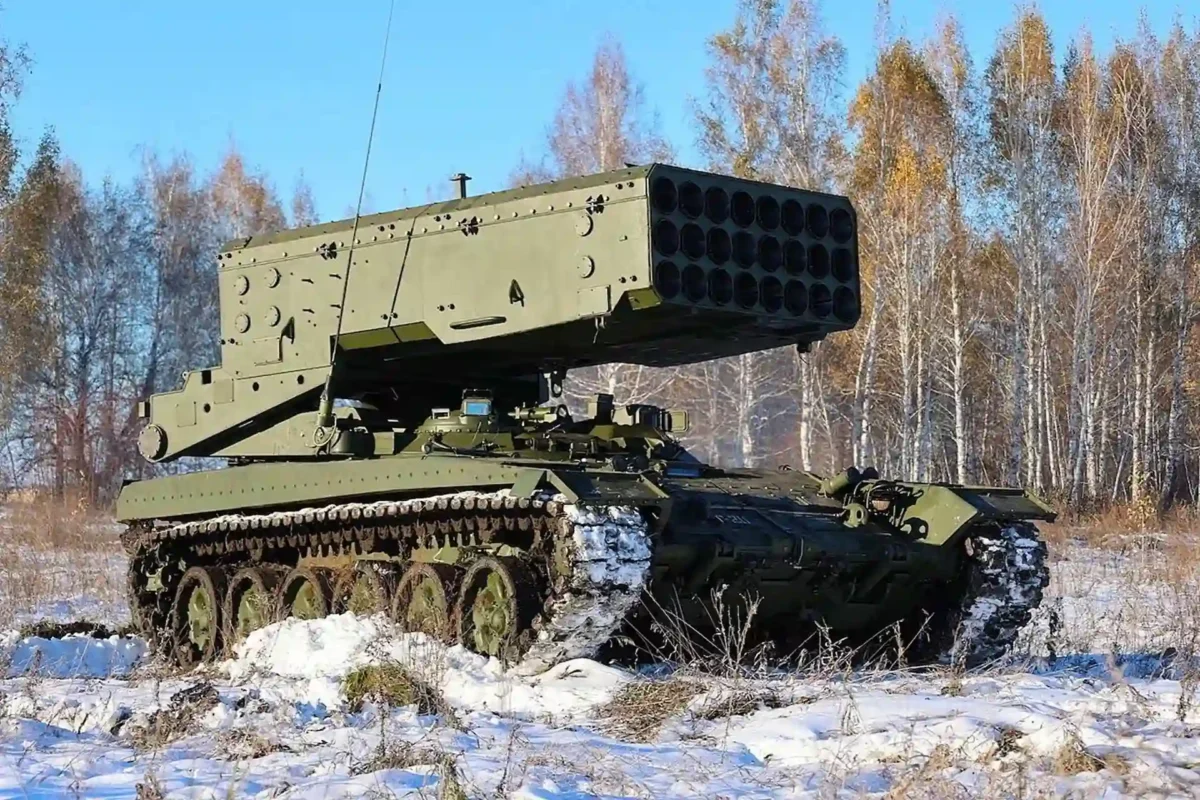
Defense Feeds – Russia has deployed a new batch of TOS-1A Solntsepek heavy flamethrower systems fitted with an upgraded anti-drone protection suite, marking another step in Moscow’s effort to strengthen frontline firepower against rapidly evolving UAV threats.
Uralvagonzavod, part of the Rostec State Corporation, confirmed the delivery on November 13, 2025, noting that each vehicle had passed field tests designed to verify its performance in harsh and unpredictable conditions.
The announcement signals that Russia is not slowing its investment in heavy assault systems despite the intense pressure of the war in Ukraine.
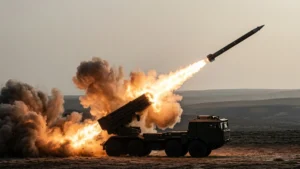
The TOS-1A Solntsepek remains one of the most distinctive weapons in Russia’s arsenal. Built on a T-72 tank chassis, the system is designed to deliver devastating saturation strikes at short to medium ranges.
Its unguided rockets can engulf up to 40,000 square meters in seconds, giving Russian assault forces the ability to overwhelm fortified positions or disrupt critical Ukrainian defensive nodes in a single strike.
On the battlefield, the TOS-1A has been widely used against trenches, hardened bunkers, UAV control posts, and concentrated troop formations. Its ability to deliver intense firepower quickly makes it a key asset for Russian units trying to break through layered defenses.
Rostec repeatedly stresses that improvements to the system are based on frontline experience.
Engineers adjust the launcher’s mechanics and onboard instruments using feedback from crews who operate it under fire.
This emphasis on real-world refinement highlights Russia’s broader effort to adapt its ground systems to a conflict shaped by drones, precision fires, and rapid counterstrikes.
Rostec also notes that development of a modernized version of the launcher, built on the T-80 tank chassis, is nearing completion.
The newer model is expected to offer longer range, higher firing accuracy, and greater automation, making it even better suited for modern high-intensity operations.
The most notable upgrade in this latest batch is the integration of a dedicated anti-drone protection complex.
According to Rostec, the defensive suite was designed by examining the system’s vulnerability to drone reconnaissance and attack over months of combat use.
With FPV drones, loitering munitions, and surveillance UAVs becoming some of the most widespread threats on the frontline, the TOS-1A needed stronger shielding to prevent detection and destruction before firing.
The anti-drone package is intended to safeguard the system from both aerial reconnaissance and direct drone attacks.
This includes attempts to target the launcher using FPV drones or guide artillery fire through persistent UAV observation.
The addition reflects a major shift in Russian military planning, where drones are now treated as a primary danger rather than a secondary nuisance.
This adjustment mirrors trends seen globally, where armored and artillery units are being redesigned or supplemented with active protection systems, electronic warfare tools, and armor kits aimed specifically at drone resistance.
In Russia’s case, the TOS-1A is being adapted to survive in a battlefield dominated by cheap but deadly unmanned systems.
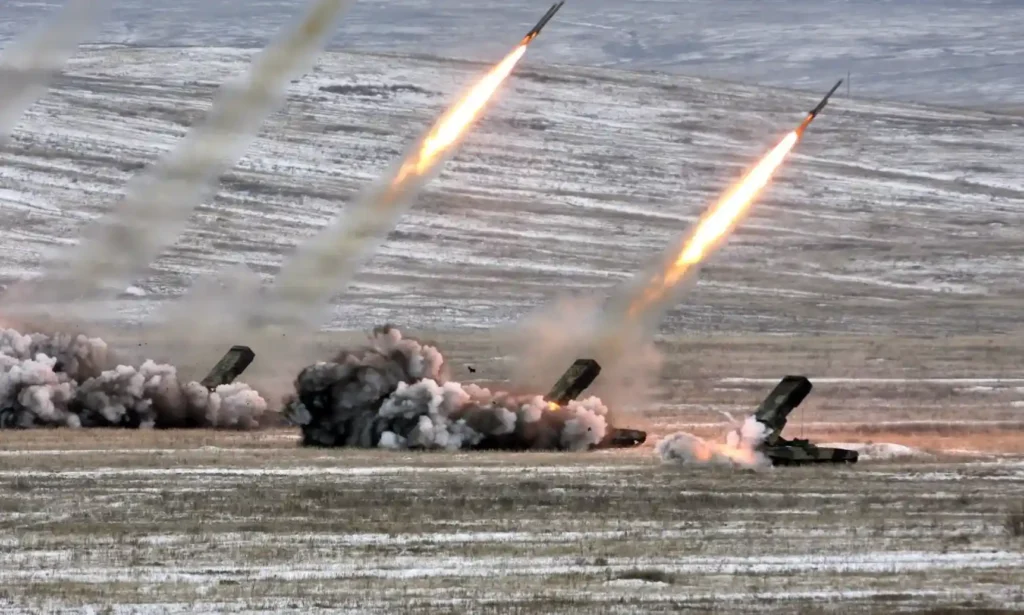
The public delivery of enhanced TOS-1A systems signals Russia’s expectation that the conflict will continue to involve trench networks, fortified defensive belts, and pervasive drone surveillance.
By improving both offensive power and defensive survivability, Moscow is preparing for prolonged ground operations rather than a short-term shift in tactics.
Rostec emphasizes continuity in production and modernization, pointing to a long-term strategy centered on heavy flamethrowers for breaching strongholds and striking critical Ukrainian positions.
The combination of intense firepower, rapid salvo capability, and new anti-drone protections positions the Solntsepek as a key tool in Russia’s plan to maintain pressure along the front.
As the war continues to evolve, the upgraded TOS-1A fleet reflects Russia’s attempt to stay ahead of the growing drone threat while keeping its most powerful assault system operational in one of the world’s most drone-saturated conflict zones.