Follow Us:
Follow Us:

Earlier this year, China gave the world another glimpse of what it’s been building behind the scenes. During its big military parade in Beijing last September, the lineup went far beyond the usual tanks and flyovers. This time, they rolled out what looked like newer generations of anti-ship and hypersonic missiles.
The kind is often labeled “carrier killers” in foreign media. It wasn’t a full reveal, but it was enough to make a point that China wants everyone to see that it’s getting serious about challenging the old balance of power at sea.
Among the many systems China has showcased, the DF-21D tends to draw the most attention. It’s a land-based ballistic missile that, according to Chinese claims, can reach and strike large ships, even a moving carrier, from long range.
That’s what earned it the label “carrier killer.” The name alone carries weight; it suggests the end of the carrier’s dominance. But can it really do what the name promises? Or is the fear of it doing so the real weapon here?
The DF-21D is basically a land-launched ballistic missile that China built to go after big ships (mainly aircraft carriers). It’s part of the wider DF-21 missile family, but this version is the one that stands out because it’s meant to hit targets at sea.
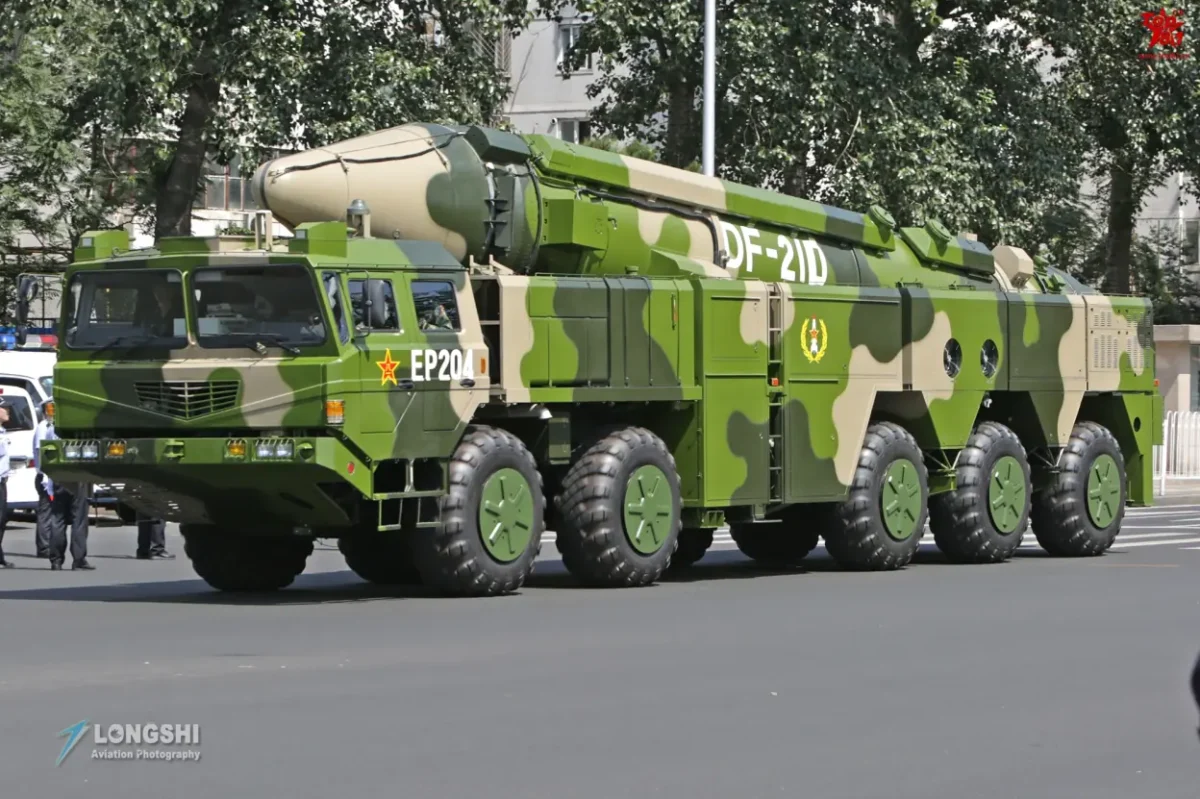
The “D” model carries a special kind of warhead that can move during reentry and uses advanced guidance to try to keep up with a moving ship.
It helps to keep a couple of perspective points in mind.
First, a lot of the DF-21D’s fame comes from its nickname — the “carrier killer.” It caught on quickly, probably because the thought of a missile launched from land hitting a moving ship seemed so bold and unexpected.
But second, being intended to threaten carriers is not the same as being proven to reliably sink one in combat, the publicly available evidence for a combat-proven hit is absent, and many analysts treat the system as a serious complication rather than a guaranteed knockout.
| Feature | Typical description |
| Origin | China; derivative of the DF-21 MRBM family. |
| Range (reported) | Common estimates put the DF-21D in the ~1,500–2,000 km class (some estimates vary by variant and source). |
| Payload | Conventional warhead (weight estimates vary) intended to cause mission kills or severe damage; exact warhead mass is not public. |
| Launch method | Road-mobile transporter-erector-launcher (TEL), gives mobility and survivability. |
| Key features | Reported maneuverable reentry vehicle (MaRV) for terminal maneuvers; mid-course updates and terminal guidance are often discussed in analyses. |
What Does That Mean?
Reports usually place the DF-21D’s range somewhere between 1,500 and 2,000 kilometers. If that’s close to true, it could cover much of the Western Pacific from inside China’s borders.
For U.S. and allied carriers, that’s not a comforting thought. They might have to stay farther out, or at least think twice before moving too close. Even if the missile’s accuracy or reliability isn’t fully proven, the mere possibility of such reach is enough to change how naval planners think about operating near China’s coast.
One thing that stands out about the DF-21D is that it’s launched from a truck, not a fixed site. That makes it a lot harder to find or hit before it fires. In a way, that mobility says a lot about China’s priorities to keep its missile force flexible and able to survive a first strike.
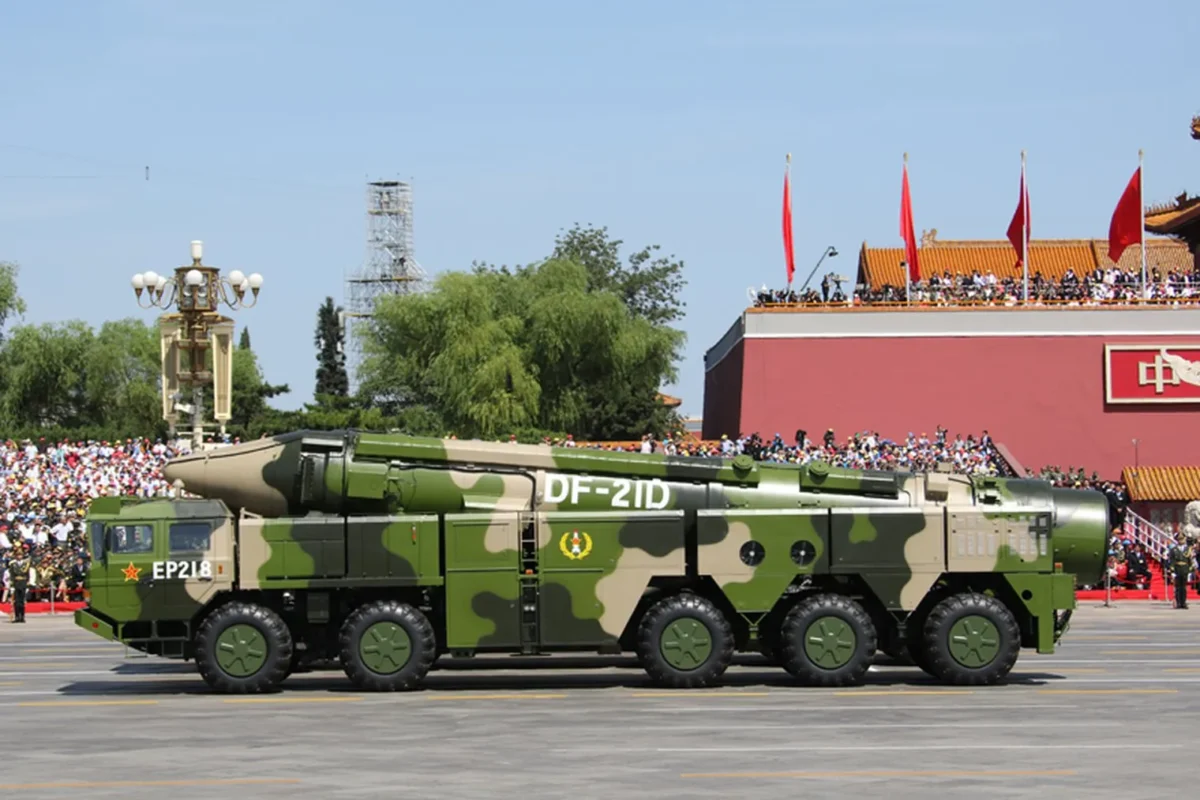
One of the things people talk about is the MaRV or maneuverable reentry vehicle, the warhead that can change course during reentry. Paired with mid-course updates and last-minute guidance, that setup could let the missile correct toward a moving ship instead of just bombing a fixed point.
It sounds neat on paper, but the real test is whether those adjustments work in a fight with jamming, decoys, and a carrier steaming away. In a contested battle, with electronic attacks and false targets, those systems could struggle, so the promise doesn’t automatically equal battlefield success.
The DF-21D doesn’t work by itself. To know where to aim, it needs other sensors to first find the carrier. That could mean satellites in orbit, long-range radar stations, or reconnaissance aircraft and drones. Each of those tools can help point to the carrier’s general area, but none gives a perfect, second-by-second fix.
Satellites only pass over sometimes, radars can see far but not very precisely, and planes or drones can run low on fuel or be forced away. So the missile’s only as good as the bits of info it’s fed and that picture is always shifting.
Because the sensors don’t give a perfect, live picture, the missile needs updates on the way. Satellite, radar and drone data go into a command network. Someone pieces those clues together, and the updated cue is sent to the warhead so it can correct course at the end. The process looks like this:
Find the ship → make a good guess where it will be → tell the missile to correct as it comes in.
That chain of messages has to be fast and reliable, and it might be vulnerable to jamming, bad weather, or mistakes.
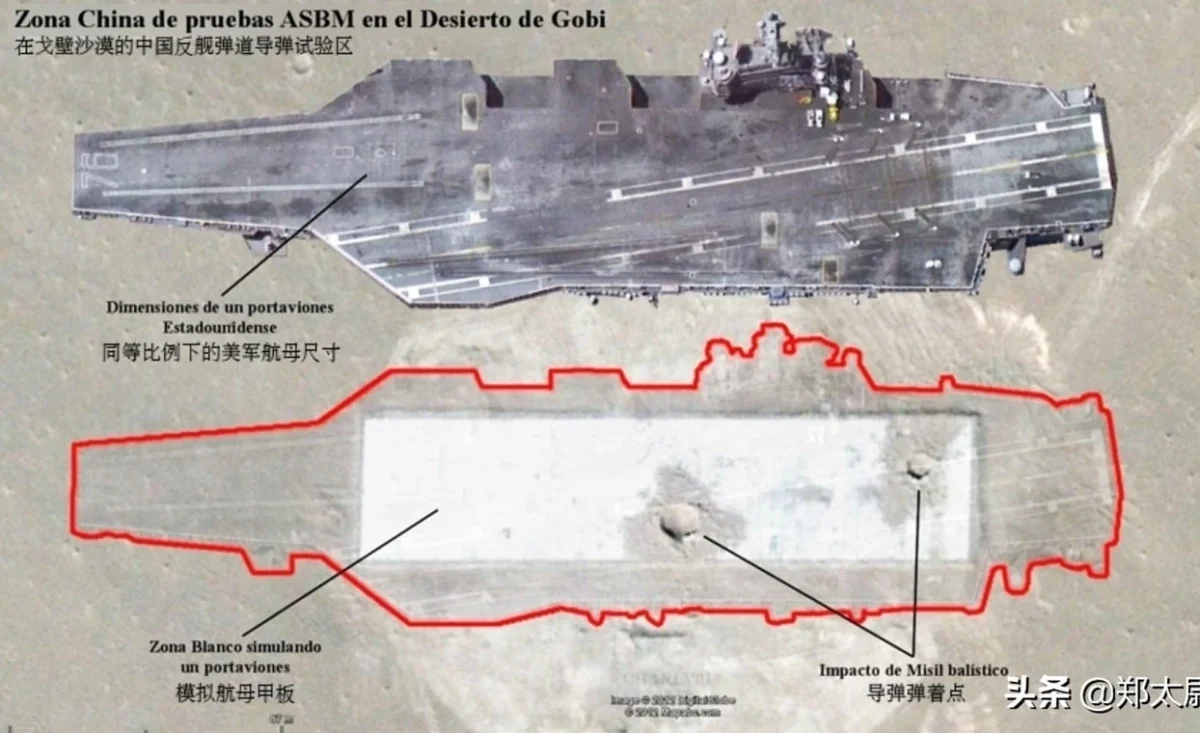
Hitting a moving carrier at long range comes down to timing. Carriers move, and they can do so fast and unpredictably. That’s the tricky part: if a missile is launched at an old fix, the ship might be miles away by the time the warhead reaches the area.
So the whole trick isn’t just a better missile, it’s getting fresh targeting data all the way through the flight. In that sense, the DF-21D might push carriers to keep their distance, yet real reliability in combat conditions remains an open question.
One reason the DF-21D scares people is straightforward. It could challenge U.S. naval freedom of movement in the Western Pacific. If a land-based missile can threaten a carrier from hundreds or even a thousand-plus kilometers away, commanders may have to keep ships further from coasts or invest heavily in new protections. Even the possibility of that changes how planners think about deploying carriers and where they feel safe operating.
There’s also a big psychological angle. Calling the DF-21D a “carrier killer” is dramatic and memorable, and that label does useful work as a deterrent. If an adversary believes it faces a plausible risk of losing a carrier, that belief alone may slow operations, force more cautious tactics, or raise political costs for intervention, even if the missile’s real combat record is unproven.
Media headlines and military talk amplify the fear. News stories, think-tank pieces, and official warnings often use vivid language, which helps the nickname stick. That doesn’t mean the technical claims are always fully vetted in public reporting, but it does mean perception, not only capability, shapes strategic thinking. Perception can be almost as important as performance in shifting naval posture and public debate.
A major technical problem is that carriers move. Big ships can steam at 30+ knots and change course; over the long flight time of a ballistic missile, that movement matters a lot. That simple fact makes hitting a moving ship far harder than striking a fixed target; it needs fresh data and fast updates, not just a one-time GPS-style aimpoint.
Electronic warfare and decoys make the challenge worse. Carriers travel with protective groups and layered defenses that can jam, spoof, or confuse incoming sensors and guidance. Aircraft, decoy drones, and electronic attacks could hide the true location of a carrier or flood the targeting network with false signals, and that could blunt what the DF-21D’s guidance is trying to do.
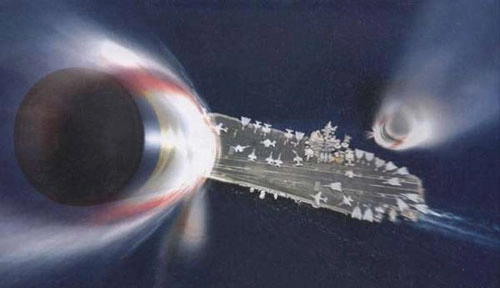
There are also questions about reliability and accuracy. Even if a MaRV can manoeuvre in the terminal phase, its success depends on precise mid-course data, resilient communications links, and a guidance chain that works under stress.
Mechanical failures, software errors, or poor data can all reduce the odds of a hit. Those limits though don’t make the DF-21D irrelevant; they just mean its real effect may be more about complicating decisions than guaranteeing sinkings.
The Navy’s go-to answer to ballistic threats is the Aegis combat system paired with Standard-family interceptors, most notably the SM-3 for exo-atmospheric, mid-course interception and the SM-6 (and older SM-2) for end-game terminal defence.
The basic idea of a layered approach is to try to catch an incoming missile early, but have additional shooters closer in if the first layer misses. That concept is sensible because no single interceptor is perfect; using several types at different ranges raises the odds of a kill.
Aegis and its SM-3 interceptors have proven they can hit test targets, mostly short- and medium-range missiles, and the system keeps getting upgrades. But a test range isn’t a real battlefield. Each interceptor costs millions, needs good timing and works best when the sensors have a clear view. If dozens of missiles come in at once, the defense can start to fall behind.

Even U.S. Navy officers have admitted that firing wave after wave of these interceptors in a real war just isn’t practical. It’s a solid defense, but not sustainable in both a logistical and doctrinal limit.
Read also: 5 Reasons Why Ballistic Missiles Are Hard to Intercept
There are a few practical problems that reduce how reassuring the Aegis/SM-3 story is against an ASBM like the DF-21D. First, timing and geometry matter — hitting a fast, maneuvering reentry vehicle late in its flight window leaves fewer options and less room for error.
Second, a saturation attack (many missiles or mixed raid-types) can exhaust interceptors or create engagement conflicts.
Third, sensors must keep a clean track and hand it off to shooters; For Aegis to work, its sensors and interceptors need to stay perfectly linked. If that connection breaks, maybe from jamming, deception, or even awkward geometry, the chances of a clean intercept fall. That’s why some experts describe Aegis as reliable in theory but less certain once things get chaotic.
Because of those gaps, the Navy is trying to supplement shipboard interceptors with other systems. They’ve tested putting Patriot-style shooters on ships, firing SM-6s alongside SM-3s, and hunting for lower-cost ways to knock down warheads. Those moves could plug holes in the shield, but they also bring problems: more types of gear to make work together, higher integration bills, and a bigger logistics tail to keep stocked in a long fight.
The Navy has already started to change how it fights. The old model, stacking the best ships around a single carrier, is being rethought. Under Distributed Maritime Operations, forces are spread into smaller teams: missiles, planes, and submarines operate from many different places.
The point is to avoid putting all the value in one place and to force an adversary to attack many smaller, less valuable nodes. This concept looks promising on paper, but it raises hard sustainment questions: logistics, command and control, and available munitions all become harder when forces are widely dispersed.
Read also: Is It Possible to Destroy an Aircraft Carrier? A Tactical Perspective
At the tactical level, carrier strike groups are also adapting. They’re restructuring formations, sailing with more escorts focused on jamming and missile defense, and testing tricks like decoys.
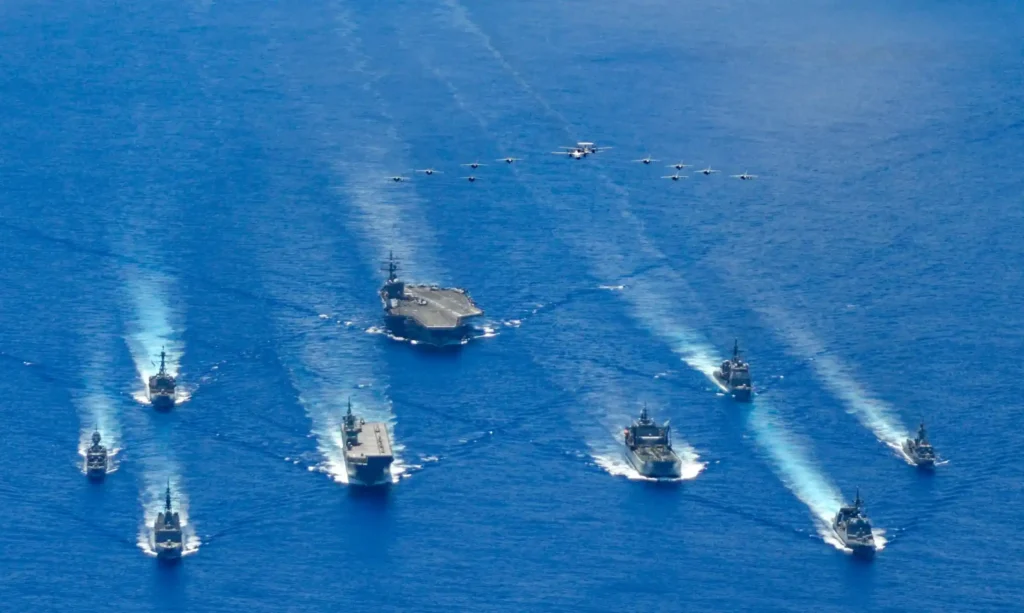
Some of the more interesting experiments put fake signatures in the air, devices that look like ships to a seeker and help buy time or steer a missile away. This step is essentially trying to make false targets that an incoming seeker will chase.
Those techniques could blunt incoming ASBMs or at least force an adversary to buy more intelligence and worry about counter-decoy measures. That said, deception and stealth are not silver bullets; they work best as part of a layered, redundant defence and depend on training, timing, and resilience against electronic attack.
Some of the earliest Western commentary sounded an alarm. Back in 2010, public reporting revealed that U.S. Pacific Command’s Admiral Robert Willard said that China was “developing and testing” a land-based missile designed to target carrier strike groups. That disclosure helped shift the conversation from “perhaps someday” to “this may already exist in some form.”
Since then, analysts such as Andrew S. Erickson have stated that the DF-21D “is no longer an aspiration.” It appears to have been deployed in limited numbers, which for now gives it an initial operational capability (IOC) status in many experts’ views. So, many agree: yes, the hardware is real; yes, China appears to field the DF-21D in some fashion.
In terms of actual test events, there are reports of large-scale missile launches from mainland China that may involve the DF-21D or similar anti‐ship ballistic missiles.
For example, one test bulletin identified missile launches in the South China Sea region, possibly involving the DF-21D or the longer-range DF‑26. More recently (in 2025) there was open speculation that an air-launched derivative of the DF-21D may have been tested from a bomber.
From the Western side, U.S., Taiwan and allied analysts, there’s a shared view: China has made serious progress, but the real proof (hitting a moving carrier at sea) is not publicly documented yet.
For instance, one U.S. study observed that while the DF-21D hardware may be mature, “the kill chain,” the sensors, data links, reconnaissance and tracking required to pull it off, remains untested in full combat conditions. Western analysts tend to treat the DF-21D as a credible threat-in-progress rather than an accomplished guarantee.
From the Chinese media and academic side, the narrative is more confident: Beijing presents the system as a key piece of its anti-access/area-denial (A2/AD) strategy. Some Chinese-language commentary suggests the system is operational and intended to change power dynamics in the Western Pacific.
However, even within China there are acknowledgments of “technological difficulties, funding and talent constraints” in achieving full capability.
Despite all the tests and commentary, there is no open, verifiable case in which the DF-21D has been used in combat to strike a moving carrier and publicly confirmed to succeed. Analysts repeatedly stress this point: tests against static or mock targets are one thing; large-scale operations at sea, in wartime conditions, are another.
Furthermore, while Chinese sources and Western analysts estimate the DF-21D has been “deployed in small numbers,” the exact number of launchers, stockpile size, and readiness status remain uncertain.