Follow Us:
Follow Us:

When Russian armor first rolled across the Ukrainian border in February 2022, few expected that two shoulder-fired weapons, the FGM-148 Javelin and the Next-Generation Light Anti-tank Weapon (NLAW), would become symbols of resistance.
Within days, in late February and early March 2022, clips of Ukrainian troops using these weapons to destroy Russian tanks went viral. Both systems quickly gained almost mythic reputations, celebrated in memes and praised on battle reports alike.
But behind the headlines lies a more complex story. The Javelin and the NLAW have very different origins, designs, and price tags and each proved its worth in its own way. The Javelin, with its sophisticated fire-and-forget guidance and long reach, became the high-end precision killer. The NLAW, lighter and cheaper, was the close-range ambusher’s favorite.
So, is NLAW better than Javelin? Or does the Javelin still hold the crown as the ultimate anti-tank weapon? To answer that, we need to look at how each performed on the battlefield, what they cost, and what makes them so different in the first place.
Let’s talk about NLAW..
NLAW (Next-generation Light Anti-tank Weapon) is a lightweight, single-use anti-tank launcher designed for short-range ambushes and urban fighting.
Developed in the 1990s–2000s by Swedish and UK teams. It was developed because modern infantry needed something light, simple, and effective at knocking out tanks in confined or close terrain; streets, woods, and the kind of broken-up battlefield where getting close matters.
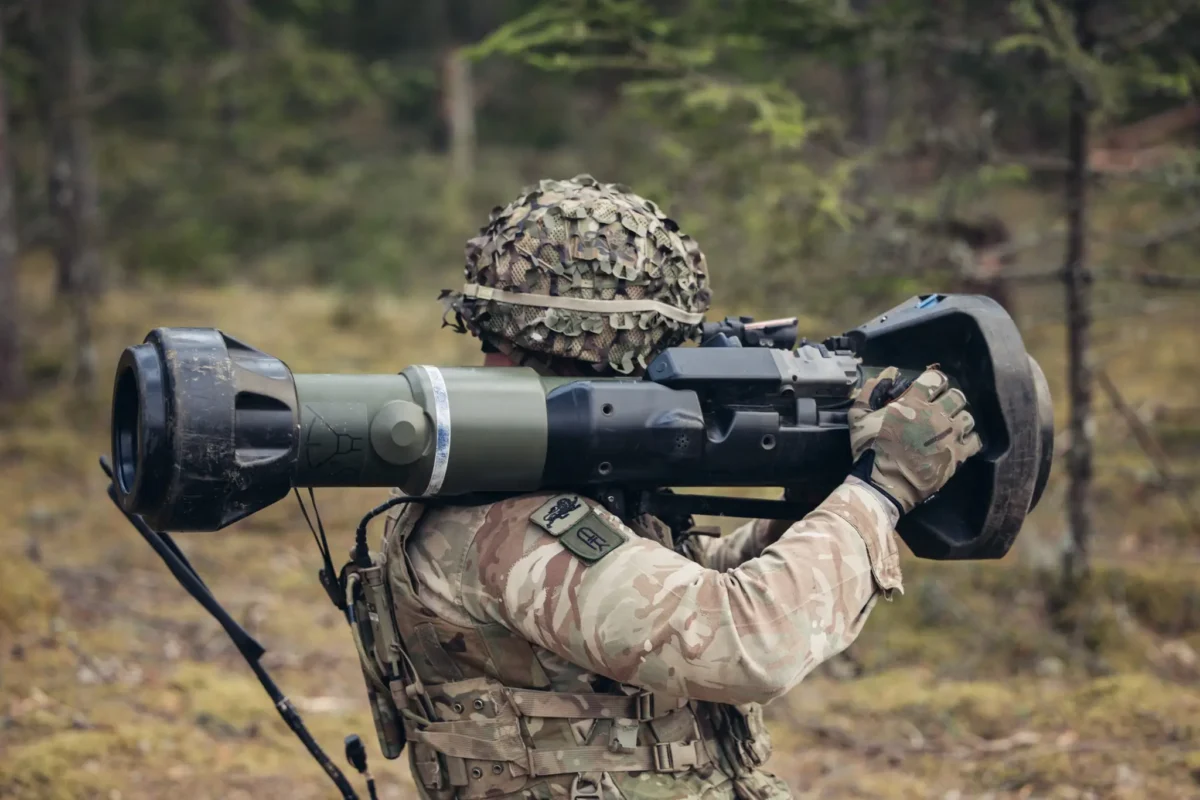
Historically, NLAW started as a Swedish/UK response to lessons learned in post-Cold War conflicts, where tanks were vulnerable in urban and close terrain. The design goal was to give infantry a single-soldier, low-training, low-logistics counter to armored vehicles so that even lightly equipped units could ambush and stop an advance.
A single sealed tube weighs roughly a dozen kilograms and is optimised for engagements from very close up to a few hundred metres (commonly cited around 20–700 m).
How to operate it?
Typically, you “lead” the target for a couple of seconds so the system records the target’s motion. That is called Predicted Line Of Sight (PLOS).
Once the missile is launched it follows an autonomous flight path that intercepts where the target will be; the concept is to overfly or hit the vehicle’s top where armour is weaker. Because it’s disposable, has low training and logistics demands, and produces a small backblast, NLAW is suited to fast-moving infantry, ambush tactics, and confined positions.
How about Javelin?
If the NLAW is the pragmatic ambush hammer, the FGM-148 Javelin is the precision scalpel; a more complex, more expensive, but much longer-reaching weapon. Its program began in the 1980s and reached service in the 1990s. It was designed to give infantry a true stand-off anti-tank capability with a modern seeker and flexible attack profiles. Over the decades, it’s been upgraded, fielded widely with NATO partners, and has become a benchmark for man-portable ATGMs.
Read also: FGM-148 Javelin – Why It’s the Top Anti-Tank Missile Today
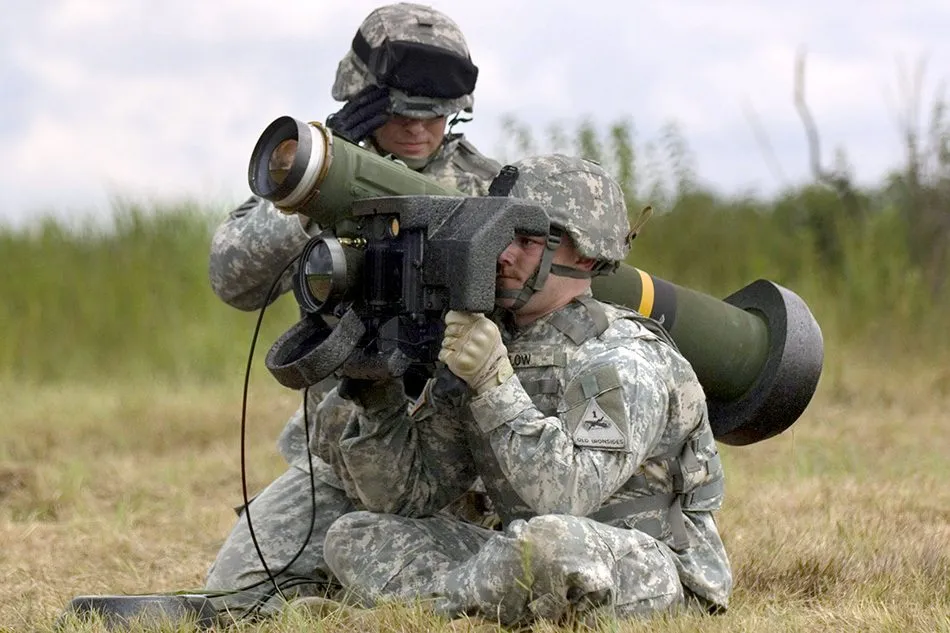
It pairs a reusable Command Launch Unit (CLU) that contains a thermal imaging sight with disposable missiles; the combined system is substantially heavier than a disposable tube and is more expensive per shot. Javelin missiles engage out to roughly a few kilometres (commonly quoted up to ~2,500 m depending on variant).
How to operate it?
Javelin uses an imaging infrared seeker. The operator acquires the target in the CLU, locks the seeker, then fires. Once launched, the missile homes on its target autonomously, that’s why Javelin is called “fire-and-forget”: the shooter can immediately relocate or take cover after firing.
It has a primary top-attack mode to strike the thinner armor on a tank’s roof, plus a direct-attack mode for buildings or helicopters. Its warhead is typically tandem HEAT to defeat explosive reactive armor (ERA) and heavy composite armor.
| Feature / Parameter | NLAW (Next-generation Light Anti-tank Weapon) | Javelin (FGM-148) |
| Role | Short-range, disposable/light anti-tank launcher for ambush and urban fights | Medium-range, man-portable fire-and-forget ATGM for precision engagements |
| Origin/developer | Sweden / Bofors (later Saab) & UK development; now marketed by Saab | United States / Joint venture (Lockheed Martin / Raytheon) |
| Entered service (approx.) | Early 2000s (entered widespread service ~2008–2010) | 1990s (entered US service early–mid 1990s) |
| Launcher type | Single-use, disposable sealed tube | Reusable Command Launch Unit (CLU) + disposable missiles |
| Weight (launcher/missile) | ~12–13 kg (single unit) | CLU ~6–8 kg; missile ~11–12 kg; system (CLU + missile) ~22–25 kg |
| Engagement range (typical) | ~20–700 / 800 m (short/close-quarters optimized) | ~65 m – 2,500 m (depending on variant & mode) |
| Guidance method | Predicted Line Of Sight (PLOS) — operator tracks briefly, missile flies to predicted intercept | Infrared imaging seeker, “fire-and-forget” (autonomous target seeker) |
| Attack profile | Direct or top-attack (designed to strike weaker top armor); optimized for ambushes | Primary top-attack, also has direct-attack mode for structures/short ranges |
| Warhead type | Single HEAT (designed to defeat modern tank top armor) | Tandem HEAT (designed to defeat reactive armor + main armor) |
| Launch signature / backblast | Soft-launch (lower backblast; suitable for confined positions) | Soft-launch (CLU design reduces backblast; suited for hull/room firing) |
| Crew / operator | Single soldier; minimal setup | Two-man team common in doctrine but can be operated by one trained soldier |
| Training & use | Short training cycle; quick to field to conscripts/territorials | Requires more training on CLU, target ID, modes; more operator skill to exploit range/thermal imagery |
| Unit cost (rough ballpark) | Relatively low — hundreds to low thousands USD per round depending on contract | Much higher — tens of thousands USD per missile (CLU is expensive capital kit) |
| Best use case | Ambushes, urban/wooded close fights, cheap mass distribution | Long-standoff precision kills, high-value targets, countering advanced armor at range |
The NLAW is a short-range weapon optimized for close-in ambushes, with an effective band typically cited around 20–700 metres. That compact envelope suits sudden, short encounters in confined visibility (e.g., streets, rubble, and broken terrain), where rapid deployment and quick shots matter most. With an effective envelope often quoted between 2,000–2,500 metres, the Javelin provides true stand-off anti-tank capability.
The system’s thermal sight finds targets and the missile’s autonomous seeker completes the attack, removing the need for continued guidance.
In practice, NLAW offers concentrated short-range defense capable of covering likely approach routes, while Javelin enables long-distance strikes that influence combat further from the front line.
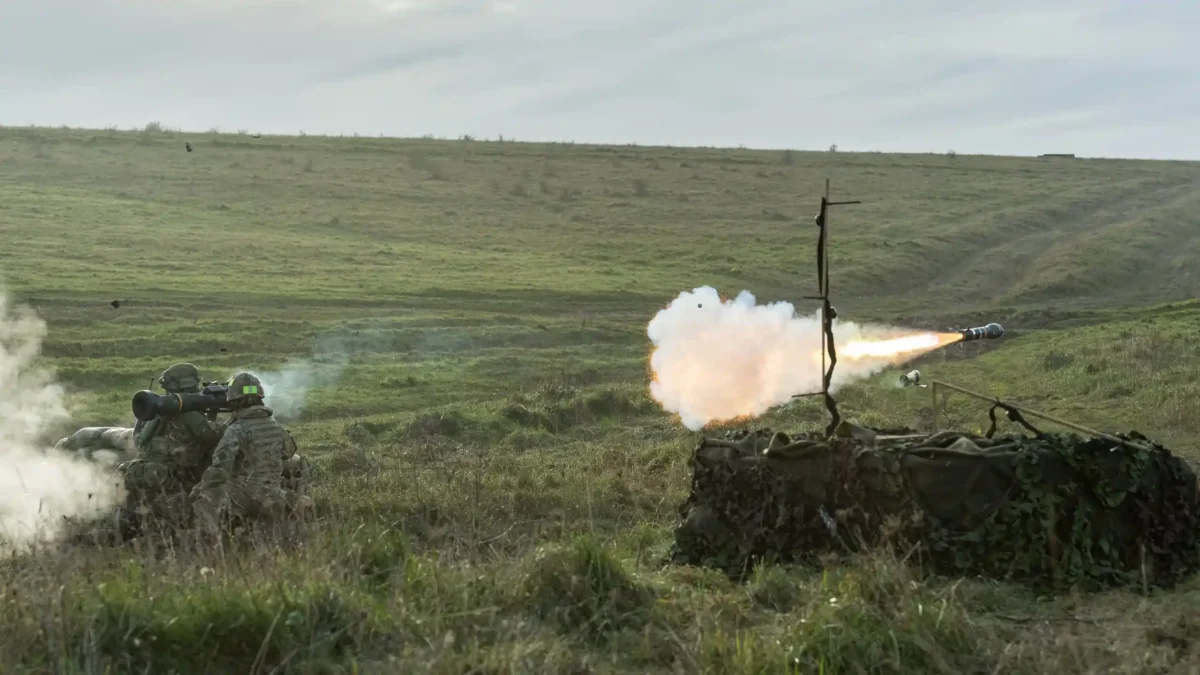
NLAW’s limited range leaves its operators more exposed in open areas, whereas Javelin’s extended reach only delivers full advantage when supported by skilled crews and reliable logistics for its launch units and missiles.
NLAW typically mounts a single HEAT-style warhead engineered to defeat thinner top armor or to achieve a targeted strike against lighter protections.
The design emphasizes simplicity and an effective strike against roof armor, but most variants do not include a tandem charge dedicated to defeating modern explosive reactive armor (ERA).
Javelin, by contrast, uses a tandem HEAT warhead together with a true top-attack profile (and a selectable direct-attack mode), explicitly intended to defeat ERA and advanced composite protection.
In contested fights against ERA-equipped main battle tanks, Javelin’s tandem warhead and seeker-guided precision provide a clear advantage in first-shot probability of kill.
NLAW remains highly capable against lighter vehicles, legacy tanks, or when a favorable top hit is achieved, yet it is comparatively more vulnerable to modern countermeasures.
Simplicity is a core strength of NLAW: short training cycles, minimal pre-shot procedures, and disposable launchers reduce maintenance and logistical burden. Those features make wide distribution feasible; reserves and irregular units can be equipped and trained rapidly, and attrition is less crippling.
Javelin requires more extensive training to exploit the CLU’s thermal sight and modes effectively; the CLU itself is a delicate, reusable asset that demands care, spare parts, and sustainment.
Cost differences are significant. An NLAW round is far cheaper than a Javelin missile, and CLU procurement and upkeep add lifecycle costs. The operational critique is that NLAW wins on scalability and cost-effectiveness for saturation tactics, while Javelin demands investment but rewards it with greater single-shot lethality and flexibility against modern armor.
Dense and urban terrain accentuates NLAW’s advantages. Short engagement distances, soft-launch characteristics that reduce backblast, and rapid-deploy capability suit ambushes from buildings, rubble, woods, and other broken ground.
Javelin is also employable in urban settings, and its fire-and-forget nature lets crews relocate quickly after firing; however, the system’s bulk and requirement for clear lines of sight to exploit range can be limiting in very cramped environments.
In open terrain or at operational depth, Javelin’s standoff range and precision dominate, allowing engagement of armor before it reaches effective firing positions and enabling dispersed, concealed defensive postures.
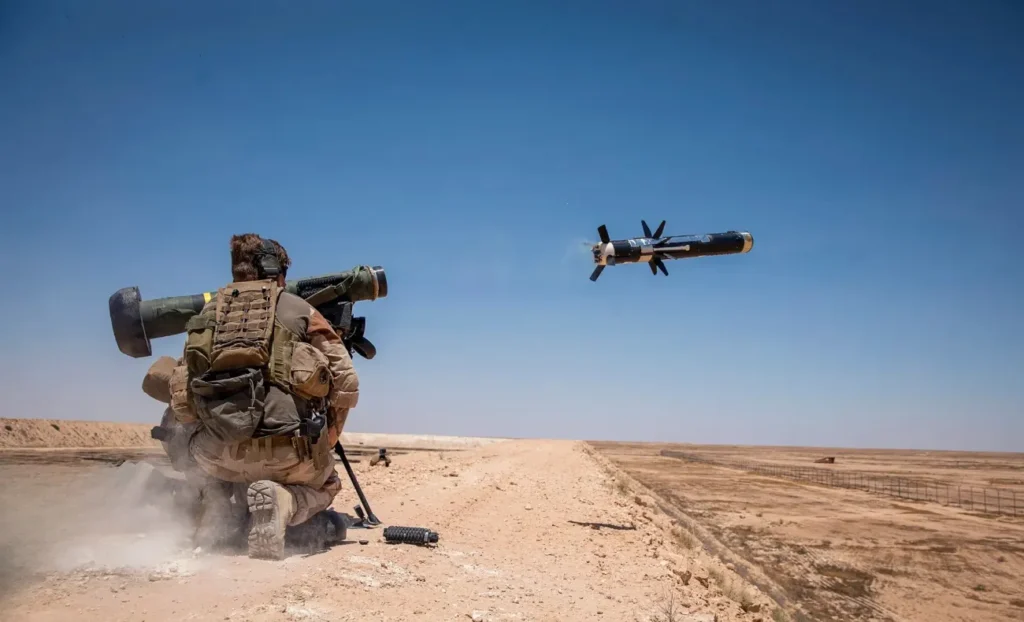
NLAW’s urban strengths are immediate and tactical, but in open, combined-arms battles Javelin provides operational-level lethality and survivability that disposable short-range systems cannot match.
When the war in Ukraine erupted in early 2022, both the NLAW and the Javelin quickly became symbols of Western military aid, and of Ukraine’s unexpected defensive success. The United Kingdom was among the first to act, rushing several thousand NLAW launchers into Ukraine within weeks of the invasion.
By mid-2023, estimates suggested that over 5,000 NLAWs had been delivered, forming the backbone of Ukraine’s early anti-tank resistance. The United States and its allies followed suit with their own contributions, supplying multiple thousands of Javelin systems and missiles, supported by large replenishment contracts to sustain production.
Assessing battlefield performance has been more complex. While Javelin manufacturers have quoted success rates over 90 percent, these results stem from controlled trials, not combat. Open-source databases like Oryx have confirmed thousands of destroyed or abandoned Russian armored vehicles, but few cases can be directly tied to a single weapon type.
Top-attack strikes seen in many circulated videos align with the flight profiles of Javelin or NLAW systems, yet those clips illustrate isolated examples rather than broad, verifiable data. What’s clear is that both systems have contributed to the extraordinary attrition of Russian armor, though exact hit or kill rates remain unverified in independent analysis.
Battlefield reports from Ukraine give a clear picture of how both systems were used. NLAW proved most effective in close, chaotic settings; streets, forests, and trenches, where its simple design and quick reaction time made it ideal for surprise attacks. They could be fired from windows, rooftops, or behind rubble.
Javelin, by contrast, excelled in planned engagements, where trained teams could strike high-value targets from long distances. Because its guidance was automatic after launch, crews could fire and move before being spotted. So, the two systems ended up complementing each other: NLAW brought numbers and speed, Javelin brought accuracy and reach.
Both systems, however, faced limitations once the fighting evolved. NLAW’s limited reach frequently forced operators into risky positions where return fire and counter-artillery posed real dangers.
Javelin’s reach and lethality reduced that exposure; however, high unit cost, supply constraints, and CLU maintenance restricted how widely it could be employed. The war also prompted adaptations; Russian forces began fitting tanks with “cope cages” makeshift roof armor designed to disrupt top-attack profiles.
How did weapons like the NLAW and Javelin actually change the way the war was fought in Ukraine?
From the start, Ukrainian troops used these launchers not just as single “tank killers,” but as part of a larger battlefield system. Small infantry teams began setting up layered ambushes; NLAWs for quick, close-range strikes and Javelins for longer-range, high-value shots.
Drones often helped spot targets, while artillery finished off damaged vehicles. This mix of cheap, mobile weapons and smart coordination made Ukrainian units surprisingly effective against much larger armored forces.
For Russia, the shock was immediate. Traditional armored tactics; long tank columns moving along roads became dangerously exposed. Crews started adding “cope cages” and makeshift roof armor to protect against top-attack strikes, and tanks began operating more cautiously, usually with infantry or drones providing overwatch. But these quick fixes often failed to stop guided missiles, and the changes slowed Russia’s momentum and flexibility on the battlefield.
The big lesson from all this is clear: portable, precise anti-tank weapons have changed how modern wars are fought. Armies can’t just rely on heavy armor anymore. Drones, dismounted troops, and electronic-warfare systems must operate in concert for forces to survive on modern battlefields.
Ukraine’s experience also showed that thousands of simple, reliable launchers in many hands can matter as much as a handful of high-tech missiles. Future conflicts should probably combine both approaches: mass distribution for area denial and precision-guided weapons for decisive strikes.
Which one turned out to be better?
The honest answer is: it depends on what’s needed. NLAW suits rapid, low-cost distribution and close-range ambushes in built-up or broken terrain. For engaging modern tanks at a distance with high first-shot lethality, Javelin is the superior tool. It excels at longer-range, precision strikes against heavily protected targets, allowing teams to fire from cover and relocate immediately.
Neither weapon is a universal solution. NLAW wins affordability, easy training, and quick fielding for mass defense. Javelin brings sophisticated guidance, standoff range, and superior penetration against ERA-equipped tanks.
The real difference comes down to context: terrain, tactics, and training. In dense or urban environments, NLAW’s portability and fast reaction time are ideal. In open terrain or high-intensity operations, Javelin’s range and accuracy dominate.
That’s why most modern militaries see the smartest approach as a mix of both types; simple, disposable weapons for mass defense, and advanced, guided missiles for precision strikes. This layered capability ensures flexibility across environments and threat levels.
For future anti-tank procurement, the key takeaway is balance: combine numbers with quality, invest in training and logistics, and tailor systems to the terrain and mission, not just the technology itself.