Follow Us:

Follow Us:


Defense Feeds – China Debuts New DF-61 ICBM at a military parade in Beijing, officially unveiling its most advanced nuclear weapon to date.
The missile, carried on 16-wheeled transporter-erector-launchers (TELs), was showcased during the September 3 event marking the 80th anniversary of victory over Japan.
While technical details remain undisclosed, the debut of the Dongfeng-61 signals a new phase in China’s nuclear weapons modernization and highlights Beijing’s push to expand a fully credible nuclear triad.
China publicly presented the full scope of its land, sea, and air nuclear forces for the very first time.
The JingLei-1 air-launched long-range cruise missile, JuLang-3 submarine-launched ballistic missile (SLBM), and the newly revealed DF-61 ICBM joined the latest DF-31BJ variant and other established systems, including the DF-5C and the much-discussed DF-26D “carrier killer” missile.
The coordinated display of land-, sea-, and air-based delivery platforms highlights Beijing’s intention to demonstrate survivability, deterrence, and the ability to retaliate through diverse launch modes.
Analysts noted that this kind of coordinated presentation is consistent with past Chinese practice of unveiling new strategic weapons systems during major anniversaries or commemorative parades.
The DF-61 itself drew significant attention because it is widely interpreted as either the successor or a technological complement to the DF-41 ICBM, which was paraded publicly for the first time in 2019.
Like its predecessor, the DF-61 is believed to place emphasis on road mobility and survivability, key features for missiles designed to withstand a potential first strike.
The DF-61 was mounted on transporter-erector-launchers similar to those of the DF-41, suggesting China is maintaining consistency in its deployment approach.
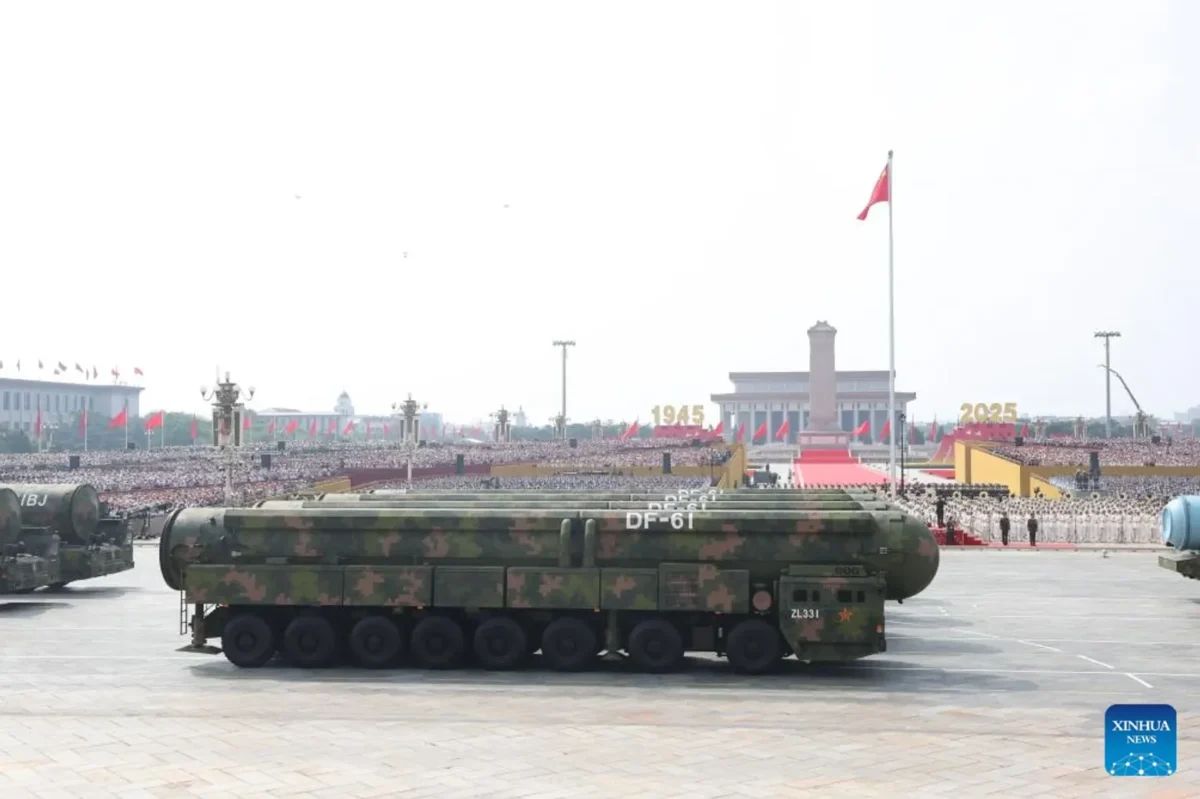
Although no official technical specifications were disclosed during the parade, the DF-61 is thought to represent a leap forward in warhead delivery capability.
The DF-41, which began development decades ago and entered service by 2017, measures around 20 meters in length, carries multiple reentry vehicles, and is believed to reach targets at distances of 12,000–15,000 kilometers.
Reports that circulated prior to the DF-61’s public unveiling had suggested a next-generation system under provisional names like DF-45 or DF-51.
These concepts discussed missiles larger than the DF-41, with takeoff weights above 110 tons, capable of carrying either multiple mid-range warheads or even high-yield payloads, potentially above five megatons.
Some assessments speculated about fractional orbital bombardment system (FOBS) integration, which would allow warheads to briefly enter low-earth orbit and return from unexpected trajectories, making them much harder to detect or intercept.
This remains unconfirmed, but given China’s investments in hypersonic glide vehicles and maneuverable reentry vehicles, the DF-61 could integrate advanced penetration technologies.
The decision to reveal the system at this juncture reflects the broader momentum of the People’s Liberation Army Rocket Force (PLARF), which is pursuing rapid expansion.
In its December 2024 report, the U.S. Department of Defense stated that China’s nuclear arsenal had exceeded 600 active warheads by mid-2024 and was on track to reach more than 1,000 by 2030.
Within this growth, the DF-61 is expected to serve as a key platform, combining improved survivability with long-range strike capability.
China has also been building out its infrastructure. At least three new ICBM silo fields have been documented by satellite imagery, each sized to accommodate over 100 silos.
This large-scale silo construction goes hand in hand with new mobile missile brigades, painting a picture of a diverse and redundant nuclear architecture that blends fixed and mobile deployments.
China’s DF-61 stands as the latest evolution in its intercontinental missile arsenal, a history that began in the Cold War years.
China’s first-generation missiles, such as the DF-2 developed in the early 1960s, represented breakthroughs in basic strategic reach.
The DF-4 extended strike ranges to 7,000 kilometers, providing coverage of Moscow and U.S. bases in Guam, while the liquid-fueled DF-5, fielded in the 1980s, became China’s first true intercontinental system, capable of carrying massive warheads over 13,000 kilometers. In later decades, solid-fuel designs like the DF-31 introduced greater mobility.
By the time the DF-41 appeared in 2019, China achieved a qualitative leap: MIRV (multiple independently targetable reentry vehicle) capability, longer ranges, and mobility combined.
The DF-61 is widely seen as continuing this evolutionary arc, but at a time when China’s strategic doctrine appears to be shifting from minimum deterrence toward building a more dominant, flexible nuclear force.
Whether the DF-61 will directly replace the DF-41 or serve alongside it is not yet confirmed.
No reports of its operational deployment have surfaced, and its presence at the parade may signify an initial declaration of its official role rather than active service.
Defense think tanks have speculated that China might be developing multiple new ICBM designs simultaneously, one to eventually substitute the DF-41 and another as a successor to the long-serving DF-5 family.
Whichever path Beijing chooses, the symbolism is clear. The DF-61’s public introduction—alongside JuLang-3 and JingLei-1—marks the arrival of China’s fully developed nuclear triad.
This capability had long remained aspirational, but with solid-fuel mobile ICBMs, advanced SLBMs, and modern air-delivered long-range missiles, China now joins the United States and Russia as the only powers deploying all three branches of nuclear deterrence.
As China continues to diversify its strategic arsenal with systems like the DF-26 intermediate-range missile and the CJ-100 cruise missile, the DF-61 cements its position as the backbone of a rapidly evolving nuclear strategy.
It adds uncertainty for potential adversaries, complicates U.S. missile defense planning, and signals to regional rivals that Beijing’s nuclear umbrella is expanding at pace.