Follow Us:

Follow Us:

The Littoral Combat Ship (LCS) was once seen as a glimpse of the Navy’s future. It’s a smaller, faster vessel that could operate close to shorelines and handle a mix of missions with ease. It was designed to be flexible, modular, and cheaper than larger warships, offering a way to take on coastal threats without putting billion-dollar destroyers at risk.
But things got complicated pretty quickly. What started as a “low-cost, high-speed” project turned into one of the Navy’s most expensive learning experiences.
Ships broke down more often than expected, maintenance costs shot up, and critics began to question whether the LCS could actually hold its own in a real fight. Two versions, the Freedom-class and the Independence-class, gave the Navy options, but they also doubled the logistics and design headaches.
Even so, the story isn’t all bad. Some LCS ships are still active, and the Navy has found new uses for them, from counter-drug patrols to testing new drone defenses. A few even got missile upgrades this year, which suggests the Navy’s not ready to give up on them completely.
The Navy came up with the Littoral Combat Ship because not every fight happens out in deep water. It started as an attempt to deal with coastal zones where big Navy ships can’t really move around. It’s smaller, built for speed, and meant to handle those close-in jobs, like mine work, sub tracking, and small-boat threats. The whole point was flexibility in places where a destroyer would be out of its element.
In the early 2000s, the Navy started rethinking how it would handle new kinds of fights. The focus wasn’t just on big ocean fleets anymore but on the complicated coastal zones where most real-world encounters were taking place. The plan was for a smaller, faster ship that could change its purpose when needed.
So, instead of building one fixed warship, the Navy wanted a kind of “plug-and-play” design. In theory, an LCS ship could head out with mine-hunting gear one month, then return to port, switch modules, and go back out as an anti-submarine or surface warfare platform.
The word “littoral” basically means “near the shore.” In military terms, it refers to the zone between land and deep ocean, places like bays, ports, and coastal waters. These are busy, complex environments where threats are hard to spot and can come from anywhere: speedboats, submarines hiding in shallow waters, or even sea mines. The LCS was supposed to handle that kind of environment, built to move fast, slip through tight spots, and switch missions when needed.
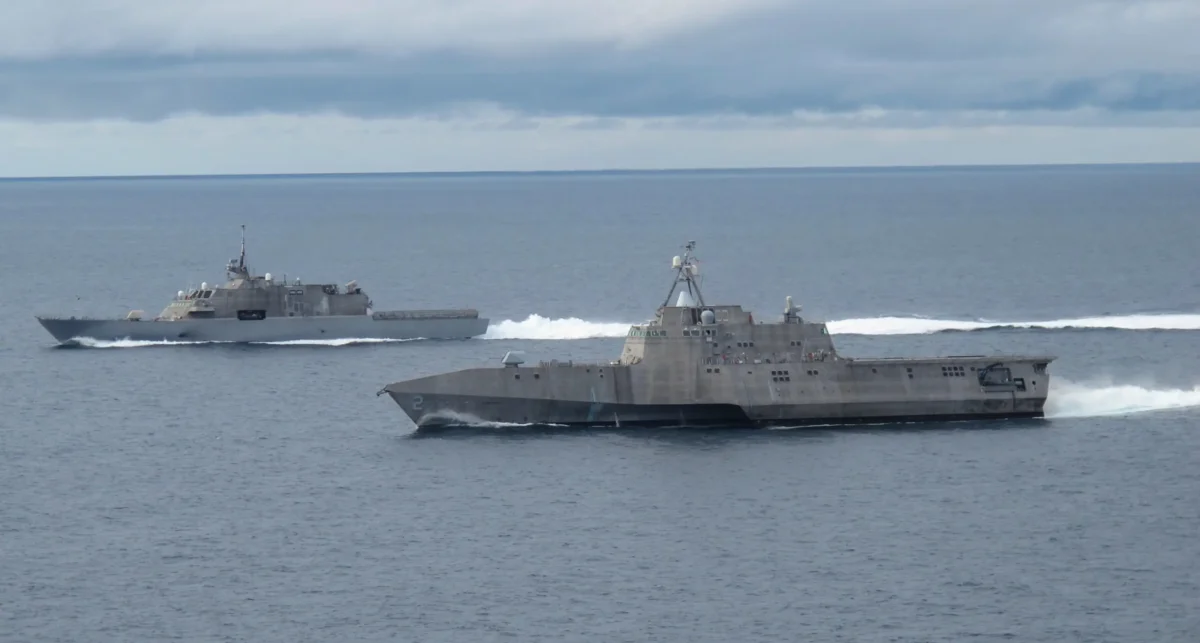
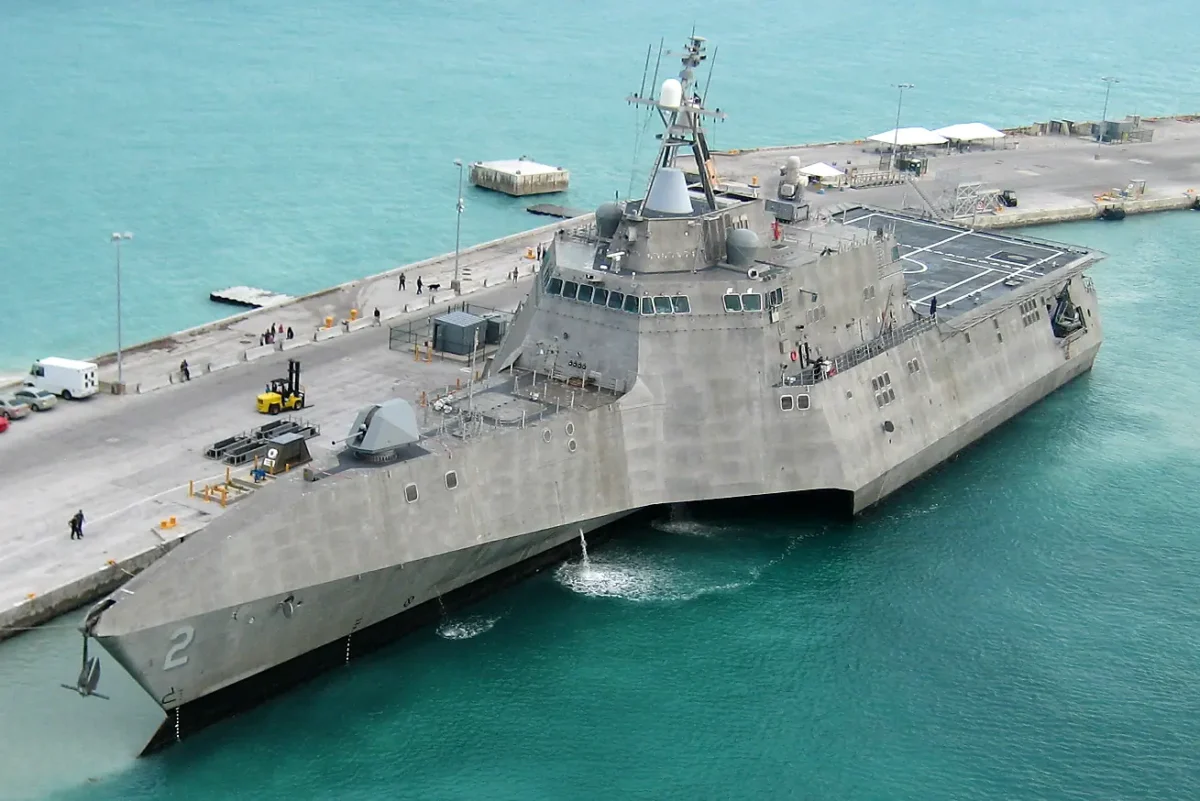
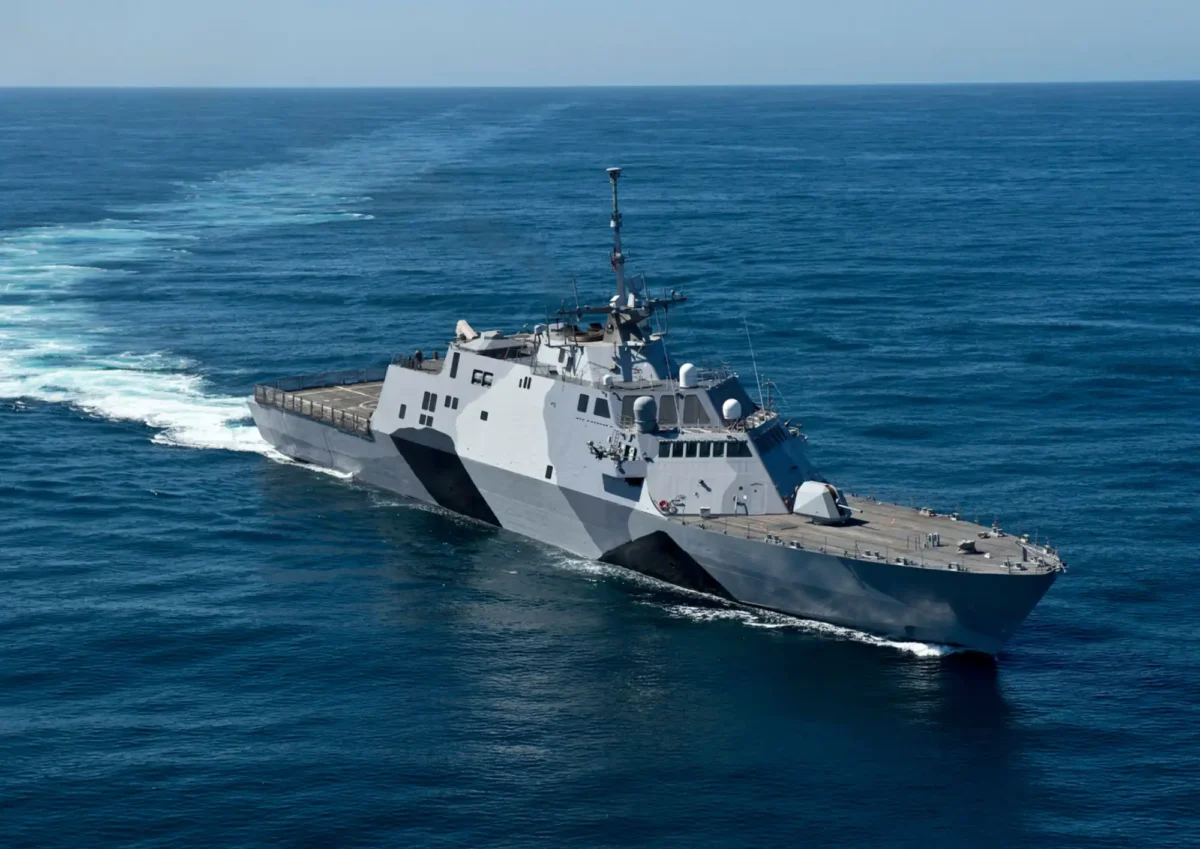
The program ended up producing two different versions of the ship. Lockheed Martin built the Freedom class, a steel-hulled ship built for speed; simple and sleek, like a modern corvette. Austal USA built the Independence class, which looked completely different: they used a futuristic-looking aluminum trimaran hull with three connected hulls that give it a wide deck and excellent stability.
The second design handled rough seas better but came with more maintenance trouble. Both were meant to be fast, flexible, and able to work close to shore, but neither escaped technical problems. Some ships were even retired early because of them.
The Cold War ends. Big enemy fleets vanish. Suddenly, the Navy’s massive destroyers and cruisers feel… out of place. The new challenges? Tiny but fast-moving threats near coasts (e.g., pirates, diesel subs lurking near ports, little missile boats zipping around).
The Navy realized that its large destroyers and cruisers were powerful, but they moved like tanks in shallow waters. The Navy needed something nimble and affordable, like a ship that could sprint in, handle business in littoral zones, and get out quickly. That’s where the LCS ship came in.
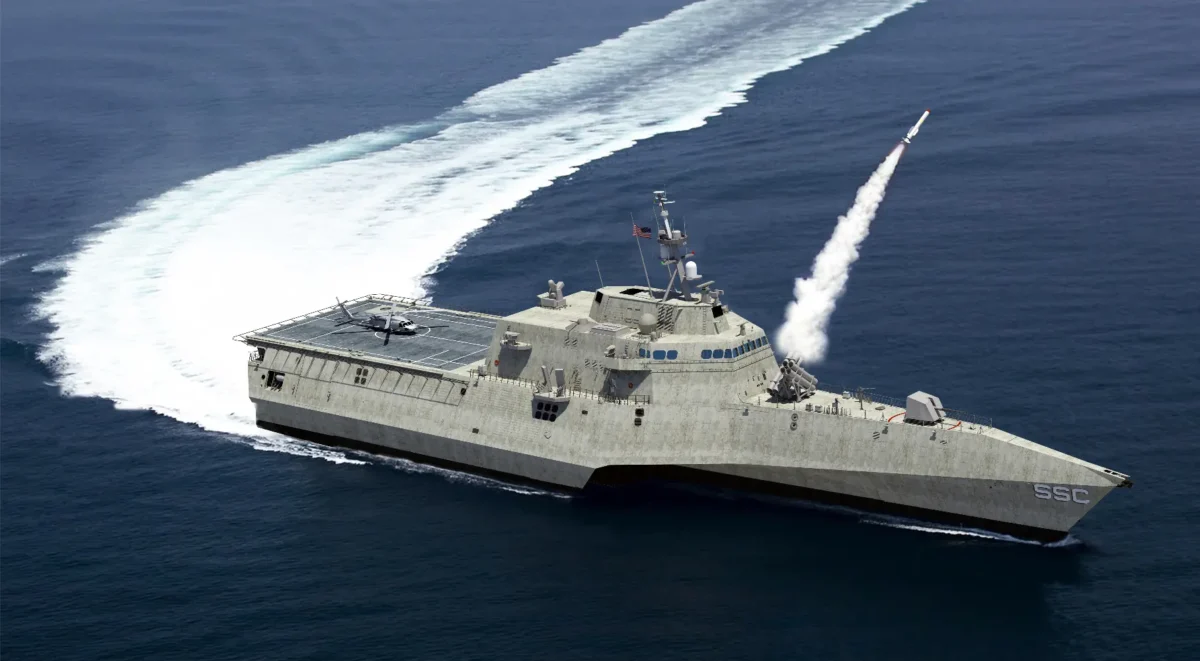
One of the most ambitious ideas behind the program was modular warfare. Instead of building separate ships for each mission, the Navy hoped to create one flexible design that could switch roles almost like swapping apps on a phone.
In theory, a ship could return to port, unload its anti-submarine module, and load up a mine-clearing or surface warfare package instead. It was a bold concept meant to save time, money, and manpower. The idea sounded great on paper (one ship, many roles) and it promised to make the Navy more adaptable in unpredictable environments.
The Littoral Combat Ship was meant to handle three main roles: tackling small surface targets, tracking submarines, and spotting or clearing naval mines. These missions might seem narrow, but in coastal zones they are vital, whether securing a harbor or supporting amphibious operations. Some ships were also expected to step into secondary roles, such as counter-drug work or humanitarian missions, depending on the Navy’s needs.
| Category | Early Estimate (2000s) | Actual / Later Cost | Notes |
| Construction Cost per Ship | ~$220 million | ~$500–600 million | The original low-cost goal rose sharply due to design changes and overruns. |
| Total Program Cost (including R&D) | ~$15 billion (initial plan) | ~$30–35 billion (estimated total) | Includes research, testing, training, and maintenance over time. |
| Mission Modules (mine, anti-submarine, surface warfare) | ~$50 million each | ~$100–120 million each | Many modules delayed or never fully fielded; costs doubled in development. |
| Annual Operating Cost per Ship | ~$20 million | ~$50–70 million | Maintenance and logistics far exceeded expectations. |
| Expected Service Life | 25 years | Some retired after 10–12 years | Several early Freedom-class LCS were decommissioned due to cost and reliability. |
When the Navy rolled out the Littoral Combat Ship program, the pitch was basically: “Why spend so much on a destroyer when you could have a smaller, modular ship?” The plan was to swap mission kits depending on the job, which was meant to keep costs down. Back then, each ship was expected to run about $220 million, which is a fraction of what a destroyer costs.
But like a lot of defense projects, that optimism didn’t last long. Once production began, the price tag started climbing fast. Design changes, new technologies, and unexpected maintenance issues drove costs up.
By the time the Freedom-class LCS and Independence-class LCS were being delivered, the average price per ship had ballooned to around $500–600 million and that’s just for construction. When you add in research and development, training, and support costs, some analysts estimate that the total program could exceed $30 billion.
The ships turned out to be far more expensive to maintain than expected. These ships need constant maintenance and some pretty specialized parts, which makes keeping them in service expensive.
Read also: Type 31 Frigate – The Future of Affordable Naval Defense
As a result, a few of the earliest Littoral Combat Ships were retired after just about ten years. That didn’t sit well with lawmakers, who were frustrated that the Navy was taking ships out of service that had cost hundreds of millions to build.
The budget debates around the LCS got heated at times. Congress wanted answers, the Navy defended its choices, and the Pentagon eventually started scaling back future orders.
Some lawmakers argued it didn’t make sense to keep sinking money into a ship that had so many problems, while others thought the Navy should at least finish the mine-clearing and anti-submarine systems to get something out of the investment.
The Littoral Combat Ship ended up costing way more than anyone anticipated, not just in cash, but in confidence.
The program showed how even clever ideas can go sideways when technology, expectations, and budgets don’t line up. Even today, people still ask the same thing about the LCS: was it really worth it, or could the Navy have gotten a better ship for the same money?
The Littoral Combat Ship looks like a smart move when you first read about it. Both the Freedom-class LCS and the Independence-class LCS were built around that same idea: fast, light, and flexible.
Speed was a highlight for the Littoral Combat Ship. While most big ships max out around 30 knots, the LCS could hit nearly 45, which is pretty impressive for a vessel of its size. That’s possible because it’s much lighter and uses powerful waterjet propulsion instead of traditional propellers.
The hull shapes also play a role. The Freedom’s sleek monohull and the Independence’s wide trimaran both cut through the water in different ways, but each was optimized for agility and stability near the coast.
One of the LCS’s standout features was automation. The Navy figured it could operate with just 70 people, compared to 150 or more on a standard frigate. Advanced systems and remote monitoring were supposed to cover the jobs a bigger crew would normally handle. It sounded great, but in practice, the smaller crews ended up stretched thin, especially during long deployments when systems failed or needed manual workarounds.
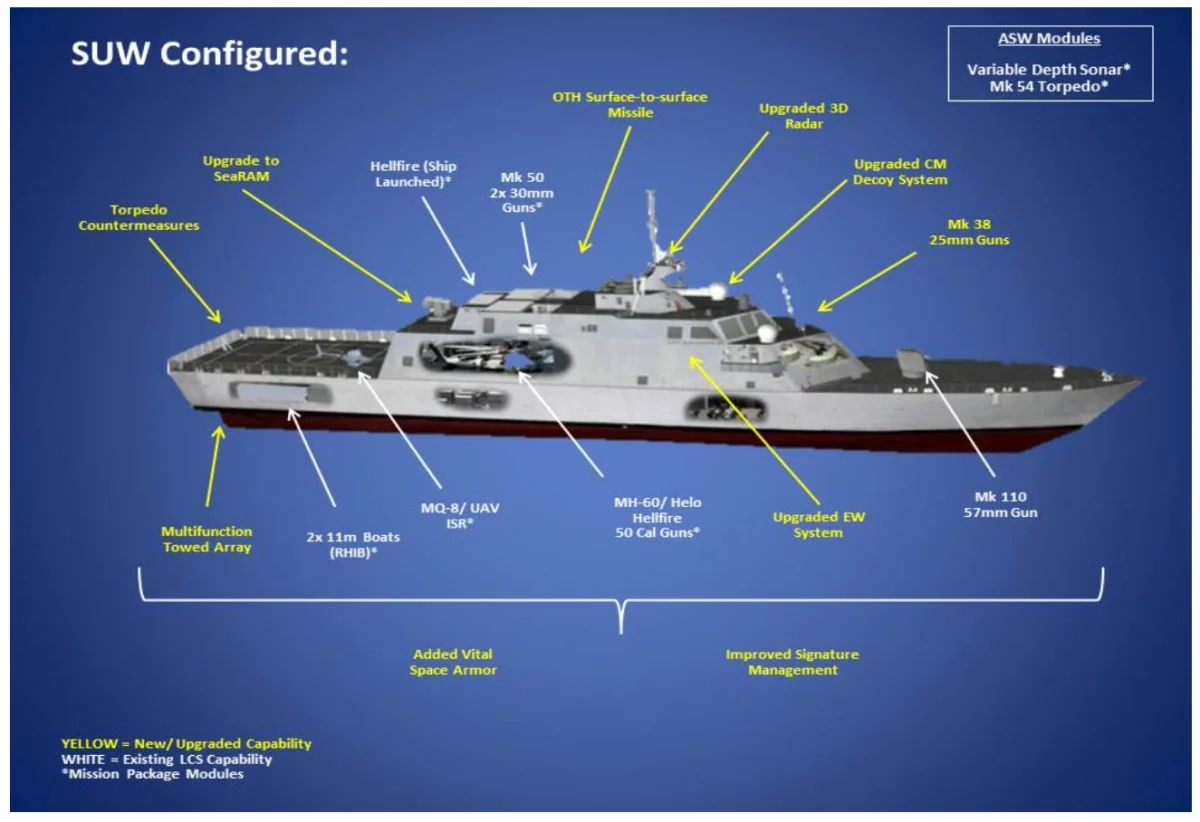
Then there were the mission modules, probably the most talked-about part of the design. The idea was that you could “plug and play” different modules for different missions: one for anti-submarine warfare, another for mine countermeasures, and another for surface combat. It was one of the boldest experiments in U.S. naval design, but it also became one of the biggest disappointments.
Swapping modules wasn’t as simple or quick as hoped, and the technology behind them took years longer to mature. Some, like the mine-clearing module, are only now becoming usable after more than a decade of testing.
On the weapons side, the littoral combat ship armament was always meant to be modest. It carries a 57 mm gun, small missiles, and defenses against aircraft or drones. The Navy hoped speed and flexible modules would cover for the lighter armament. But as threats got tougher, critics said it needed more firepower, so now some are getting upgraded missile systems to give them a bit more bite.
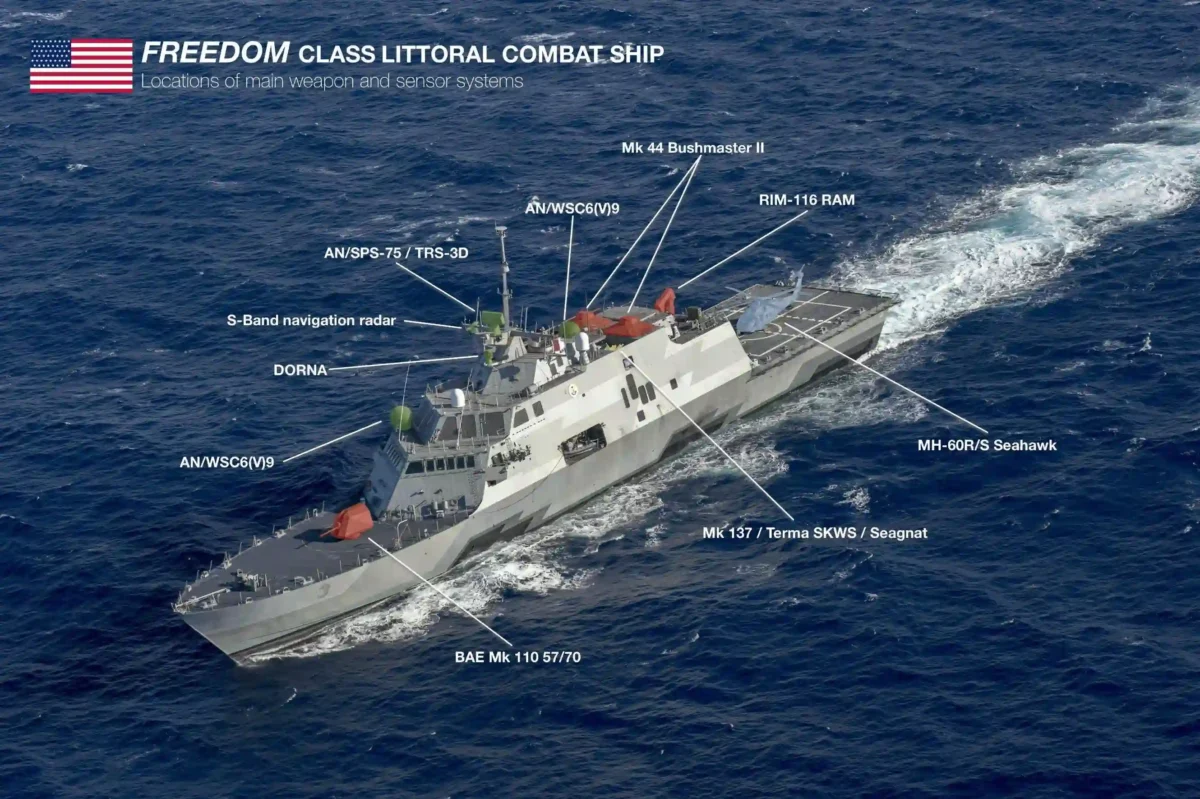
Indeed, the LCS ship looks great on paper, but it also might have tried to do too much at once. It pushed naval design in directions that will probably influence future ships, even if the LCS itself never quite lived up to its original promise.
It’s fair to say the Littoral Combat Ship became one of the Navy’s most debated programs in recent memory. The main issue was its purpose.
From the start, critics said the LCS lacked a clear mission. Was it a patrol ship? A mini-destroyer? A test platform for new tech? The Navy’s answer kept shifting, and that strategic confusion made it hard for anyone, including Congress, to see exactly what role the LCS was supposed to fill.
Then came the early retirements. Some of the first Freedom-class LCS ships were pulled from service after barely a decade, long before their expected 25-year lifespan. The Navy called them “non-deployable” or too costly to upgrade. That didn’t sit well with lawmakers, who saw hundreds of millions of dollars’ worth of relatively new ships heading for scrap. A few even called them “dead-end” ships or vessels with no path forward in the modern fleet.
Government watchdogs didn’t hold back either. Reports from the GAO (Government Accountability Office) and various congressional hearings pointed to repeated design flaws, maintenance issues, and cost overruns.
The Navy, for its part, admitted that the LCS program had fallen short of expectations but argued that lessons learned would feed into future projects, particularly the new Constellation-class frigate, which is meant to correct many of the same problems.
So, did the LCS hit the mark? In a lot of ways, not really, it never quite became the modular workhorse the Navy hoped for. But it did serve as a reality check on just how far innovation can go before practicality catches up.
Even with all the complaints, the Littoral Combat Ship isn’t completely out of action. The Navy is settling into what these ships are good for, and the focus now is on using them in ways that make the most of their capabilities.
A few patrol the Caribbean on counter-drug missions, hunting down fast smuggling boats, while the open deck gives room for helicopters or boarding teams. Others are testing out new tech, like drone-defense setups or mine-clearing gear, which the Navy hopes to improve for future ships.
Now, some of the older LCSs are being taken out of service. This is part of the littoral combat ship decommissioning as the Navy focuses on the Constellation-class frigates. The idea is to keep the best parts of the LCS and give them more firepower and reach.
So while the LCS didn’t turn out to be the game-changer it was meant to be, it’s not a total loss either. It gave the Navy valuable experience in modular design, automation, and high-speed operations.
In a way, the LCS was an experiment, an expensive one, sure, but experiments are how you learn what works and what doesn’t. The ships that come after it will almost certainly carry a few lessons learned from the LCS story, even if the program itself never quite lived up to the hype.