Follow Us:

Follow Us:


Defense Feeds – Huntington Ingalls Industries (HII) and Shield AI recently completed a successful major test combining their autonomy technologies aboard the Romulus 20 USV, marking a critical milestone.
Conducted over three days in late October off Virginia Beach, Virginia, this trial represented the first maritime deployment of Shield AI’s Hivemind autonomy software integrated with HII’s Odyssey control suite.
The integration leveraged Shield AI’s combat-proven Hivemind Enterprise Software Development Kit (SDK) with HII’s Odyssey autonomy system on the Romulus 20 USV model.
This fusion allows the Romulus 20 USV to autonomously execute complex missions, even in contested environments where GPS and communications might be denied.
The successful test highlights the companies’ joint commitment to accelerating the deployment of advanced AI-enabled unmanned surface vessels capable of operating seamlessly alongside manned naval groups.
The ROMULUS USV family is designed for high-endurance, open-ocean missions with speed exceeding 25 knots and a range up to 2,500 nautical miles.
The line’s flagship, ROMULUS 190, currently under construction, will be capable of carrying four 40-foot ISO containers.
Its commercial-standard hull supports rapid production and mission adaptability, making it a flexible asset for the U.S. Navy, Marine Corps, and allied forces.
HII’s ROMULUS combines long-range operational capability with modular payload options and advanced autonomy for surface warfare applications, anti-submarine warfare, and intelligence surveillance.
Crucially, these vessels are designed to integrate seamlessly with manned strike groups and support multi-agent coordinated operations.
The ROMULUS platform’s versatility stands as a force multiplier by extending fleet reach while reducing personnel risk.
Shield AI’s Hivemind autonomy software, proven effective in unmanned aerial systems, is now entering maritime operations with impressive results.
Its ability to sustain mission performance without human input in GPS-denied or communication-contested environments is enabled by the modular and open architecture of the Hivemind Enterprise SDK.
Rapid integration with HII’s Odyssey system, accomplished in under six weeks, contrasts with the months or years such efforts typically require.
This cross-domain autonomy empowers AI to coordinate complex tasks across multiple unmanned platforms, optimizing mission success in unpredictable or hostile conditions.
Together, Hivemind and Odyssey will provide next-generation autonomous naval solutions that boost operational effectiveness, enhance deterrence, and increase resilience in the face of evolving geopolitical challenges and emerging maritime threats.
This partnership ushers in a new era of multi-domain autonomous capabilities for naval defense.
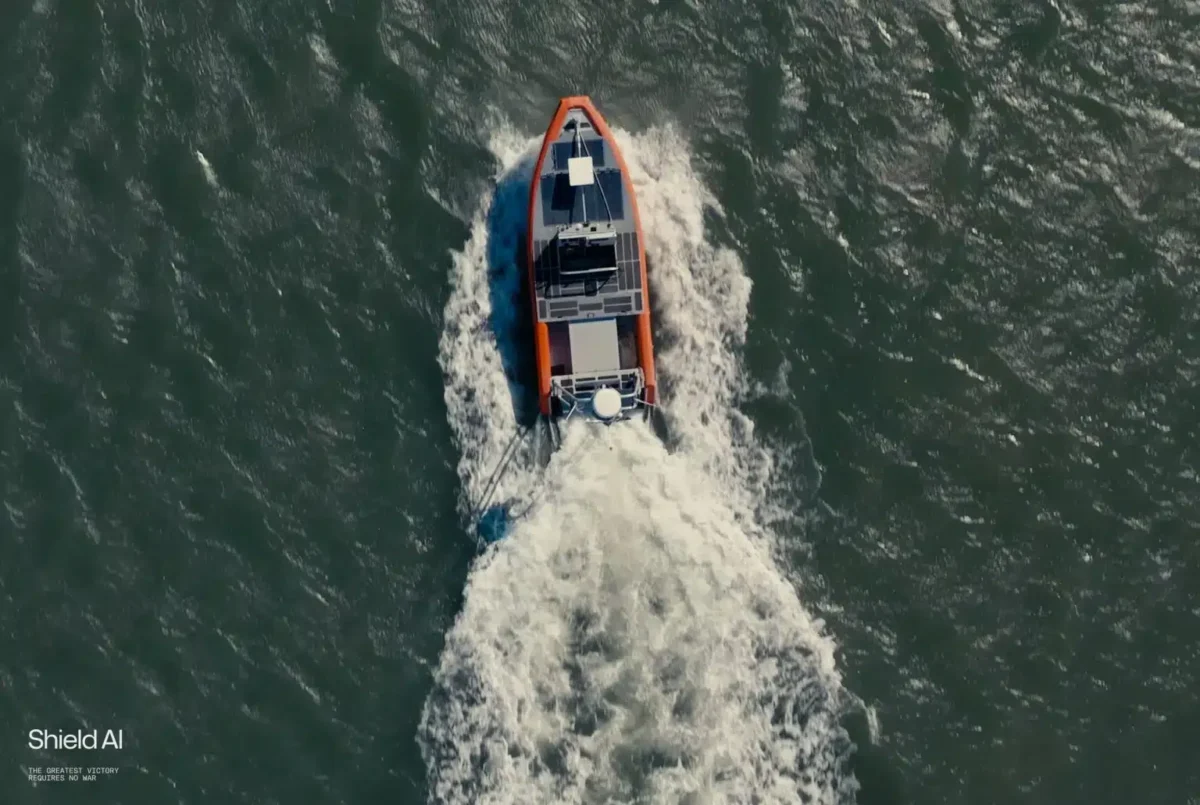
The collaboration between HII and Shield AI highlights how adaptable autonomy frameworks accelerate the development and deployment of advanced unmanned surface vessels.
Andy Green, president of HII’s Mission Technologies division, emphasized that the rapid integration validates the partnership’s potential and sets the stage for expanded autonomous functions across the entire ROMULUS fleet.
Shield AI CTO Nathan Michael noted that these advances underpin credible deterrent postures through autonomous mission capability that works in multi-domain naval contexts.
Looking ahead, the integration of Shield AI’s Hivemind and HII’s Odyssey autonomy system represents a significant leap toward operationalizing large-scale unmanned surface fleets.
These vessels will augment and operate alongside crewed strike and surface action groups, enhancing fleet flexibility, responsiveness, and survivability in increasingly contested maritime environments.
The push for such autonomous solutions reflects the evolving nature of maritime warfare where AI-enabled smart systems will play a decisive role in controlling contested waters and safeguarding national interests.