Follow Us:
Follow Us:


Defense Feeds – China upgrades Hongdu JL-10 with a refreshed twin-tail design, marking the first major redesign of the advanced jet trainer platform in nearly two decades.
This upgraded aircraft, also known as the L-15 Falcon in its export version, is developed by the Hongdu Aviation Industry Group under the state-owned Aviation Industry Corporation of China (AVIC).
Images circulating on social media, first posted by aviation expert @RupprechtDeino and picked up by defense media, display the modified JL-10 boasting two vertical stabilizers instead of one.
Analysts suggest this design improvement could increase structural strength and aerodynamic stability, possibly preparing the jet for carrier operations or more advanced combat training roles.
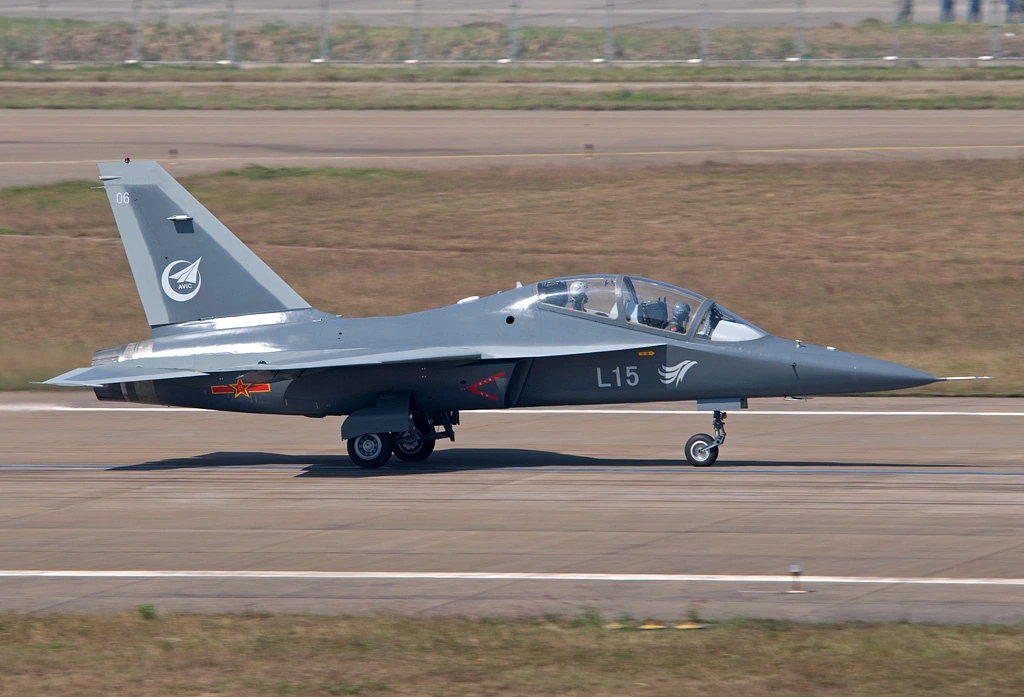
When first introduced, the JL-10 was a symbol of China’s growing aerospace ambitions. The original L-15 variant relied heavily on Ukrainian engine technology,
specifically the AI-222-25 and AI-322 afterburning turbofan engines developed by Ivchenko-Progress and produced by Motor Sich in Zaporizhzhia.
These engines allowed the JL-10 to reach supersonic speeds and execute high-G maneuvers, placing it in the same performance class as South Korea’s T-50 Golden Eagle and Italy’s M-346 Master trainers.
However, Beijing’s access to Ukrainian propulsion systems has declined sharply. Following Motor Sich’s nationalization in 2021, Ukraine imposed tighter export restrictions as its defense sector moved closer to Western partners.
This decision, combined with the company’s entanglement in legal disputes involving Chinese investors, nearly halted further engine transfers to China.
The unveiling of the twin-tail JL-10 has fueled speculation that the new model is powered by an indigenous Chinese engine.
Defense analysts suggest the project may serve as a testbed for a domestically developed powerplant intended to replace reliance on Ukrainian imports.
After Russia’s full-scale invasion of Ukraine, most joint projects between Chinese and Ukrainian aerospace firms were suspended, leaving several contracts incomplete.
A 2023 report from Euro Security & Defence noted that only around one-third of Motor Sich’s active engine deliveries to China were fulfilled before the war disrupted supply chains.
Since then, Beijing has accelerated efforts to achieve self-sufficiency in key aviation technologies, drawing from existing engine designs and advancing its local manufacturing capabilities under AVIC’s umbrella.
Although the twin-tail prototype’s specific powerplant remains undisclosed, its clean, unpainted appearance and absence of military markings suggest it is still undergoing early-stage testing.
The configuration changes also align with China’s ongoing push to develop jet trainers suited for carrier-based fighter preparation, an area becoming increasingly vital as the People’s Liberation Army Navy (PLAN) expands its carrier fleet.
The updated JL-10 reflects China’s persistent effort to modernize its training fleet and reduce dependence on foreign technology.
Over the last ten years, China has focused on creating its own jet engines, a complex engineering task that has progressed more slowly compared to advances in airframe and avionics technology.
Industry observers have pointed out that a twin-tail setup usually enhances stability during low-speed, high-angle maneuvers, which are essential for naval operations.
If the new JL-10 variant is indeed intended for carrier training, it could eventually support next-generation fighters such as the J-35 and J-15B.
This technological evolution mirrors developments across the broader defense landscape.
In July 2025, Russia delivered the Indian Navy frigate INS Tamal, which used Ukrainian-built turbines before export restrictions reshaped Moscow’s procurement options.
The trend underscores how global defense supply chains have been redrawn since the conflicts in Eastern Europe.
While AVIC and China’s Ministry of Defense have yet to comment officially, the twin-tail JL-10 represents a noteworthy milestone in China’s drive for independent aerospace technology.
It indicates both a leap in design innovation and a potential shift toward fully domestic engine solutions, which has been central to Beijing’s long-term modernization strategy.