Follow Us:
Follow Us:

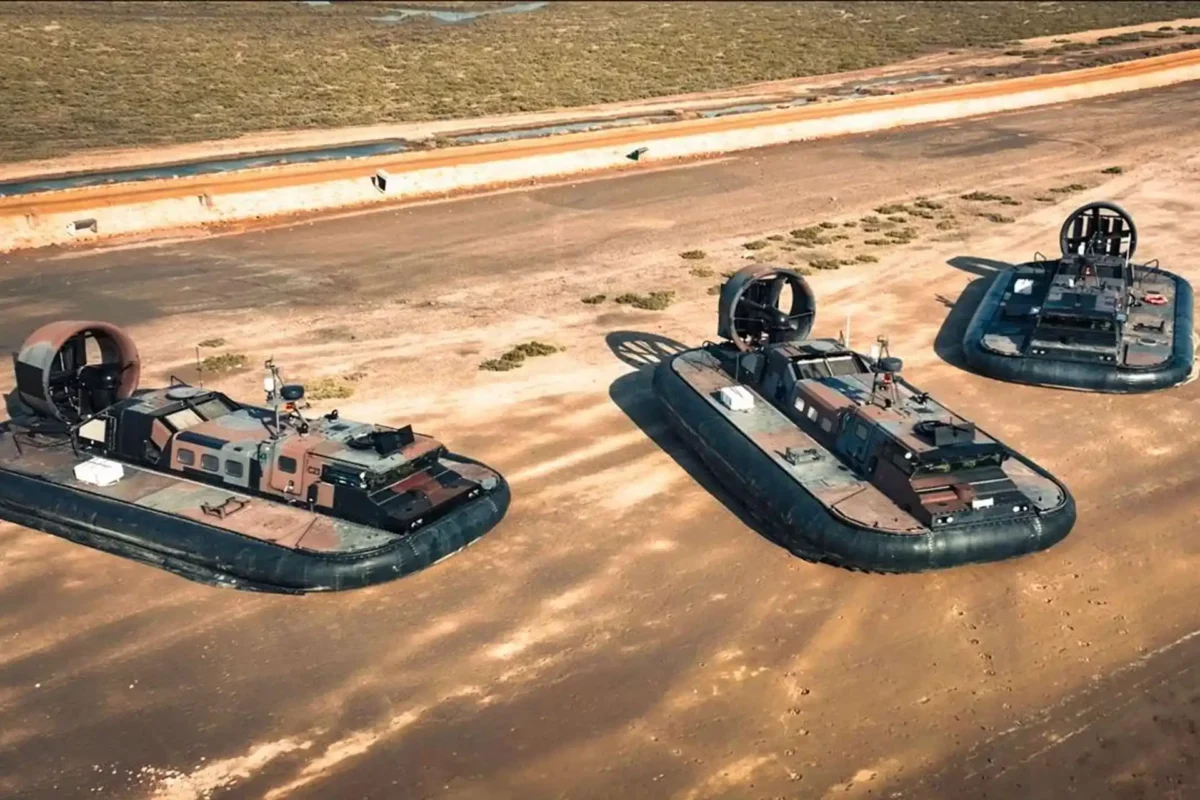
Defense Feeds – Pakistan has officially inducted three Griffon 2400TD hovercraft into its Marines, amplifying the nation’s capacity to operate within the complex and shallow waterways of southern Sindh.
The ceremony, held on October 26, 2025, was overseen by Chief of the Naval Staff Admiral Naveed Ashraf during an inspection of forward posts in the Creeks Area.
The announcement from the Pakistan Navy highlights a deliberate effort to modernize coastal forces capable of acting swiftly across mudflats, mangrove estuaries and tidal zones where traditional boats struggle to maneuver.
The induction marks a substantial leap in the Navy’s strategy to reinforce amphibious operations and secure the nation’s vulnerable coastlines.
It also strengthens inter-agency efforts for rapid response, counter-smuggling enforcement and coastal surveillance across the Indus delta, a region historically known for difficult operating conditions.
The Griffon 2400TD is a compact British-engineered hovercraft designed to travel over water, sand, mud and marshy terrain by riding on a cushion of air.
Developed by Griffon Hoverwork, the platform was previously part of the United Kingdom’s Royal Marines fleet before being transferred to Pakistan through a government-to-government disposal program managed by Defence Equipment & Support (DE&S).
After its retirement from UK service in 2021, the trio of hovercraft underwent a full refurbishment by British contractors in 2022 before being shipped to Pakistan in early 2025.
This transfer helps Pakistan minimize logistical and developmental risks by adopting a field-tested platform with an existing global training and support infrastructure.
According to available specifications, the Griffon 2400TD measures roughly 12 to 13 meters in length and reaches speeds of more than 30 knots, depending on load and sea state.
It can carry a small Marine squad or around 2 to 2.5 tonnes of equipment, making it ideal for fast troop movements, reconnaissance patrols and light logistics missions along confined waterways.

Unlike standard patrol boats or rigid-hull inflatables, hovercraft can glide seamlessly between water and land without grounding, offering unmatched access across terrain that changes with tidal flow.
The 2400TD’s ability to transit over mudbanks or shallow channels gives Pakistan’s coastal forces an essential tactical edge in the Creeks area, where land-sea boundaries are constantly shifting.
Compared to much larger platforms such as the U.S. Navy’s LCAC or Russia’s Zubr-class, the Griffon 2400TD prioritizes speed, maneuverability and lower maintenance costs over heavy lift capacity.
This operational flexibility aligns with Pakistan’s emphasis on high mobility rather than bulk transport, reflecting a shift toward distributed littoral operations and rapid insertion tactics.
These hovercraft also produce minimal wake, an advantage in maintaining low visibility and reducing erosion along fragile coastal habitats.
This characteristic proves valuable for maintaining discreet patrols and supporting environmental response tasks in addition to military duties.
Strategically, Pakistan’s decision to field the Griffon 2400TD directly supports its wider goals of enhancing maritime domain awareness and securing its coastline from illegal infiltration, smuggling and other asymmetric threats.
The ability to move Marines, supplies and surveillance assets swiftly across tidal flats allows the Navy to maintain persistent presence and shorten reaction times during both security and humanitarian operations.
Admiral Naveed Ashraf’s review of naval deployments in the Creeks Area underscored the Navy’s continuing modernization efforts to align field capabilities with the country’s coastal defense doctrine.
The addition of the Griffon 2400TD hovercraft demonstrates how Pakistan is adapting to its local maritime geography, converting environmental limitations into operational advantages.
While financial details remain undisclosed, the procurement under UK transfer terms reflects a value-driven approach leveraging allied surplus equipment.
For Pakistan Marines, these platforms symbolize a step toward more agile and responsive coastal forces able to protect national maritime interests within the broader Indian Ocean Region.