Follow Us:

Follow Us:

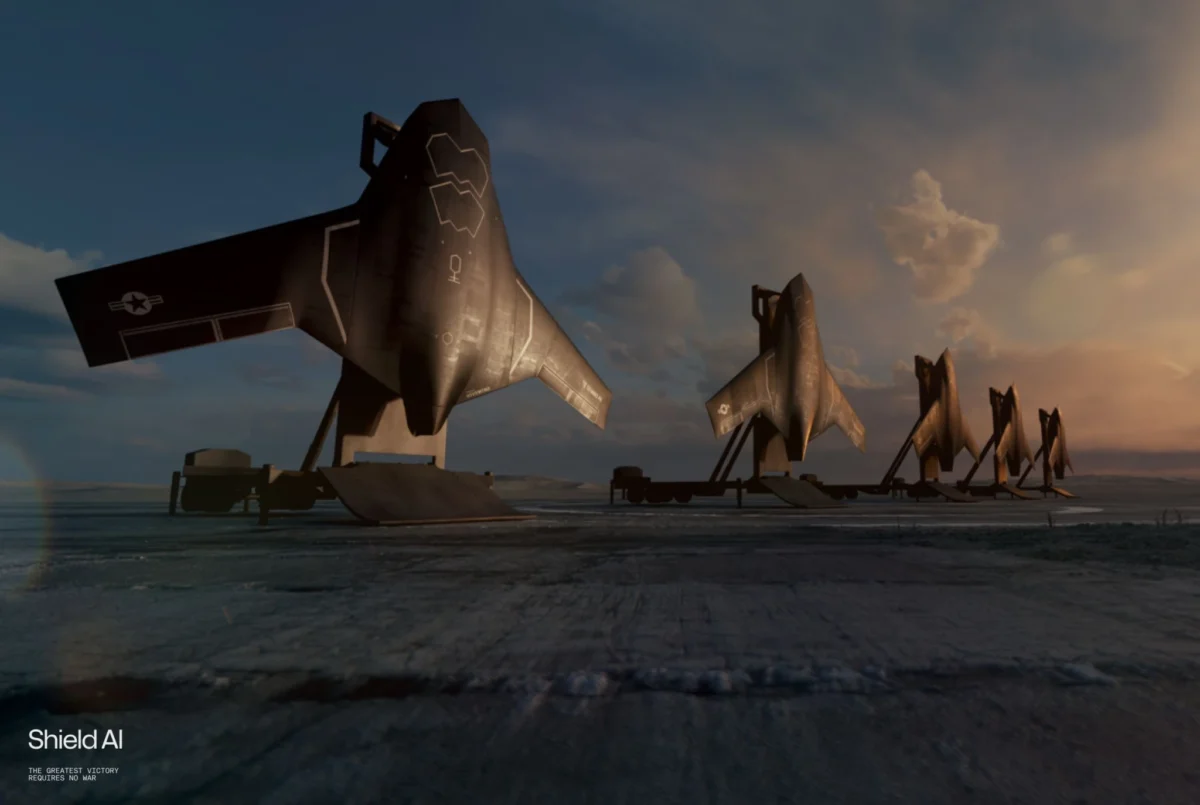
Defense Feeds – Shield AI Launches X-BAT, a cutting-edge vertical takeoff and landing (VTOL) stealth drone designed as a loyal wingman fighter.
This latest innovation from the artificial intelligence firm combines advanced AI autonomy, stealth technology, and multi-role versatility in a jet-powered unmanned aerial vehicle (UAV) with applications in air combat, surveillance, and electronic warfare.
The X-BAT features a powerful F-16 class engine with thrust vectoring, enabling supersonic speed and vertical takeoff and landing capabilities.
It offers an impressive combat radius of over 2,000 nautical miles, internal weapons bays, external hardpoints for munitions, and modular payload options, making it adaptable to diverse mission profiles.
Powered by Shield AI’s Hivemind autonomous pilot system, the X-BAT is capable of operating independently or as a loyal wingman alongside manned aircraft, even in communications-denied environments.

The X-BAT represents Shield AI’s ambitious expansion into large unmanned aerial systems, classified by the Pentagon as Group 5 drones, the heaviest and most capable UAV category.
Unlike traditional fighters, X-BAT can take off and land vertically, enabling operation from austere locations without the need for runways.
This jump in operational flexibility means the drone could launch from ship decks, islands, or forward-deployed bases, significantly increasing reach and survivability.
Powered by what Shield AI describes as an “F-16 class engine,” featuring afterburner and thrust vectoring nozzles originally developed for late 1990s fighter programs, the X-BAT combines supersonic speed with stealthy aerodynamic design.
It boasts an internal weapons bay, external hardpoints for munitions, and modular payload bays supporting mission-specific equipment such as surveillance sensors and electronic warfare packages.
The drone’s design emphasizes radar cross-section reduction, heightening its survivability in contested airspace.
With a remarkable combat radius exceeding 2,000 nautical miles, the X-BAT offers endurance suited for prolonged missions deep into contested areas.
At the core of the X-BAT is Shield AI’s proprietary autonomy software called Hivemind, an AI pilot system capable of flying the drone in communications-denied or electronically contested environments.
This autonomy allows the X-BAT to operate either independently or as a loyal wingman paired with manned fighters, dynamically executing collaborative combat tactics without the need for constant communication channels.
Hivemind’s ability to pilot complex aircraft like the F-16 autonomously has already been demonstrated by Shield AI, and integration with the X-BAT aims to expand this capacity into more advanced, multi-role combat drones.
The software fosters operational resilience against electronic warfare and jamming, a critical advantage in modern warfare scenarios.
Shield AI’s X-BAT enters a highly competitive and evolving market of Collaborative Combat Aircraft (CCA) programs pursued by the U.S. Air Force, Navy, Marine Corps, and Army.
These programs seek to develop autonomous, AI-enabled drones that augment manned aircraft in complex combat scenarios, offering force multiplication and enhanced mission flexibility.
While Shield AI designed the X-BAT, the company aims to announce production partners and propulsion suppliers soon, suggesting collaboration with major defense and aerospace firms.
Initial vertical flight tests are slated for fall 2026 with full operational validation expected by 2028.
The X-BAT aligns with Pentagon modernization goals focusing on multi-role, versatile UAVs that balance capability with affordability, echoing the design philosophy of the widely exported F-16 fighter jet.
With the Air Force preparing to award contracts for second-generation CCA prototypes soon, and other services seeking similarly capable loyal wingman drones, the X-BAT positions Shield AI at the forefront of next-generation autonomous combat aviation.
The combination of VTOL functionality, stealth technology, and AI-driven autonomy represents a major advancement in drone warfare, poised to transform air power projection and defense strategies on a global scale.
In summary, Shield AI’s X-BAT is shaping up to be an innovative leap in unmanned fighter jets, offering runway-independent operations, jet fighter-class performance, and advanced AI piloting.
These features promise to enhance U.S. and allied military airpower, providing persistent, survivable, and highly autonomous platforms for future battlefield dominance.