Follow Us:
Follow Us:


Defense Feeds – China Reveals LY-1 Laser System in a major display of military innovation, showcasing what could be its most advanced naval laser weapon to date.
During the Victory Day parade in Beijing on September 3, 2025, the new LY-1 naval defense laser was mounted on an HZ141 eight-wheeled vehicle in its first public demonstration.
Officials claim the directed-energy weapon could reshape the future of naval warfare, with the ability to disable drones, intercept missiles, and blind enemy sensors.
This debut highlights Beijing’s push to project military strength while positioning itself in the global competition for directed-energy weapons — cutting-edge systems designed to deliver precision strikes with beams of concentrated light at low operational cost.
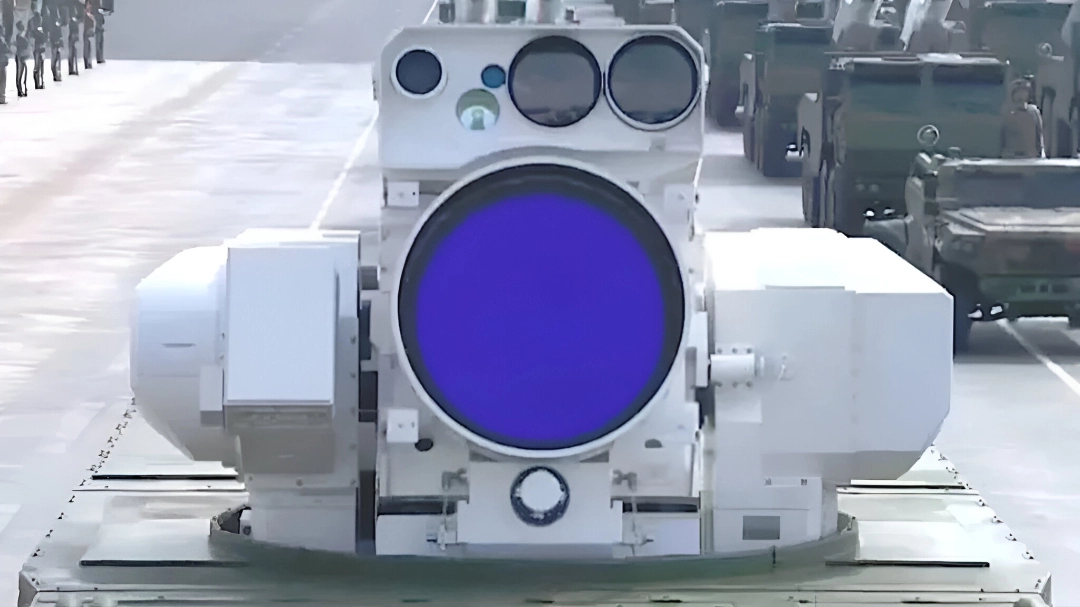
Chinese state media described the LY-1 as one of the most powerful military lasers currently in development.
Its primary role is described as countering aerial threats — particularly drones, cruise missiles, and precision-guided weapons — through two main capabilities: destruction of incoming aerial platforms and disruption of their onboard optics and tracking systems.
Instead of relying solely on costly missile interceptors or kinetic rounds, the LY-1 relies on ship-generated power to produce its shots.
In practical terms, this means that as long as the vessel has sufficient energy stores, the laser can continue intercepting threats at a near-zero cost per engagement.
For military planners, this represents both a financial advantage and a way to cope with the growing challenge of saturation attacks, in which swarms of low-cost drones are used to overwhelm traditional defenses.
Naval analysts highlight an equally vital feature of such weapons: speed. Unlike missile interceptors, which take time to reach their target, lasers strike at the speed of light, reducing engagement time to a fraction of a second.
This becomes especially critical when defending against fast-moving or maneuverable targets that could slip through slower defense systems.
The unveiling of the LY-1 in a large-scale parade underscored Beijing’s growing defense capabilities while serving as a symbolic message to international observers.
Directed-energy weapons (DEWs) are increasingly viewed as a key component of future warfare, and showcasing such capability reinforces China’s ambition to be seen as a leader among military powers.
Military observers note that China is not alone in pursuing laser-based defense technology.
The United States Navy has already equipped several Arleigh Burke-class destroyers with testbed high-energy lasers designed to engage drones, small attack boats, and potentially cruise missiles.
Israel continues to develop its “Iron Beam” concept to support its Iron Dome missile shield, while European powers such as Germany and the United Kingdom are testing laser systems aboard frigates and land-based vehicles.
Russia has also publicized experimental research, although fewer details have emerged from official sources.
A shared objective across these programs is finding effective defenses against the growing danger posed by drones and other inexpensive asymmetrical threats.
Unlike traditional air defense missiles, which are limited in number and cost millions per unit, lasers promise potentially limitless interception capacity in the field, constrained only by electrical generation on each platform.
However, experts caution that directed-energy technology still faces significant challenges.
For naval units, power demand remains the greatest obstacle, alongside weather-related factors such as humidity, rain, or smoke that can scatter or absorb the beam, reducing effectiveness.
Long-term durability under combat conditions is another unresolved issue. Despite these limitations, analysts agree that lasers are moving steadily from concept to reality in military doctrine.
The LY-1’s potential naval deployment could mark a turning point for Chinese maritime operations.
Warships are particularly well-suited to host high-energy laser systems due to their ability to carry larger power modules and cooling systems compared to land vehicles.
If fully integrated, such systems could relieve pressure on missile batteries, creating a layered defense system that combines kinetic missiles, artillery, and lasers.
For the Chinese Navy, this capability would provide a flexible way to handle everything from reconnaissance drones to high-end anti-ship missiles.
Even when not used to fully destroy an incoming threat, the laser can “blind” or disable a drone’s optical sensors, thereby robbing adversaries of their surveillance and targeting tools in contested waters.
The symbolic value of the LY-1’s debut also cannot be understated. With regional tensions simmering in the South China Sea, where overlapping territorial claims and U.S. naval patrols frequently raise the risk of confrontation, China’s demonstration of its directed-energy technology serves as a deterrent message.
By showcasing the system on a parade vehicle, Beijing ensures that international observers — from Washington to Tokyo — acknowledge its growing mastery of next-generation military technology.
Although China has not released the LY-1’s precise specifications, its debut secures Beijing a place among the few nations showcasing operational high-energy laser weapons.
Military strategists suggest that within the next decade, lasers could shift from experimental roles to standard defensive equipment aboard warships, reshaping how navies worldwide approach air and missile defense.