Follow Us:
Follow Us:

When most Americans hear the term “Golden Dome,” they might think of college stadiums or gilded architectural marvels. Few realize that a quiet shift may be underway in U.S. defense strategy.
This emerging concept, often referred to as the “Golden Dome project”, is being framed by some in Washington as a last line of defense. This is believed to be an invisible wall to protect against long-range missile threats, particularly from nuclear-armed adversaries like North Korea, China, or Russia.
However, this isn’t a done deal, nor is it widely discussed in public circles. Unlike the high-profile F-35 fighter program or THAAD deployments in the Pacific, the Golden Dome for America—if it exists as a cohesive strategy at all—remains elusive.
Some analysts even question whether it’s a real program, or more of an amalgam of overlapping systems (like Aegis Ashore, Ground-Based Midcourse Defense, and new radar networks) now being rhetorically bundled under a politically palatable label.

While the idea of a US homeland missile defense system evokes strength and security, critics argue it could be technologically unfeasible, financially irresponsible, and strategically destabilizing.
A comprehensive missile shield might, they warn, embolden first strikes by undermining the principle of nuclear deterrence. Others contend that placing too much faith in defensive systems, especially those that haven’t proven themselves in real high-volume combat, is a dangerous gamble.
In this post, we’ll unpack what’s currently known (and unknown) about the Golden Dome missile defense initiative, trace its roots through existing U.S. missile shield architectures, and scrutinize its technical feasibility, geopolitical implications, and fiscal logic.
So, what exactly is the Golden Dome Defense System? At this stage, the honest answer might be “it’s complicated, and possibly still evolving”.
Unlike Israel’s Iron Dome, which is a concrete, operational missile defense system developed by Rafael Advanced Defense Systems to intercept short-range rockets and artillery shells, the Golden Dome missile defense concept for the U.S. homeland appears to be less a singular system and more a strategic ambition, possibly even a branding effort.
Read also: Iron Dome System: Israel’s Shield Against Missile Threats
There’s no formal U.S. Department of Defense program explicitly named “Golden Dome” listed in public documents or defense appropriations bills. However, some defense analysts and media outlets have begun to refer to a “Golden Dome project” when describing the growing network of U.S. homeland missile defenses, especially as new radar systems, sensor nodes, and layered interceptors are being explored or deployed.

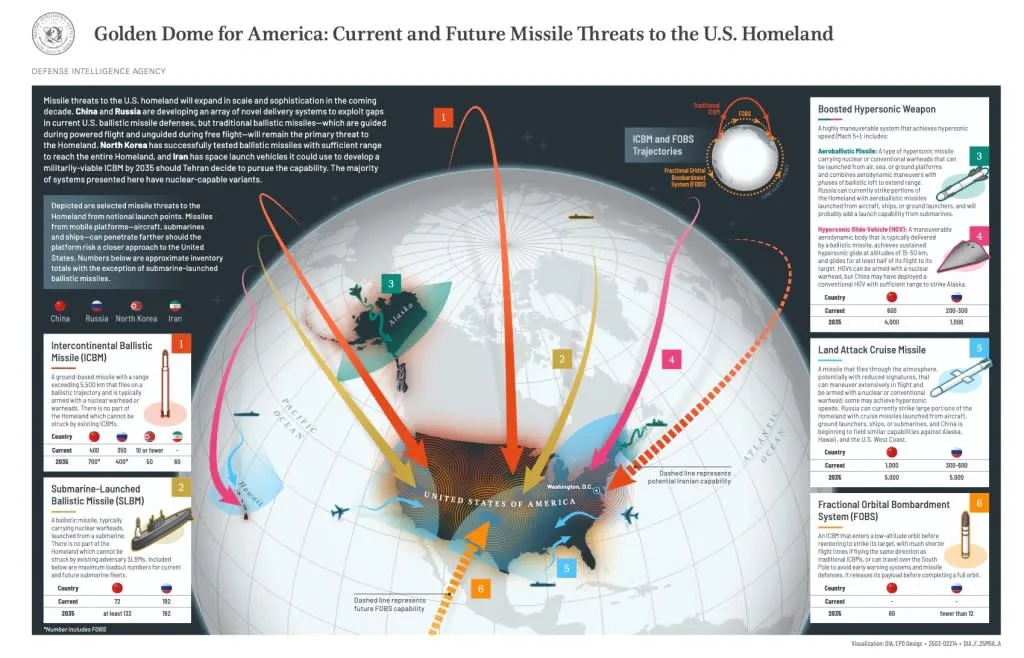
In this sense, “Golden Dome” may be more of an umbrella term used to capture a vision for a comprehensive, multilayered US missile shield that aims to protect the American mainland from advanced missile threats, including hypersonic glide vehicles, cruise missiles, and ICBMs.
This leads to a critical distinction; unlike Israel’s Iron Dome, which is built to intercept low-altitude, relatively slow projectiles within a tight geographical radius (like rockets fired from Gaza into southern Israel), the U.S. “Golden Dome” would need to contend with vastly different parameters—far longer distances, much faster and more complex threats, and a much larger territory to defend.
In fact, it’s worth noting that the Iron Dome wouldn’t be effective as-is for U.S. homeland defense. That system excels in localized conflicts and urban-area protection, not against intercontinental threats from peer adversaries.
However, the symbolic success of Iron Dome, its visual proof of concept, may have inspired policymakers and defense contractors to adopt the “Dome” branding as a way to make large-scale missile defense appear feasible, palatable, or even inevitable for the American public.
At the same time, elements of a Golden Dome-like network are arguably already in place or under development. The U.S. has long maintained components of a missile shield: the Ground-Based Midcourse Defense (GMD) interceptors in Alaska and California, the Aegis Ballistic Missile Defense System, THAAD batteries, and now advanced radar systems like LRDR (Long Range Discrimination Radar) in the works. These are often integrated with space-based early warning satellites and new AI-driven command-and-control systems.
So, is the Golden Dome real? Technically, not as a single, unified system—at least not yet. But if you interpret it as the next step in the U.S. homeland missile defense architecture, then yes, it may be taking shape incrementally, through a patchwork of legacy systems, future capabilities, and evolving strategic doctrine. Even if that’s the case, one must also be cautious.
The use of terms like “Golden Dome” may serve political or rhetorical purposes. It evokes clarity and completeness, even if the reality is far messier.
As discussions around the Golden Dome missile defense continue to circulate, one key question emerges: is this meant to be an American version of Israel’s Iron Dome or something more complex, perhaps even complementary to existing U.S. defense architecture? The answer appears to be layered, and possibly still unfolding.
At face value, a direct Iron Dome replica wouldn’t align with the scale, geography, or threat profile the U.S. faces. The Iron Dome was designed to intercept short-range rockets and artillery in relatively confined regions like southern Israel.
The U.S., by contrast, spans a continent and must anticipate threats from intercontinental ballistic missiles (ICBMs), hypersonic glide vehicles, cruise missiles, and even drone swarms, many of which travel faster, further, and with more evasive flight profiles than the kinds of munitions Iron Dome typically intercepts.

So rather than a copy, the Golden Dome project may represent a technological evolution, a hybrid defense layer that builds on the symbolic success of Iron Dome but integrates deeply into a multitiered missile shield already under development across the U.S. military. This points toward the idea of a complementary system, rather than a substitute.
Read also: THAAD Missile System: The Advanced U.S. Anti-Missile System
A major difference lies in the technological upgrades being pursued. While Iron Dome relies on radar-guided interceptors and centralized control systems, a hypothetical U.S. Golden Dome would likely incorporate advanced radar arrays (like the new SPY-6 and Long Range Discrimination Radar), AI-enhanced threat detection, and automated kill chains capable of responding to saturation attacks within seconds.
There’s also growing interest in directed-energy weapons (such as high-powered lasers) and non-kinetic interception methods as a future part of this framework is still in developmental or experimental phases.
But more importantly, integration is key. The U.S. already fields a range of systems designed to defend against various types of missile threats:
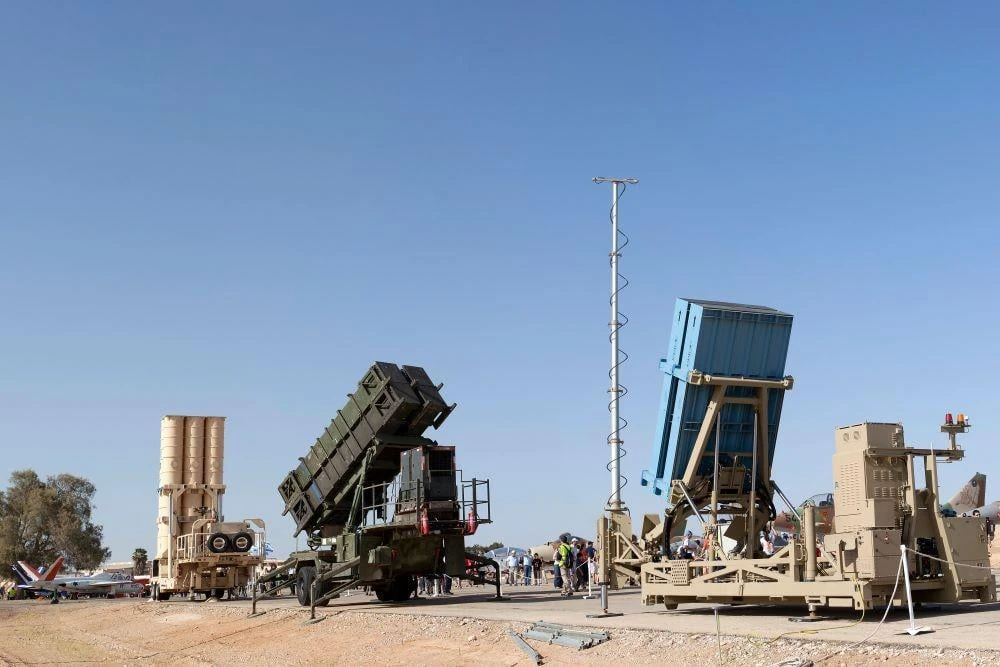
Critically, these components are not operating in isolation. Recent developments in Joint All-Domain Command and Control (JADC2) doctrine aim to fuse sensor data, radar coverage, and interceptor control across air, land, sea, space, and cyber domains.
This could make a future Golden Dome far more dynamic than Israel’s largely terrestrial Iron Dome, allowing U.S. homeland missile defense to track and respond to threats across continents and at multiple altitudes.
Even so, technical feasibility doesn’t eliminate the complexity of politics and cost. Each additional integration point, whether with NORAD, THAAD, or space-based sensors, adds layers of interoperability, procurement delays, and potential bureaucratic friction. A fully realized “dome” may be years, if not decades, from deployment, if it ever materializes at all.
In that sense, the Golden Dome for America might best be seen not as a clean replacement or clone of Israel’s Iron Dome, but rather as an incremental complement to an already maturing ecosystem of homeland missile defense. It may serve to fill critical gaps in low-to mid-tier threats, particularly in urban or strategic areas, while heavier systems like GMD, THAAD, and Aegis continue to shoulder the burden of long-range ballistic defense.
If the Golden Dome missile defense system is ever fully realized, its strategic purpose would likely extend far beyond intercepting missiles in the abstract.
At least rhetorically, the Golden Dome for America is being framed as a necessary evolution in US homeland missile defense. Many important places in the U.S., like power plants, military factories, and tech hubs, could be targets in a future attack, but right now, they’re not very well protected.
Some experts have warned that missiles or drones could be used to strike these areas without much warning, especially in places like the East Coast or the Pacific Northwest, where a lot of key infrastructure is located. The Golden Dome defense system might help solve this problem by building strong protection around these high-risk areas, but it would only work if it’s set up carefully and kept in good working order.
One scenario being floated involves concentrated Golden Dome coverage over select regions, rather than attempting a full national umbrella. In this model, city-based radar-interceptor pairs or hardened air defense corridors might ring areas like Washington D.C., NORAD’s Cheyenne Mountain complex, Silicon Valley, or defense logistics hubs in Alabama and Virginia. These mini-dome zones could serve as testbeds or prototypes for eventual expansion, especially if geopolitical conditions worsen.
Even though the idea of a Golden Dome missile defense system sounds reassuring, there’s still a lot of confusion and disagreement about what it actually looks like in practice. So far, deployment plans remain vague, and many defense experts are asking tough questions:
Can the U.S. really build a system strong enough to protect such a large country with so many important sites?
Is it even possible to defend against all kinds of missile threats, especially with the speed and complexity of modern weapons? And even if it is possible, how much would it cost?
This last question is at the heart of the controversy. Building a full-scale US homeland missile defense system, especially one as ambitious as a so-called “Golden Dome” would likely cost tens or even hundreds of billions of dollars. It would need to connect and coordinate with multiple systems already in place; NORAD, NORTHCOM, cyber defense teams, and other federal and local agencies.
Plus, with missile technology changing so quickly, the system would need constant upgrades to stay relevant. That means ongoing spending, year after year.

In Congress, there’s already debate about whether the Golden Dome project is a smart investment or a high-tech fantasy. Some lawmakers and defense officials support the idea, arguing that growing threats from countries like North Korea, China, and Russia make it essential to build a better U.S. missile shield. They say protecting critical infrastructure, like energy grids and command centers, is no longer optional.
But critics are more cautious. Some worry that the system is being oversold, especially since past missile defense programs have struggled to perform reliably in real-world conditions. Others argue that putting so much faith and money into interception-based defense could give the public and policymakers a false sense of security. After all, even the best radar systems and interceptors can fail, especially if overwhelmed by multiple missiles at once.
There’s also a deeper, more philosophical debate about whether homeland defense meant to truly stop an attack or simply to make people feel safer? That question matters, because it changes how we think about the purpose of systems like the Golden Dome.
Still, despite all the concerns, some level of support for the Golden Dome idea seems to be growing. In today’s world, where threats can appear with little warning, and missile technology is advancing quickly, many believe the U.S. can’t afford to rely on deterrence alone. Some kind of active defense, even if limited at first, may be seen by both military planners and politicians as a necessary step forward.
Missile defense used to be simple: track a missile flying high and fast in a straight line and try to shoot it down. But that world is disappearing.
Now, new threats are changing the game. Hypersonic missiles can fly low, move unpredictably, and arrive with almost no warning. At the same time, drones, especially in swarms, can sneak in under the radar, coming from multiple directions at once. These threats are harder to see, harder to stop, and much faster than what U.S. systems were originally built to handle.
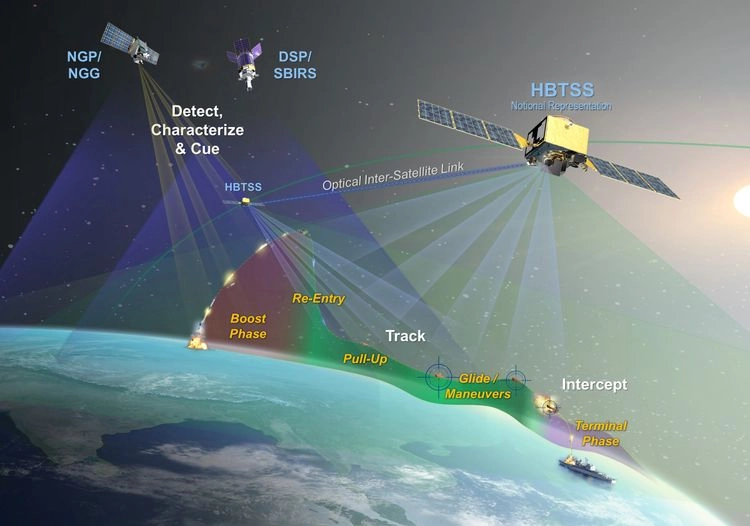
To catch up, the U.S. is looking for new tools. AI is being added to defense systems to help detect threats faster and make split-second decisions. Satellites with advanced radar are also being developed to track fast-moving weapons from space.
Still, none of this is easy or fully ready yet. These technologies are promising, but they’re expensive and mostly untested in real combat. The Golden Dome missile defense idea might help bridge the gap and be seen as a step toward a future where high-tech defense systems work together to protect the homeland from every direction.