Follow Us:
Follow Us:


Defense Feeds, Beirut – The discovery of a US-made GBU-39B Small Diameter Bomb unexploded in Beirut has ignited a complex geopolitical crisis, highlighting rising tensions between major powers and the risks of advanced military technology falling into hostile hands.
This incident, stemming from an Israeli airstrike in Beirut’s Hezbollah-controlled Harat Hreik district, underscores urgent US fears of sensitive technology leakage to rival states like China, Russia, and Iran—intensifying the strategic clash over precision weapon superiority.
On November 24, 2025, during a precision air raid targeting Hezbollah leadership, an Israeli strike deployed eight bombs, with one GBU-39B failing to detonate and landing intact in a Hezbollah stronghold. This unexploded weapon quickly became the focal point of a diplomatic and security crisis as Lebanese authorities and Hezbollah allegedly secured it before US officials could intervene.
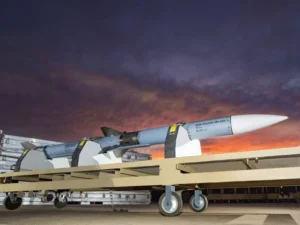
The GBU-39B Small Diameter Bomb is a cornerstone of US precision strike capability, valued not just for its $70,000 to $90,000 unit cost but for its billion-dollar investment in cutting-edge guidance systems, advanced electronics, and stealth designs. Its compact size allows aircraft like the F-15E and F-35 to deliver multiple bomblets from standoff distances, minimizing risk to pilots while maintaining surgical strike accuracy.

The bomb’s failure to detonate is highly unusual and represents the worst-case scenario for US security planners. Its intact recovery allows potential adversaries unprecedented access to core technologies, including GPS anti-jamming, microelectronic components, and composite materials, that the US military guards fiercely. If copied or reverse-engineered, these components could accelerate development of rival precision weapons, undermining US global technological leadership.
Upon confirmation of the bomb’s unexploded status, the United States immediately pressed Lebanese officials for the bomb’s rapid return. Washington warned of severe risks, including the possibility that Hezbollah or its Iranian benefactors could exploit the weapon’s components to strengthen their own missile and drone arsenals.
Washington’s concerns are grounded in past instances where adversaries used captured Western weapons remnants to fast-track their own development programs. Russia’s battlefield salvage in Ukraine and Syria, and China’s known reverse engineering of foreign defense assets, exemplify what could happen if the GBU-39B falls into the wrong hands. Additionally, Iran could leverage insights to improve guidance on its Fateh missiles or Iranian-backed proxy groups’ UAVs.
Lebanon remains politically divided and constrained by Hezbollah’s influence over regions where the bomb was found. This has complicated US retrieval efforts, as the bomb might be used as a political leverage tool or propaganda trophy.
The Lebanese government faces intense pressure from both internal factions wary of US demands and the risk of diplomatic sanctions or foreign aid suspension if it refuses cooperation. Meanwhile, the UN Interim Force in Lebanon (UNIFIL) has offered to mediate but has limited access within Hezbollah-controlled zones.
The incident’s repercussions extend well beyond the Middle East, prompting a reevaluation of weapon deployment strategies in contested regions worldwide. The risk that precision-guided munitions could be seized intact by adversaries challenges current military doctrines. Defense planners across Asia and Europe are quietly reassessing how to protect sensitive technologies in areas where US-backed forces engage in proxy conflicts.
In the Asia-Pacific, China’s pursuit of enhanced anti-access/area denial (A2/AD) capabilities linked to precision strike weapons could accelerate if GBU-39B guidance technology is replicated. This development raises alarm for US partners like Japan, South Korea, and the Philippines, facing growing missile and drone threats. The incident may also impact US arms export policies, tightening controls over sales of advanced munitions to frontline allies such as India and Singapore.
Non-state actors, especially Hezbollah, stand to gain from improved intelligence derived from the bomb, enhancing their defensive and offensive military capabilities—a situation that could destabilize the already volatile Middle Eastern security environment. Iran-backed militias across the region, including in Yemen and Iraq, could similarly benefit.
The GBU-39B episode has reignited debates about adding irreversible self-neutralization mechanisms to precision munitions, ensuring that in the event of failure, sensitive electronics become inaccessible. The Pentagon is pushing for next-generation failsafe designs including remote deactivation and encrypted components to prevent a repeat of this technological breach.
If Lebanon does not comply with US demands, consequences could range from diplomatic isolation to financial sanctions, further straining ties with Washington. Conversely, cooperation might bring reconstruction aid but risks provoking Hezbollah and its Iranian allies. This delicate balancing act illustrates Lebanon’s complex geopolitical dilemma.