Follow Us:

Follow Us:


Defense Feeds – China develops trimaran arsenal ship as part of its expanding advanced naval program, signaling a major step forward in uncrewed maritime warfare.
The country appears to be progressing with the construction of a next-generation unmanned warship that could redefine naval strike operations.
Recent satellite images analyzed by defense experts show a peculiar trimaran-style vessel under construction at the Huangpu Wenchong Shipyard in Guangzhou.
The vessel, covered entirely under dark tarpaulins, has drawn global attention due to its unconventional design and secretive assembly process.
Analysts believe the ship, measuring around 65 meters long, could be a semi-submersible missile platform intended to operate autonomously or with minimal crew.
This hull configuration and concealed structure mark a significant departure from conventional warships like China’s Type 054A frigates or corvettes typically produced at the same facility.
The extent of concealment suggests sensitive military technology or experimental naval systems under development.
Satellite imagery indicates that the vessel features a narrow hull with submarine-like contours and trimaran outriggers projecting from the stern.
Its sharp bow and box-shaped forward section hint at a hydrodynamic design optimized for speed and reduced detectability.
The dark gray, almost black exterior resembles submarine coatings more than standard naval paint schemes, hinting at efforts to minimize radar cross-section and thermal signature.
Experts also noted the extremely compact superstructure, leaving minimal space for traditional living quarters.
This feature adds weight to the theory that the platform is conceived as an unmanned surface vehicle (USV) or an optionally crewed combat vessel.
Such designs fit within China’s broader push toward autonomous warfare and distributed maritime operations aimed at overwhelming enemy defenses through saturation attacks.
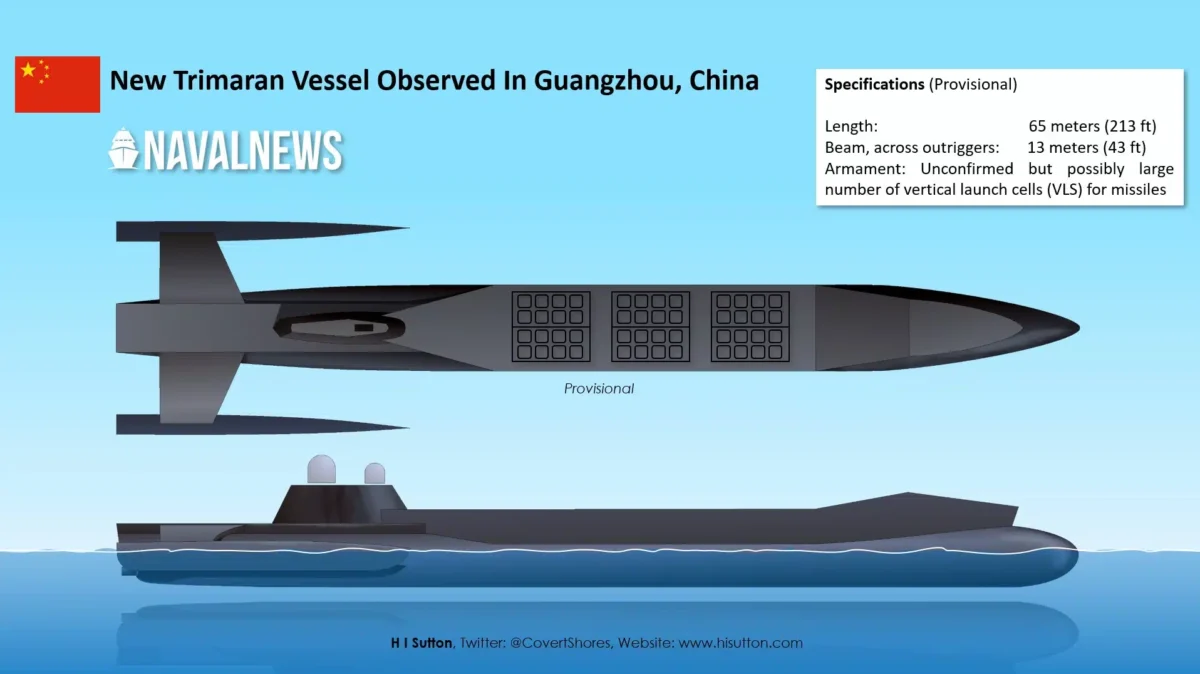
The trimaran’s dimensions resemble design research on semi-submersible arsenal ships that can partially sink below the surface to reduce radar visibility and endure hostile conditions.
These platforms are intended primarily as missile carriers, operating in coordination with larger surface combatants or land-based command systems.
Reports of such a Chinese project have circulated since 2017, although most were dismissed as speculative.
The newly obtained images, however, lend substantial credibility to those earlier claims.
Based on the hull depth and length, experts believe the forward section could house a vertical launch system (VLS) capable of deploying long-range cruise missiles or potentially even hypersonic weapons.
The configuration suggests a role as a deployable missile barge, enhancing the navy’s firing potential while allowing main warships to stay beyond hostile range.
If confirmed, this uncrewed semi-submersible vessel signals a strategic evolution in China’s naval posture.
It reinforces Beijing’s commitment to enhancing long-range precision strike capability, survivability, and operational flexibility across the Pacific theater.
Integrating such vessels into fleet structures would allow the People’s Liberation Army Navy (PLAN) to undertake distributed maritime operations, dispersing offensive power while complicating enemy targeting efforts.
Without a large radar mast or onboard fire-control system, the vessel likely depends on targeting data from satellites, aircraft, or command destroyers.
This network-centric approach mirrors trends in modern naval warfare where autonomy, coordination, and stealth outweigh traditional tonnage.
A system like this could challenge the surveillance and interception capabilities of U.S. and allied naval forces by presenting low-profile, high-lethality threats in large numbers.
Military observers view this black-trimaran project as another indication of China’s rapid progress in modular shipbuilding and intelligent mission systems.
If operationalized, the vessel could serve as a prototype for a new class of arsenal ships that emphasize unmanned endurance, stealth, and saturation missile delivery.
This approach may reshape how future naval conflicts play out across contested maritime zones.