Follow Us:
Follow Us:


Defense Feeds – Hanwha Launches K-NIFV, officially introducing the Korea New Infantry Fighting Vehicle (K-NIFV) as a next-generation tracked platform built for drone-heavy battlefields.
Revealed by Hanwha Aerospace at Seoul ADEX 2025, the vehicle highlights South Korea’s commitment to developing self-reliant, export-ready armored systems.
The debut underscores Seoul’s ambition to lead in smart land warfare through the integration of artificial intelligence, advanced vehicle defense suites, and enhanced sensor fusion capabilities.
The all-new K-NIFV, evolved from the proven Redback platform, pushes innovation further with a fully unmanned turret, AI-powered counter-drone defenses, and a strong focus on domestic production.
This new design reflects Hanwha’s broader strategy to cut foreign reliance, streamline life-cycle costs, and maintain high levels of mobility and protection that meet global standards.
Central to the K-NIFV’s combat design is its new unmanned turret armed with a 30 mm automatic cannon, upgradeable to a 40 mm cased-telescoped weapon system.
The modular architecture supports a coaxial 7.62 mm machine gun and twin launch pods for a domestically developed anti-tank guided missile currently being engineered under Hanwha’s Precision Guided Munitions program.
The absence of crew in the turret frees up internal space to accommodate an eight-soldier dismount team and provides more room for mission payloads or automated systems.
Key domestic suppliers now fill roles once held by foreign subcontractors, with SNT Dynamics producing the main gun and transmission and Hanwha Systems delivering the AI-enabled sighting units and active protection suite.
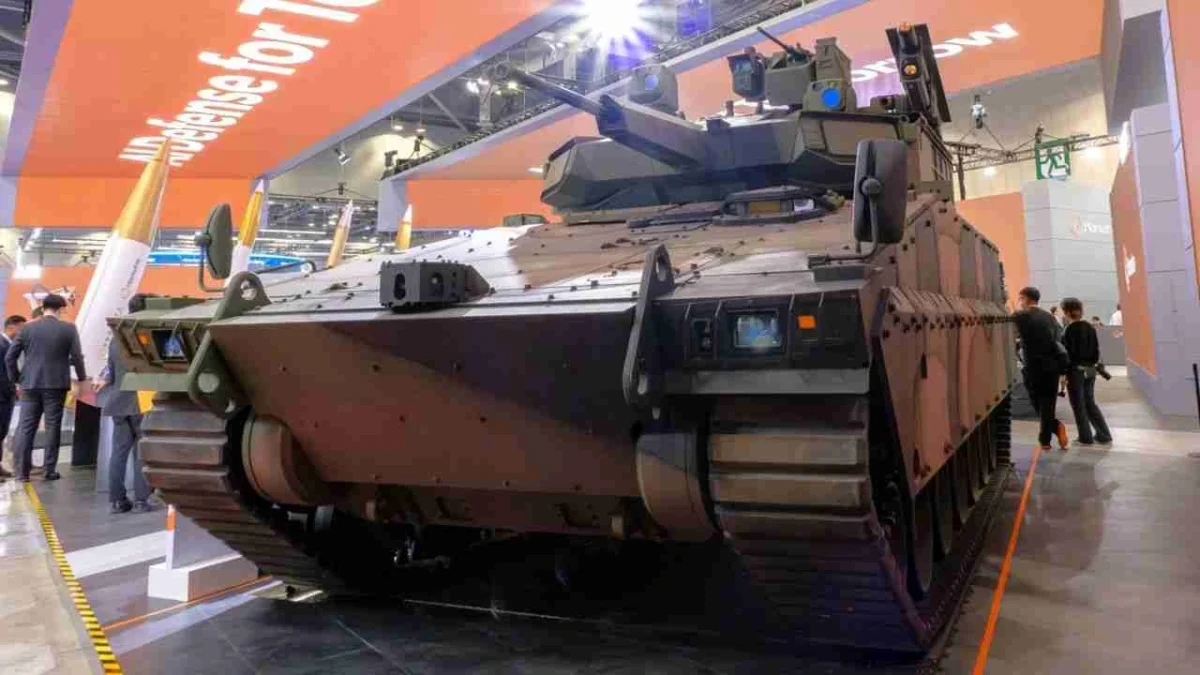
One of the K-NIFV’s standout innovations lies in its layered counter-unmanned aerial system (C-UAS) architecture, crafted to counter modern aerial threats such as loitering munitions and quadcopters.
Using radar-fed remote weapon stations combined with AI-driven target recognition, the system detects, tracks, and neutralizes hostile drones before they reach the vehicle’s proximity.
Hanwha’s new K-APS replaces the Redback’s earlier Iron Fist shield as the hard-kill layer, while radar-cued remote weapons can engage small UAVs up to one kilometer away.
When enemy drones close in, the APS intercepts them within several hundred meters.
The approach mirrors lessons learned from recent conflicts in Ukraine and the Middle East, where armored formations faced devastating hits from low-cost drones.
Hanwha also equips the K-NIFV with optional organic reconnaissance drones and manned-unmanned teaming links to small unmanned ground vehicles (UGVs).
This system allows crews to survey the battlefield, identify hidden threats, and gather intelligence from a safe distance while staying protected inside the vehicle.
Development of the K-NIFV began in 2024 under a 34.5 billion won budget as part of an “export Redback modernization” initiative.
The design cleared its critical design review earlier this year and is projected for completion by March 2028.
Hanwha aims to field the first production block as a replacement for South Korea’s aging K200A1 reconnaissance vehicle, while a future Block-2 variant is being studied as a successor to the K21.
That second version is expected to introduce hybrid propulsion and active suspension technologies.
Hanwha has already signaled potential export targets including Romania, Italy, Norway, the UAE, and Saudi Arabia.
With competitive pricing, strong after-sales support, and rapid production timelines, the K-NIFV could become a key contender in the global infantry fighting vehicle market, especially in regions seeking modern platforms with integrated drone countermeasures.
The debut arrives as South Korea’s defense industry experiences a surge in growth. ADEX 2025 showcased an expanding lineup of AI-integrated land, air, and maritime systems, fueled by an 8.2 percent proposed increase in the 2026 defense budget.
As global militaries adjust to drone-focused conflicts, Hanwha Aerospace’s K-NIFV showcases South Korea’s drive to define the future of ground warfare through integrated automation, protection, and data-based operations.