Follow Us:

Follow Us:


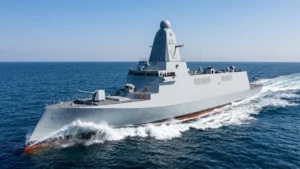
Defense Feeds – Taiwan Unveils Next-Gen Light Frigates at the Taipei Aerospace & Defense Technology Exhibition (TADTE) 2025, showcasing scale models of both Anti-Air Warfare (AAW) and Anti-Submarine Warfare (ASW) variants as part of its naval modernization effort to counter China’s growing military pressure.
The Republic of China Navy (ROCN) provided briefing materials highlighting the frigates’ roles in future missions.
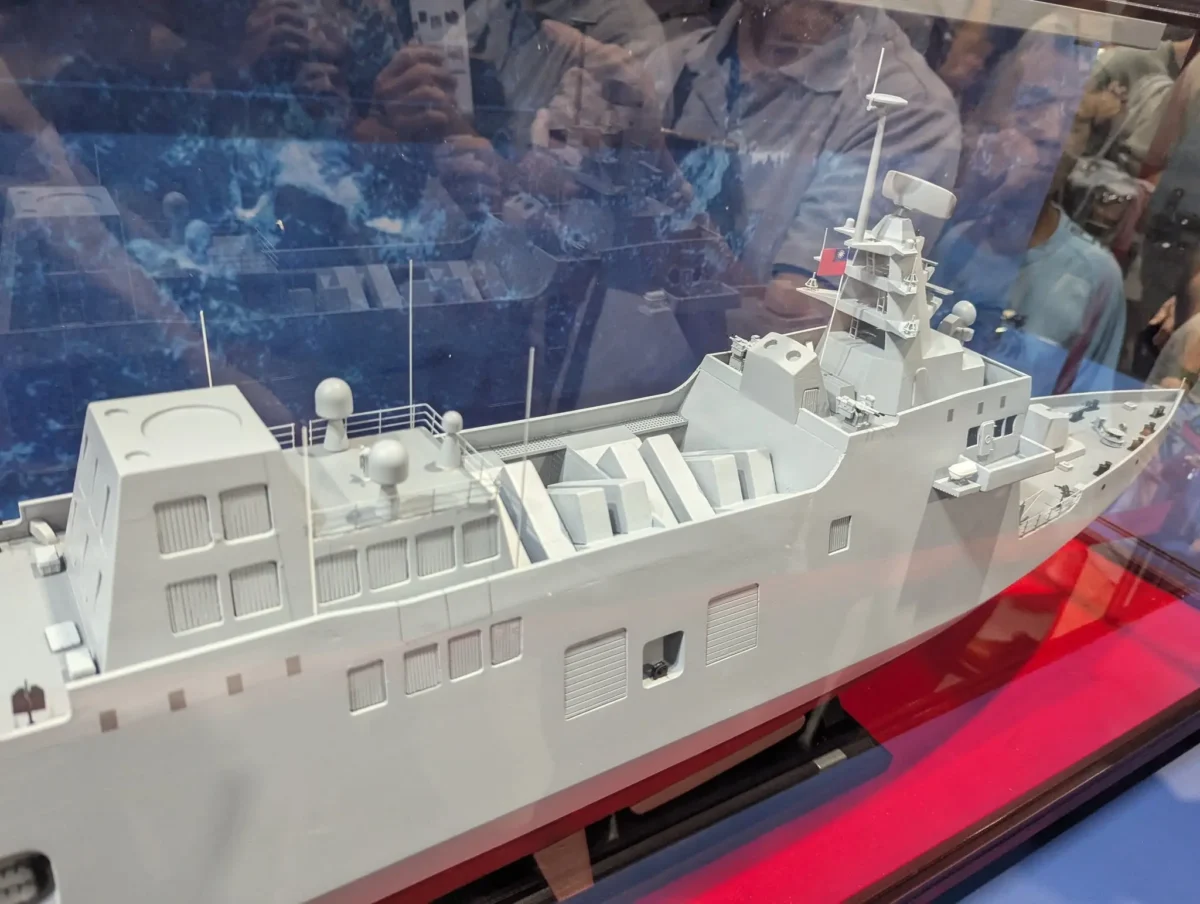
The ROCN emphasized that the main purpose of these light frigates, known in Chinese as Qīngxíng xúnfángjiàn (輕型巡防艦), is to counter persistent “gray-zone” activity—operations short of war—by the People’s Liberation Army Navy and Air Force around Taiwan’s waters and airspace.
Over the past decade, Beijing has increased military patrols, harassment, and near-daily incursions into Taiwan’s defense identification zone.
In times of peace, the new frigates are tasked to patrol Taiwan’s maritime approaches, conduct surveillance, reconnaissance, and air defense support while helping to safeguard sea lanes and assist larger combat task forces.
During crises or wartime scenarios, these warships will defend port entrances, monitor Chinese aircraft movement, and engage in joint strike missions using their advanced onboard weapon systems.
An officer at the Ministry of National Defense pavilion explained that the clearest distinction between the two variants lies in the AAW model, which features Taiwan’s indigenous Hua Yang vertical launch system (VLS).
This launcher is designed to deploy the TC-2N surface-to-air missile, a navalized version of the Sky Sword II series, giving the ship layered air defense capability against fighters, drones, and incoming missiles.
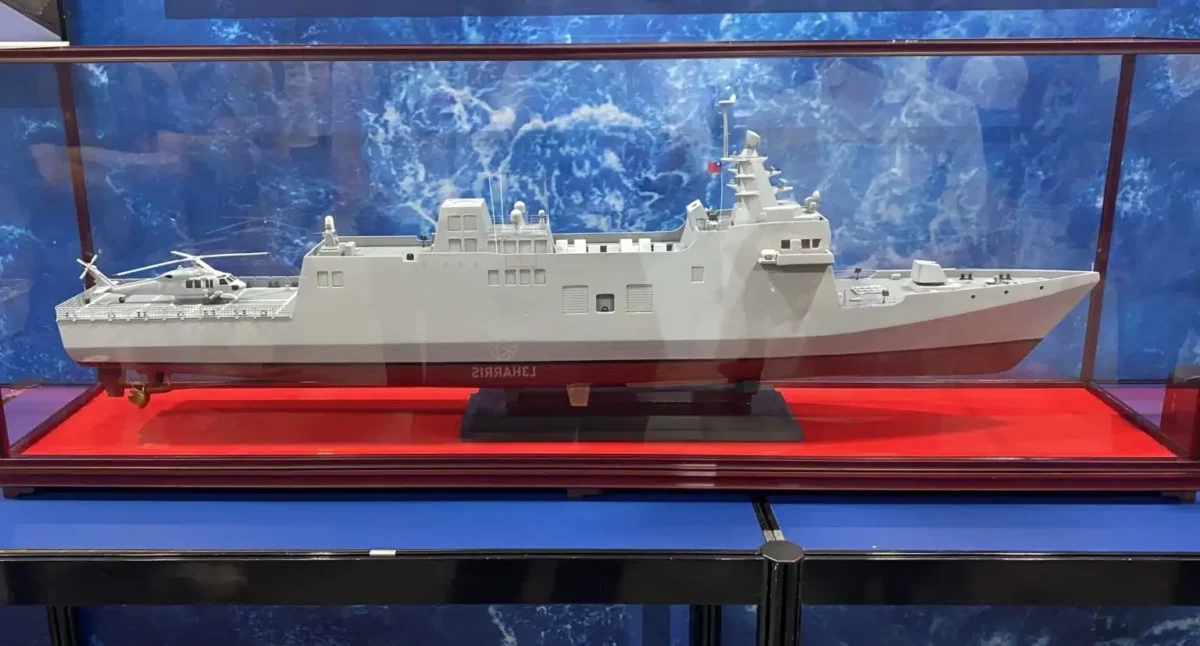
While the ROC Navy provided insights into the program’s objectives, industrial partners displayed far less about the platform.
Lockheed Martin showcased concept illustrations highlighting its CMS-330 Combat Management System featured across different warship designs, including Taiwan’s frigate.
Gibbs & Cox, a long-time American naval design firm, presented information banners indicating their technical support for the project.
The actual builder, Jong Shyn Shipbuilding Company (JSSC), Taiwan’s main private naval constructor, maintained a low profile.
Company officials refrained from addressing earlier media speculation about the program suffering schedule delays.
A manager at the firm emphasized that public information should come directly from the Navy and acknowledged the challenges of building a warship of this tonnage for the first time.
He urged strong backing from local citizens and politicians to ensure delivery of the frigates.
This cautious stance reflects the difficulties faced earlier in the process. The light frigate belongs to a long-term force-building blueprint announced by the ROC Navy in 2016.
The plan originally called for a 4,500-ton vessel integrated with an advanced active electronically scanned array (AESA) radar.
However, the National Chung-Shan Institute of Science and Technology (NCSIST) struggled to miniaturize its AESA radar design for a smaller warship.
This technological bottleneck forced Taipei to scale down the requirement, leading to the current 2,500-ton light frigate design.
Despite the setbacks, Taiwan’s defense planners view these compact frigates as vital “Tier 2” combatants—smaller than the Navy’s Keelung or Kang Ding-class ships but more advanced than missile corvettes.
They will form a backbone second-line fleet to undertake continuous patrols and protect territorial waters while freeing up larger vessels for power-projection missions.
Analysts describe the light frigate project as a strategic answer to China’s maritime coercion.
By deploying frigates equipped with modern sensors and early-warning radars, Taiwan can extend its maritime situational awareness and improve its ability to conduct distributed operations.
These ships are designed not only to provide surface escort but also to enhance deterrence by fielding cruise missiles and anti-ship systems capable of disrupting attempted blockades.
In a contingency, the ROC Navy envisions their light frigates as support escorts within multi-domain task forces.
They would provide anti-submarine screening, sector air defense, and even limited land-attack capabilities from stand-off ranges.
Together with submarines, missile boats, and shore-based missile batteries, they form Taiwan’s integrated defense web against larger Chinese fleets.
The AAW variant of the frigate prioritizes area air cover by deploying VLS cells for interceptors and command and control systems to coordinate fleet defense.
The ASW version, by contrast, is optimized with sonar suites, torpedoes, and helicopter facilities to track and neutralize PLA Navy submarines—an increasing concern as Chinese nuclear and diesel-electric subs become more active across the Taiwan Strait.
By diversifying its fleet composition, Taiwan ensures it does not rely solely on large surface combatants vulnerable to missile salvos.
Instead, smaller vessels like these frigates introduce more flexibility, making it harder for adversaries to suppress Taiwan’s naval presence.