Follow Us:
Follow Us:


Defense Feeds – China unveils DF-5C, its advanced intercontinental ballistic missile (ICBM), during the nation’s military parade marking the 80th anniversary of World War II’s end.
The new liquid-fueled strategic nuclear missile features cutting-edge technology, an estimated range exceeding 20,000 kilometers, and sophisticated capabilities enhancing China’s nuclear deterrence and global strike potential
The DF-5C missile is a major evolution of China’s long-standing DF missile series, combining the most effective technologies from earlier versions such as the DF-5 and DF-41 missile.
Military experts note the missile’s extended range enables it to threaten targets anywhere on the planet, providing China with a truly global strike capability.
This range exceeds 20,000 kilometers, allowing Beijing to hold at risk any potential adversary’s strategic military assets worldwide. This capability plays a vital role in both projecting power and deterring adversaries.
One of the most notable improvements is the missile’s segmented transport system. The DF-5C is broken down into three separate sections, each transported independently by specialized vehicles.
This design contrasts with earlier models where transport and handling were bulkier and less flexible.
The modular configuration significantly shortens launch preparation time, enabling quicker deployment and response during high-alert situations.
This agility is vital for survivability in a strategic context where rapid reaction can be decisive.
In addition to faster mobilization, the missile’s propulsion system and aerodynamic design contribute to its ability to sustain high speeds.
The DF-5C is said to reach speeds of tens of Mach, making it difficult for many existing missile defense systems to intercept. Rapid flight reduces the window for interception, enhancing the missile’s likelihood of penetrating enemy defenses.
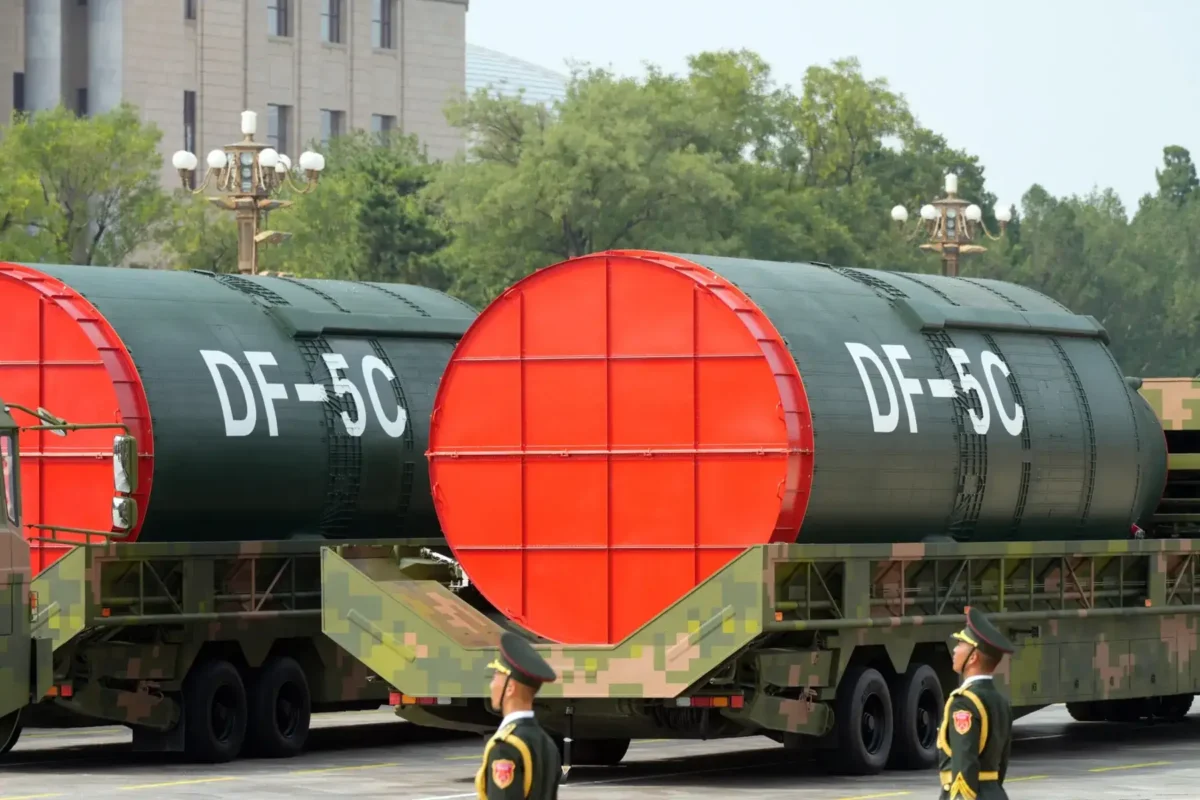
The DF-5C is equipped with multiple independently targetable reentry vehicles (MIRVs), an advanced technology that greatly magnifies its offensive power.
MIRVs enable a single missile to carry several warheads, each able to strike distinct targets independently.
This capability complicates an adversary’s missile defense since interceptors must simultaneously engage multiple warheads.
Furthermore, the warheads may include nuclear, conventional, or even decoy payloads, designed to confuse and overwhelm missile defense systems, further increasing chances of a successful strike.
A key element underpinning the DF-5C’s effectiveness is its precision guidance system. It employs a multi-layered guidance approach that includes inertial navigation, starlight-based celestial navigation, and China’s indigenous Beidou satellite navigation system.
This fusion of technology achieves a level of accuracy previously unheard of for a missile flying more than 20,000 kilometers.
Analysts suggest that in terms of precision, the DF-5C rivals shorter-range missiles, making it capable of neutralizing critical high-value targets with surgical accuracy.
This combination of range, speed, maneuverability, and guidance precision uniquely positions the DF-5C within the global strategic weapons landscape.
It provides China with a credible and reliable second-strike capability, critical for ensuring national security under the doctrine of mutual assured destruction.
Despite unveiling this powerful weapon, China continues to promote a transparent and defensive nuclear posture.
Chinese officials have consistently emphasized their adherence to a no-first-use policy toward nuclear weapons, committing never to be the first to use nuclear arms under any circumstances.
They also firmly state that nuclear weapons will not be targeted or threatened against non-nuclear states or nuclear weapon free zones. This stance reflects an effort to maintain strategic stability and avoid an arms race escalation.
Additionally, China supports the total and verifiable global elimination of nuclear weapons.
It has reiterated its opposition to nuclear arms competitions and stated its commitment to keeping nuclear forces at the minimal level needed to ensure national defense.
This approach attempts to balance deterrent capabilities with global non-proliferation goals and international security concerns.
The recent parade and the debut of the DF-5C simultaneously reflect national pride in military achievements and a sober recognition of ongoing security challenges.
Experts note that the current international environment remains complex and threat-laden for China.
The DF-5C, along with other advanced strategic weapons displayed, symbolizes the country’s determination to modernize its military tools in response to evolving external threats.
The development underscores that China regards a strong strategic missile force as an indispensable asset for securing its national interests and maintaining peace through deterrence.