Follow Us:
Follow Us:


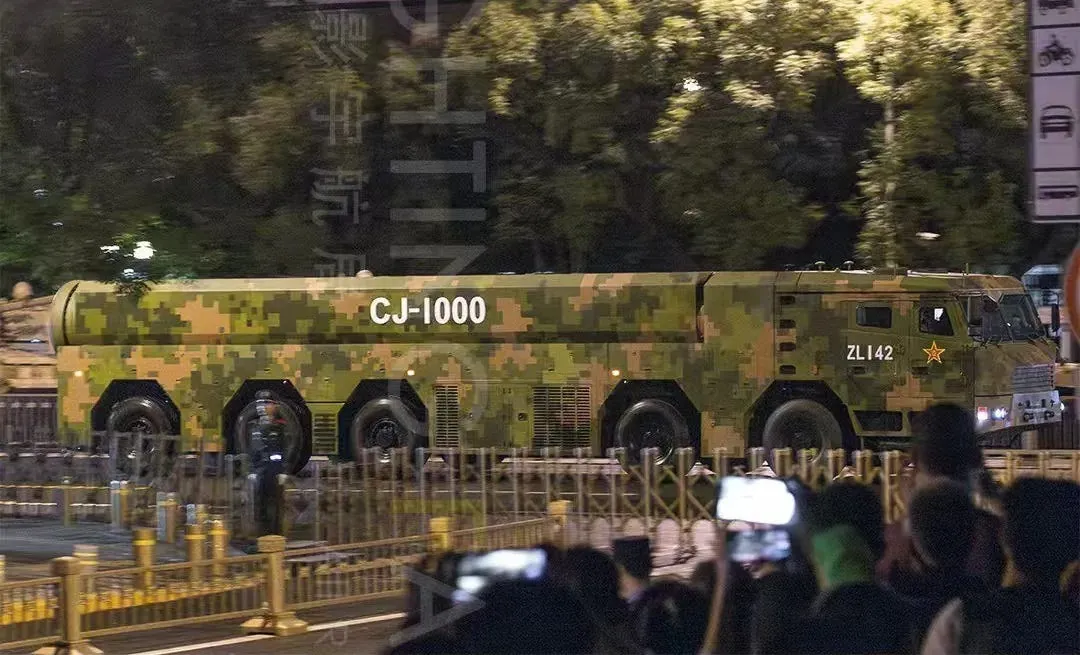
Defense Feeds – China’s New CJ-1000 Hypersonic Cruise Missile has been officially revealed at a major military parade in Beijing, marking a significant leap in the country’s advanced strike capabilities.
The scramjet-powered missile, described as the first of its kind in China’s arsenal, signals Beijing’s growing push to field next-generation precision weapons built to challenge U.S. and allied defenses.
For the first time, the People’s Liberation Army Rocket Force (PLARF) showcased the CJ-1000, a next-generation missile intended to replace the older DF-100 system.
Unlike conventional missiles, which depend on ballistic trajectories or subsonic flight speeds, this scramjet-powered hypersonic missile is built to travel within the atmosphere at speeds above Mach 5, making it far faster and harder to intercept than existing cruise missiles.
Military analysts say the CJ-1000 represents a significant leap in China’s strike capabilities.
With an estimated range of up to 6,000 kilometers, the missile can reach strategic targets deep within an adversary’s territory, including U.S. military bases across the Indo-Pacific.
The extended reach underscores China’s objective to project power far beyond its immediate borders and reshape the regional balance of power.
Equipped with advanced guidance systems, the CJ-1000 is not only fast but also maneuverable.
Unlike ballistic missiles that follow a largely predictable arc, hypersonic cruise missiles can change course mid-flight.
This ability to shift trajectory at hypersonic speeds creates enormous challenges for traditional radar tracking and air defense systems.
The unveiling of the CJ-1000 comes at a time of heightened competition between China, the United States, and regional allies. For years,
Washington has warned that Beijing’s focus on hypersonic weapons would eventually undermine existing missile defense networks across Asia and the Pacific.
What makes the CJ-1000 especially concerning to military planners is its dual capability against land and sea-based targets.
It is believed that the missile can strike carrier groups, critical command centers, radar installations, and air defense nodes.
In strategic terms, this means China now has a stronger tool to target the backbone of enemy networks, complicating U.S. strategies for defending allies such as Japan, South Korea, and the Philippines.
Another factor is the missile’s rapid launch capability, giving the PLA Rocket Force the option to execute sudden precision strikes with little warning.
This characteristic fits within Beijing’s larger doctrine of “anti-access/area denial” (A2/AD), aimed at deterring foreign militaries—particularly the U.S. Navy—from operating freely in contested waters like the South China Sea and the Taiwan Strait.
Regional security experts argue that the CJ-1000 is not simply a tactical upgrade but a strategic statement.
By fielding an operational hypersonic cruise missile, China is demonstrating that it intends to compete head-to-head with the United States in the field of advanced long-range strike technology.
This development also forces Washington and its allies to accelerate their work on early-warning satellites, next-generation radars, and counter-hypersonic defense systems.
The CJ-1000’s debut raises pressing questions for the Pentagon. For years, U.S. defense officials have acknowledged that America lags behind both China and Russia in hypersonic missile testing and deployment.
While the United States is investing heavily in programs such as the Long-Range Hypersonic Weapon (LRHW) and the Hypersonic Conventional Strike Weapon, most of these systems remain in development phases.
Allied nations are also watching closely. Japan has already rolled out plans to invest in hypersonic defense, while Australia—through the AUKUS partnership with Washington and London—is pooling resources to develop both hypersonic capabilities and counter-systems.
South Korea, meanwhile, is pursuing long-range strike tools and interoperable air defense networks designed to counter threats from both North Korea and China.
However, intercepting a hypersonic cruise missile remains an extraordinarily difficult task, even with advanced defense systems.
Today’s leading technologies such as the U.S. Patriot, Aegis, and THAAD were mainly created to combat ballistic missiles, not hypersonic glide vehicles or scramjet-powered cruise missiles.
This means the unveiling of the CJ-1000 does more than expand China’s arsenal—it accelerates a growing arms race in missile technology.
Some analysts caution that the timeline for the missile’s full deployment remains unclear.
While the public unveiling demonstrates operational capability, questions linger about production scale, accuracy under combat conditions, and integration with China’s broader military strategy.
Nonetheless, even its limited fielding adds a serious new dimension to regional security planning.