Follow Us:
Follow Us:


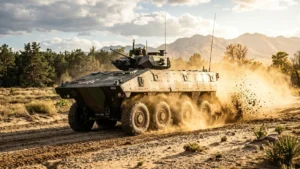
Defense Feeds – China Unveils Type 100 Medium Tank as part of a major transformation in its armored warfare strategy, moving away from traditional massed heavy tank formations toward more specialized, lighter combat vehicles designed for specific operational theaters.
This shift was prominently displayed during Beijing’s recent military parade, where the People’s Liberation Army (PLA) introduced the new medium-weight Type 100 tank alongside various related platforms built on its chassis.
The introduction of the Type 100 and its accompanying vehicles highlights a significant shift in China’s ground combat doctrine.
Whereas in the past, strategic emphasis was placed on amassing large numbers of heavy main battle tanks like the Type 99A2, China’s current military priorities favor vehicles that are lighter and more agile.
These new armored weapons are optimized for rapid deployment and better performance in challenging environments, such as high altitudes and amphibious operations.
Military analyst Serhiy Berezutskiy explains that the shift is driven by a change in China’s primary perceived adversaries.
Once focused on countering Russia across the vast Mongolian steppes and Siberian terrain, the PLA now views India as its main land-based rival, particularly in the high-altitude Ladakh region.
Heavy tanks struggle in these mountainous conditions due to reduced engine power and poor maneuverability, whereas medium and light tanks like the newly introduced Type 100 and Type 15 can operate efficiently at elevations exceeding 4,000 meters while still offering adequate firepower against Indian armor.
The modernization thus aligns military assets closely with likely conflict scenarios faced in the Himalayas.This approach also dovetails with China’s regional ambitions surrounding Taiwan.
Unlike cumbersome heavy tanks, medium-weight vehicles can be loaded onto landing ships, transported quickly across the Taiwan Strait, and deployed during amphibious assaults.
The Type 100’s enhanced mobility and modular design make it better suited for rapid second-wave landings, beachhead consolidation, and inland operations in Taiwan, a critical aspect of Beijing’s Taiwan contingency planning.

As a fourth-generation tank, the Type 100 showcases major technological and tactical improvements.
It features an unmanned turret housing a 105-millimeter main gun, complemented by coaxial machine guns and remote weapon stations.
Such an unmanned turret design offers multiple benefits, including greater space inside the hull for ammunition and improved crew protection by concentrating armor around the crew compartment.
The tank integrates advanced battlefield technologies, such as an active protection system paired with a quad-faced phased array radar.
This system continuously scans the environment for incoming threats like rockets, missiles, or anti-tank shells, enabling the tank to neutralize dangers with counter-munitions before impact.
Additionally, an array of cameras and sensors surrounding the vehicle provides comprehensive situational awareness and aids in defending against drone attacks.
A significant feature of the Type 100 support vehicle is its carriage of a rotor-wing drone.
This drone is designed for reconnaissance, ambush detection, and potentially offensive roles such as armed or suicide missions, enhancing the tank’s operational effectiveness in complex and contested landscapes.
Unlike earlier Chinese tanks built for sheer power and thick armor, the Type 100 aims to combine firepower, enhanced defense, and sophisticated digital systems to succeed against contemporary threats such as electronic attacks and asymmetrical warfare.
China’s move away from heavy tank armadas is not just military but also strategic, reflecting its evolving geopolitical stance.
The PLA’s older armored fleet was configured for large-scale mechanized warfare against Russia or in wide-open terrains like Mongolia and Siberia.
However, that scenario has dimmed in likelihood, as Russia has increasingly aligned economically and politically under China’s sphere of influence.
Instead of costly full-scale armored campaigns to reclaim former territories in Siberia or Central Asia, China now leverages economic tools and political influence to advance its interests in these regions, reserving military modernization for more immediate concerns like India and Taiwan.
The doctrinal pivot encourages deployment of forces based on terrain and mission specificity rather than overwhelming numerical superiority.
With air and naval forces undergoing complementary modernization, China is crafting a versatile, integrated military force capable of addressing its most pressing security challenges effectively.