Follow Us:
Follow Us:

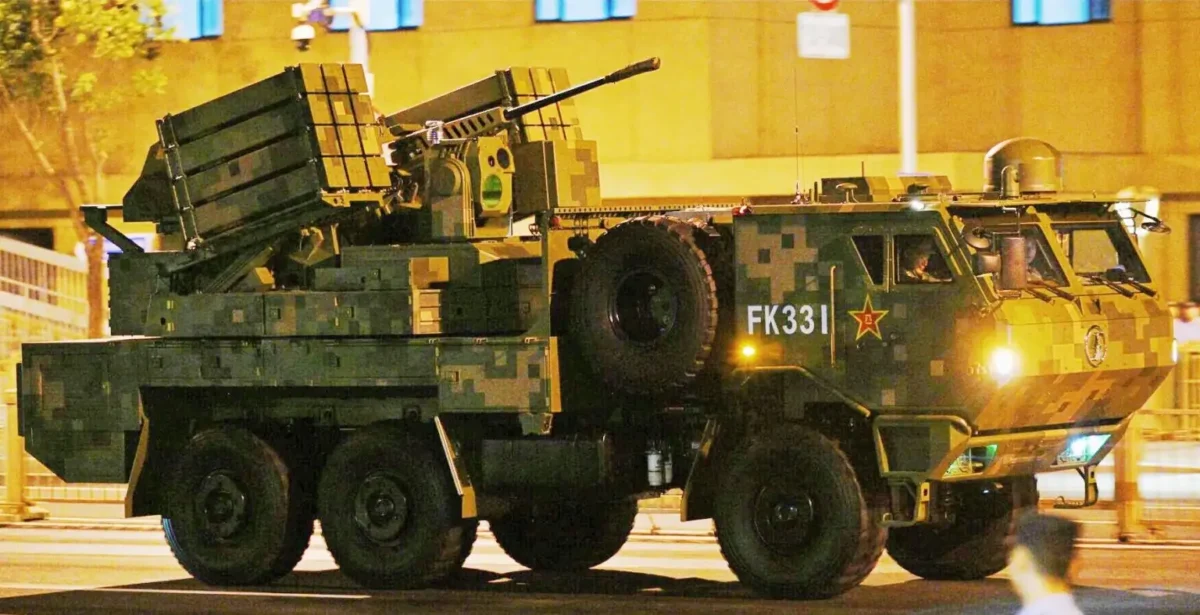
Defense Feeds – China has started deploying the New FK-3000 Anti-Drone System, its latest short-range air defense platform developed to counter the growing threat of drone swarms on modern battlefields.
The system combines a 30mm autocannon with short-range missiles, underscoring Beijing’s efforts to strengthen layered defenses against low-cost unmanned aerial vehicles (UAVs) that have already altered the character of recent conflicts.
After being first revealed at the 2022 Zhuhai Air Show, the FK-3000 appeared again in Beijing while the military prepared for a parade.
Its presence highlights how the People’s Liberation Army (PLA) is intensifying counter-drone operations, particularly against expendable unmanned systems similar to Iran’s Shahed drones, which have been used extensively in Ukraine and the Middle East.
Mounted on a three-axle, all-terrain armored truck, the FK-3000 integrates multiple layers of weaponry into a single mobile unit.
At its core, the system features a 30mm automatic cannon designed to shred small to medium drones at close range.
For added reach, it carries two vertically mounted launch pods, each housing 12 short-range missiles. This configuration allows the FK-3000 to engage dozens of targets simultaneously.
Chinese defense engineers claim the system has an effective engagement envelope ranging from 300 meters to 12 kilometers, covering a spectrum of threats from small quadcopters to larger fixed-wing drones or loitering munitions.
Its fire-control radar and optical targeting suite enable all-weather, day-and-night operations, and the system can automatically track incoming UAVs while prioritizing targets in real time.
Unlike traditional air defense assets that mainly focus on fighter jets or cruise missiles, the FK-3000 has been purpose-built for anti-drone warfare.
Its modular architecture means the vehicle can be reconfigured with different missile types, including micro-missiles specifically tailored to swarming unmanned threats.
This adaptability suggests that the FK-3000 is not just a single-purpose weapon but part of China’s wider effort to maintain a flexible, scalable defense network.
In the last five years, conflicts in Ukraine, Syria, and the Persian Gulf have revealed the destructive power of mass-produced drones.
Swarms of small, inexpensive UAVs have managed to bypass or overwhelm expensive air defense systems, inflicting heavy losses on armored vehicles, power stations, ammunition depots, and command centers.
Russian forces, for example, have launched repeated drone waves using Iran’s Shahed-136 loitering munitions to strike Ukrainian cities.
Meanwhile, Ukrainian troops themselves have mastered low-cost quadcopters with improvised explosives, using them effectively against Russian trenches and armored formations.
Even NATO militaries now acknowledge that drone warfare is a strategic-level threat. China has been closely watching these developments.
Analysts suggest Beijing understands that its own bases, command hubs, and mobile forces could one day face saturation drone strikes. By fielding the FK-3000, the PLA is creating a shield against exactly this type of attack.
“Traditional air defense systems were not designed to cope with dozens of small drones attacking at the same time from multiple angles,” noted one Chinese military commentator.
“The FK-3000 is meant to fill that gap with specialized weapons suited for mass drone neutralization.”
The FK-3000’s introduction reflects a shift in Chinese defense strategy toward layered counter-drone operations.
By combining guns, short-range missiles, advanced sensors, and automated fire control into one package, the PLA ensures redundancy if one weapon layer fails.
Equally important is the system’s modularity. Developers say the FK-3000 is built to accept future missile upgrades and may one day plug into networked air defense grids linking satellites, drones, and ground-based radar.
This would allow the system to exchange real-time targeting data, enabling faster responses against swarm tactics.
Analysts believe this flexibility is deliberate. Drone technology is evolving rapidly, and military engineers expect future UAVs to employ stealth designs, electronic warfare tools, or AI-powered swarm coordination.
By giving the FK-3000 an upgrade path, Chinese planners are ensuring it won’t become obsolete when new drone designs enter the battlefield.
The system is also suited for critical infrastructure defense, such as oil facilities, logistics hubs, airports, and coastal bases.
Its ability to rapidly reposition on wheeled chassis makes it useful for frontline combat brigades as well.