Follow Us:
Follow Us:


Defense Feeds – New Chinese High-Speed Helicopter Prototype images have surfaced online, sparking heated debate among defense analysts worldwide.
On August 21, 2025, photos and flight footage shared on China’s social media platform Weibo revealed the country’s first full-scale prototype of a high-speed coaxial-rotor helicopter.
The aircraft’s design immediately drew attention for its striking resemblance to the American Sikorsky S-97 Raider, a next-generation rotorcraft currently undergoing testing as part of the United States Army’s Future Vertical Lift program.
The new Chinese rotorcraft features the same hallmark traits as the Raider: a coaxial counter-rotating rotor system paired with a rear-mounted pusher propeller.
This combination allows higher speed and agility than conventional helicopters, offering airplane-like forward thrust while preserving vertical takeoff and landing capabilities.
According to military observers, China has long pursued advanced aviation projects but has often borrowed concepts already proven by the United States or Russia.
The unveiling of the New Chinese High-Speed Helicopter Prototype confirms Beijing’s rising ambition to enter the high-speed helicopter domain, a move that could one day transform the People’s Liberation Army’s air mobility and battlefield adaptability.
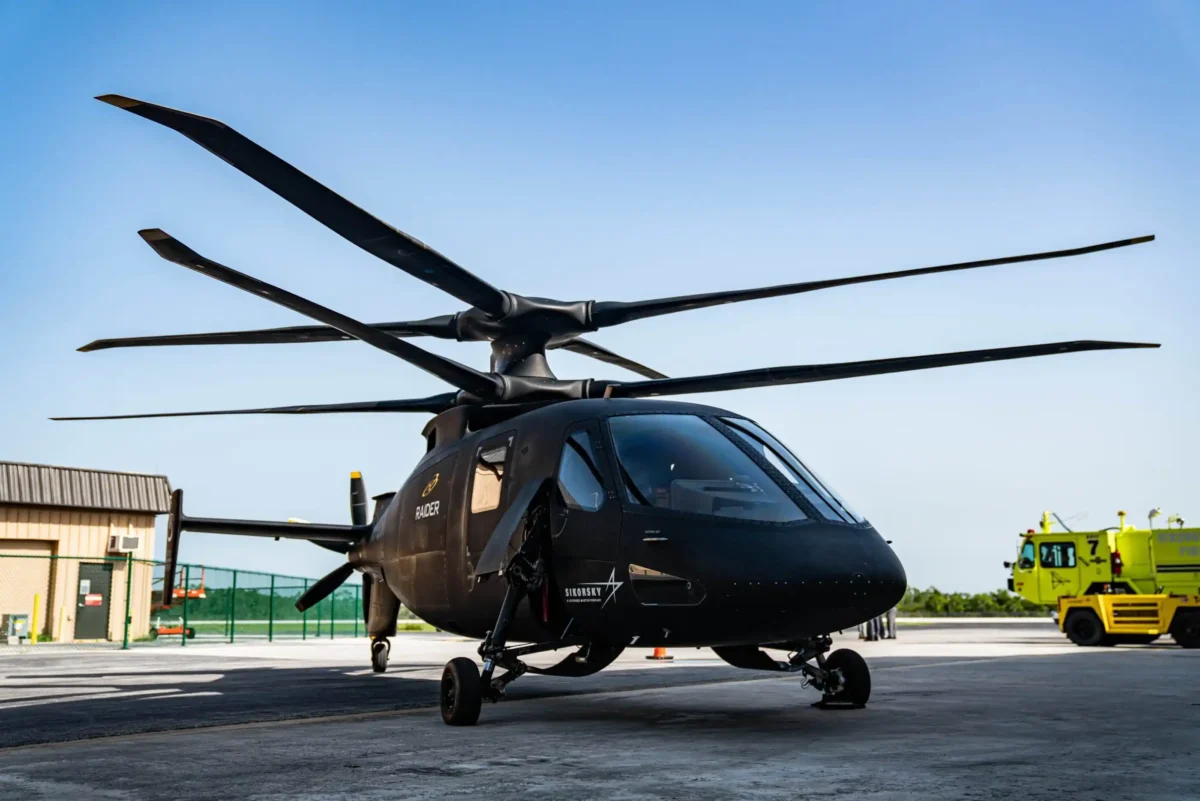
While the similarities to the U.S. Raider are undeniable, closer analysis reveals notable differences that expose the Chinese prototype’s early stage of development.
The narrow fuselage, tandem seating configuration, and streamlined body point to ambitions for reconnaissance or light assault roles in contested zones.
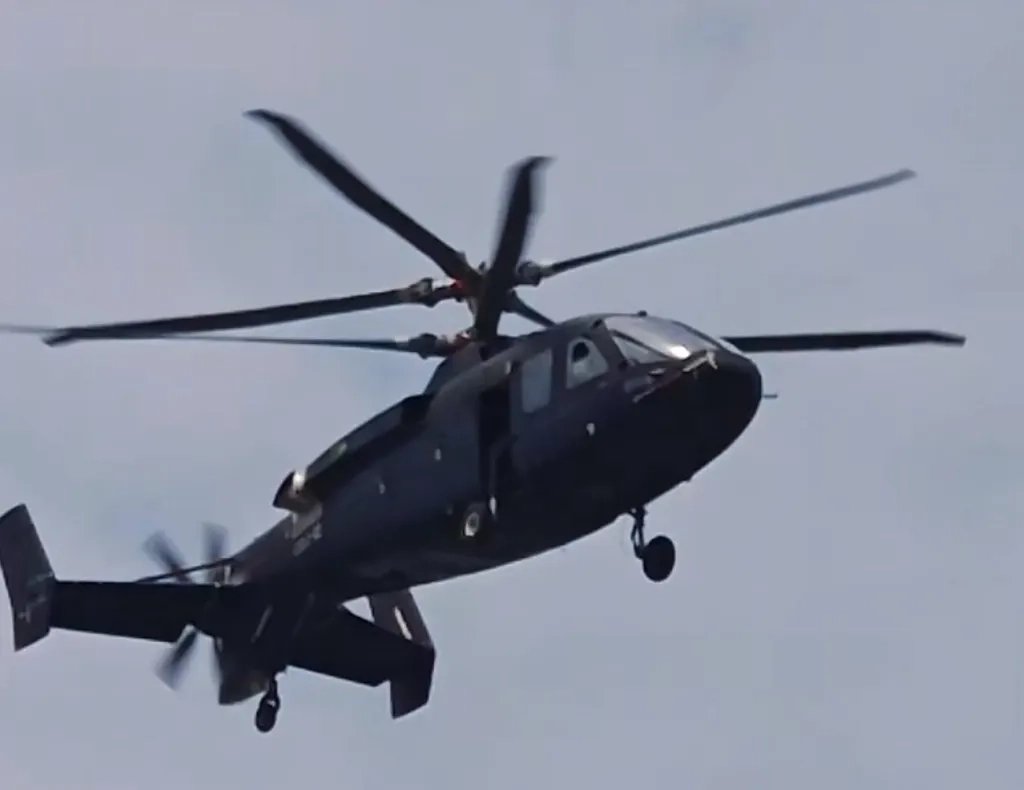
However, the prototype displays several less sophisticated design traits compared to its American counterpart.
For instance, the Chinese aircraft uses fixed landing gear instead of retractable systems, creating additional drag.
Its tail section also appears bulkier and less aerodynamically refined. A more telling difference is the engine exhaust layout.
The Sikorsky S-97 Raider directs exhaust beneath the main rotor and to the rear, minimizing turbulence while helping reduce infrared visibility.
The Chinese aircraft differs by mounting its exhaust outlets along the sides of the frame, situated between the main rotor system and the tail structure.
This layout could negatively affect airflow efficiency and increase vulnerability to heat-seeking systems.
Although these gaps suggest China still lags behind in mastering the Advancing Blade Concept and related technologies, the very act of fielding a prototype demonstrates a serious commitment.
Similar to earlier trends in Chinese aviation, such as its stealth fighter programs, Beijing tends to replicate foreign breakthroughs initially before refining them through domestic innovation.
Development of the S-97 Raider builds on American studies stretching back to the 1970s, a period when Sikorsky first explored solutions to the retreating-blade stall problem.
By comparison, China is at the beginning of this learning curve, and significant hurdles remain in areas like flight control software, vibration management, and high-performance engines.
Beyond the engineering challenges, the unveiling of this prototype carries significant strategic weight.
By pursuing a high-speed coaxial helicopter, China signals its ambition to reduce reliance on conventional transport platforms like the Z-20 and diversify its rotary-wing fleet for modern battlefield demands.
If fully developed, such a system could provide the People’s Liberation Army with faster troop insertion, improved special forces mobility, and more effective reconnaissance in contested zones such as the South China Sea or Taiwan Strait.
In fast-changing operational theaters, speed and flexibility are often decisive — giving commanders the ability to reposition assets quickly or outmaneuver slower adversaries.
Regional militaries and American allies throughout the Indo-Pacific now face an added layer of planning challenges following the appearance of this new aircraft.
Even if China’s prototype is years away from field use, the intent behind it pressures neighboring countries to consider new force requirements and countermeasures.
Geopolitically, the development also deepens concerns in Washington and allied capitals about China’s approach to military modernization.
Much as Beijing’s stealth fighters mirrored aspects of the F-22 and F-35 during their early evolution, this helicopter shows a willingness to replicate proven U.S. concepts while working toward eventual self-reliance.
The perception of direct imitation risks increasing technological rivalry and heightening already fraught U.S.-China defense tensions.
For now, the Chinese helicopter remains an experimental showcase of intent rather than a mature combat platform.
Obstacles around engine technology, software integration, and survivability still pose steep challenges.
Yet history suggests that once China commits to a defense innovation, it often moves rapidly through iterations until workable models emerge — even if initial versions lag behind their Western equivalents.
Should Beijing ultimately succeed in producing a reliable high-speed rotorcraft, the strategic balance in the Indo-Pacific would shift.
Faster helicopter transport could improve China’s capacity for special operations raids, intelligence missions, and rapid reinforcement across disputed islands.
Coupled with naval and drone modernization, the new helicopter could play a central role in expanding Beijing’s operational reach.
Until then, the emergence of this prototype serves as both a signal of ambition and a reminder of China’s ongoing struggle to close its technology gap with the United States.
The global defense community will be watching closely to see whether this aircraft matures into an operational system or remains an early experiment in the country’s growing push for aviation parity.