Follow Us:
Follow Us:


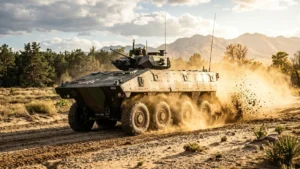
Defense Feeds – Beijing, August 19, 2025 — China is preparing to showcase what military experts describe as one of the most advanced airborne infantry fighting vehicles ever developed for the People’s Liberation Army (PLA).
Recently leaked photographs reveal this next-generation armored platform equipped with heavy firepower, enhanced protection systems and advanced counter-drone capabilities, signaling a major leap forward in the evolution of the PLA’s airborne forces.
The images, captured by defense photographer David Wang and circulated on social media, show the vehicle bearing PLA insignia with digital desert camouflage.
Experts believe the PLA’s new Airborne IFV is now in final testing and could be showcased publicly in Beijing on September 3, during the Victory Day parade marking 80 years since World War II ended.
This reveal, if confirmed, would signal the biggest improvement to China’s airborne mechanized units in the last twenty years.
For years, the ZBD-03 served as China’s primary airborne infantry fighting vehicle. Lightweight, amphibious and air-transportable, the ZBD-03 earned praise for mobility but was criticized for its thin armor and limited survivability in high-intensity battles.
In conflicts where precision-guided missiles and armed drones dominate, light armor has proven to be a serious vulnerability.
The new IFV appears to directly address those concerns. Designed with angular lines and strengthened ceramic modules, the hull delivers much better ballistic resistance than the ZBD-03 it replaces.
Despite its bulkier build, reports indicate it remains compatible with the Y-20 strategic airlifter, meaning it can be rapidly deployed in overseas or frontier operations—a vital advantage for the PLA’s rapid-reaction airborne corps.
Troop transport capacity has also been improved, with a redesigned rear compartment allowing smoother amphibious debarkation.
By enhancing both protection and mobility, China seeks to provide its paratroopers with the kind of survivable fighting vehicle usually associated with heavier mechanized brigades.
The biggest leap comes in armament. The new airborne IFV mounts a 30–35 mm automatic cannon with a coaxial machine gun for standard infantry support, but it goes far beyond the ZBD-03 in terms of secondary weapons.
On its left flank, the vehicle carries a twin launcher for heavy anti-tank guided missiles (ATGMs), believed capable of piercing the armor of modern main battle tanks.
On the right side, analysts spotted a quad launcher holding smaller rockets that could be configured for anti-personnel, incendiary, or thermobaric effects.
This combination grants the vehicle the ability to engage multiple target types, from infantry clusters to fortified positions or armored vehicles, without relying on outside support. Such a weapons package underlines a major doctrinal shift.
Airborne units, traditionally reliant on speed rather than sustained firepower, can now deploy with vehicles capable of providing both offensive punch and defensive resilience in hostile areas.
This adjustment reflects lessons from ongoing wars in Ukraine and the South Caucasus, where light vehicles without protective or offensive depth have been decimated by drones, artillery and tank fire.
One of the most striking aspects of China’s new airborne IFV is its next-generation protection suite.
The platform integrates a system of optical sensors positioned around its hull, giving full 360-degree situational awareness.
These sensors are linked to the GL-6 hard-kill active protection system (APS), which can intercept incoming anti-tank missiles, RPGs and even explosive first-person-view (FPV) drones—threats that have changed the calculus of modern mechanized warfare.
Adding another layer of defense, the vehicle features a radar-equipped counter-unmanned aerial system (C-UAS) designed to detect and disrupt small drones before they can strike.
Combined with smoke launchers, day-night optics and thermal imaging devices, the IFV appears optimized for operations in heavily contested battlefields where visibility, electronic interference and drone saturation play decisive roles.
Military scholars argue this move shows the PLA has closely studied contemporary conflicts where survivability is not dictated solely by armor thickness but by integrated electronic warfare and layered defenses.
NATO nations have long emphasized such capabilities; China’s new design suggests it aims to close that gap. units, once lightly armored and vulnerable, now appear poised to deploy with vehicles better suited for contemporary combat conditions.